First Seen
2023-07-22T22:05:53+00:00
simple-description (qwen3.5_2b-q8_0)
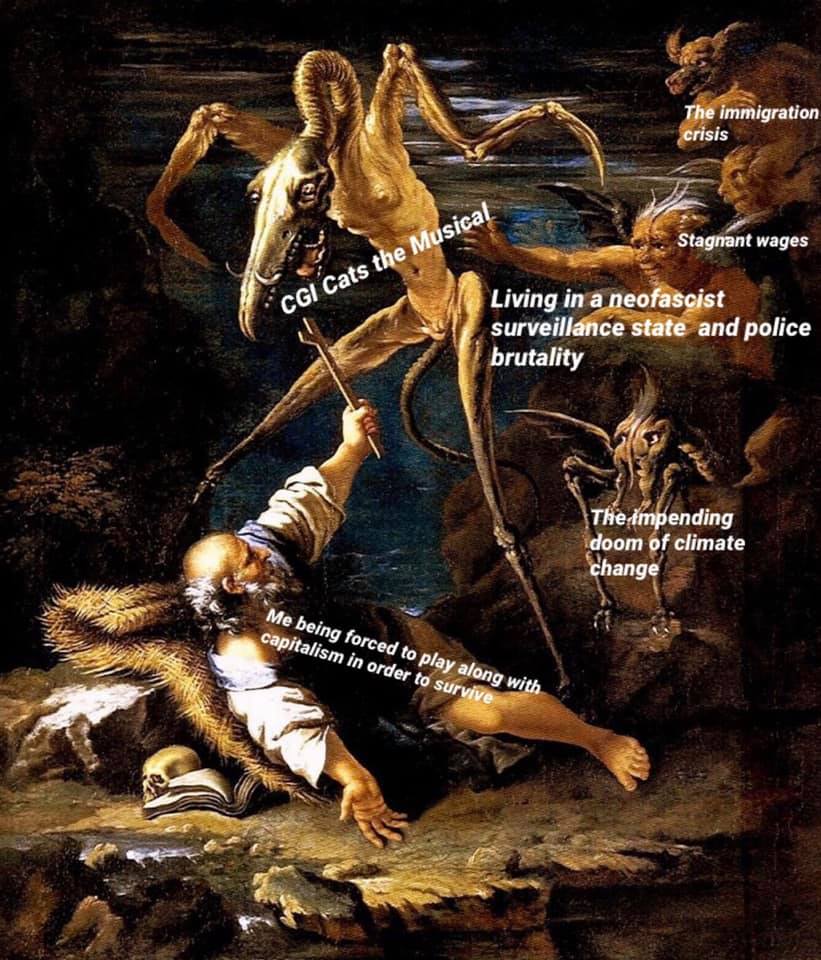
This meme illustrates "The Dread Point," a concept in queer and gender theory describing the crushing weight of overwhelming societal expectations. The text lists specific global crises—such as "Stagnant wages," "neofascist surveillance state," and "climate change"—as a monster looming over the protagonist. The painting depicts the absurdity of being forced to live in a system of capitalism where survival requires bending to "The Dread Point," effectively turning the man into a statue before he is crushed by the very forces he is asked to obey.
simple-description (llama3.2-vision_11b)
This meme is a commentary on the intersection of queer theory and post-structuralism, using the image of a demon from the 16th-century painting "The Temptation of Saint Anthony" by Matthias Grunewald. The meme juxtaposes the demon's outstretched arm with a caption that reads "when you're trying to explain post-structuralism to your queer friends but they just want to talk about the demon's abs"
detailed-analysis (gemma3-27b-vision)
Okay, let's break down this image through the requested theoretical lenses. It's a complex meme, drawing on classical art and contemporary anxieties, so there's quite a lot to unpack!
Visual Description
The image is a digital alteration of Peter Paul Rubens’ Baroque painting The Descent from the Cross. The composition maintains the dramatic, diagonal thrust of the original, but the figures have been digitally manipulated. The figure of Christ is replaced with a person in modern clothing, appearing to fall or be lowered from the cross. The figures assisting in the descent are replaced with monstrous, CGI-rendered cats with glowing eyes and sharp teeth. Text is overlaid onto the image, labeling each “cat” with various current social or political concerns: “CGI Cats the Musical,” “The immigration crisis,” “Stagnant wages,” “Living in a neofascist surveillance state and police brutality,” and "The impending doom of climate change.” Additionally, text next to the falling figure states “Me being forced to play along with capitalism in order to survive.” The overall tone is dark and dramatic, utilizing the weight of the original artwork to convey a sense of overwhelming crisis.
Foucauldian Genealogical Discourse Analysis
Michel Foucault’s work on power, knowledge, and discourse provides a potent framework for understanding this image. The meme functions as a genealogy, tracing a historical line of power relations that connects historical artistic representations (Rubens) to contemporary anxieties. The ‘cats’ aren’t merely aesthetic substitutions but act as symbols for forces that discipline and control the individual ("Me").
- Power/Knowledge: The labels assigned to the cats are representations of discourses (ways of talking and thinking) that shape our understanding of social issues. These discourses aren’t neutral; they are intertwined with power relations. For example, the "immigration crisis" isn’t just a factual description, but a term that can be used to justify border control, surveillance, and discrimination.
- Discipline & Punish: The image evokes a sense of being overwhelmed and subjected to various forms of discipline (economic, political, environmental). The person falling represents a subject struggling under the weight of these systems, forced to “play along with capitalism” as a means of survival, mirroring Foucault’s concept of docility and how power creates subjects who conform.
- Panopticism: The glowing eyes of the cats hint at surveillance. They are ever-watchful, representing the pervasive monitoring and control that characterizes modern society. This echoes Foucault's analysis of the Panopticon, where the feeling of being watched is as powerful as actual observation.
Critical Theory
The meme is deeply rooted in the principles of Critical Theory, particularly the Frankfurt School. It functions as a critique of the “culture industry” and the reproduction of social domination.
- Commodification of Culture: The reference to "CGI Cats the Musical" is a jab at the superficiality and commercialization of contemporary culture. Critical Theorists like Adorno and Horkheimer argued that the culture industry produces standardized, mass-produced products that pacify the masses and prevent critical thinking.
- Ideology: The combination of high art (Rubens) with contemporary anxieties exposes the underlying ideology that sustains these anxieties. The image challenges the “naturalness” of the problems it depicts, revealing them as products of specific social, economic, and political structures.
- Critique of Reason: The overwhelming nature of the problems represented by the cats suggests a crisis of reason. The traditional tools of rational thought seem inadequate to address the complex and interconnected problems facing society.
Marxist Conflict Theory
A Marxist reading of the image focuses on class struggle and the exploitative nature of capitalism.
- Alienation: The falling figure embodies the alienation of the worker under capitalism. Forced to "play along" with a system that doesn't serve their interests, they are separated from their own agency and potential.
- Exploitation: The “stagnant wages” label highlights the exploitation of labor. Capitalism, in its drive for profit, inevitably leads to the suppression of wages and the immiseration of the working class.
- Class Struggle: The cats, representing these oppressive forces, can be interpreted as the ruling class, maintaining their power and control through manipulation and coercion. The person falling represents the proletariat, struggling under the weight of this domination.
- False Consciousness: The "playing along" implies a level of acceptance or internalisation of capitalist norms, a state of false consciousness that prevents revolution.
Postmodernism
A postmodern interpretation emphasizes the image’s self-referentiality, fragmentation, and questioning of grand narratives.
- Pastiche & Intertextuality: The image is a pastiche, blending a classical artwork with contemporary internet culture. It operates on multiple levels of meaning, relying on the viewer's familiarity with both high art and meme culture.
- Deconstruction of Meaning: The image challenges the idea of a fixed or stable meaning. The juxtaposition of disparate elements creates ambiguity and forces the viewer to actively construct their own interpretation.
- The Death of the Author/Grand Narratives: The meme embraces a deconstruction of authoritative meaning and rejects overarching narratives, such as the idea that capitalism can deliver on its promises or that societal problems are easily solvable.
- Simulacra and Simulation: The CGI cats can be viewed as simulacra – copies without originals. They are representations of problems that have become disconnected from their material reality.
Queer Feminist Intersectional Analysis
This lens explores how power operates along multiple axes of identity, including gender, sexuality, race, and class.
- Interlocking Systems of Oppression: The meme highlights how different forms of oppression (economic exploitation, state violence, climate change) are interconnected and mutually reinforcing.
- Vulnerability and Precarity: The falling figure can be seen as embodying the vulnerability of marginalized communities who are disproportionately affected by these crises.
- Intersectionality: The meme suggests that the falling person is caught in a web of intersecting systems of oppression. The anxieties represented by the cats impact people differently depending on their social location.
- Resistance & Resilience: Although the image depicts a sense of powerlessness, it also implicitly calls for resistance. By exposing the underlying structures of oppression, it invites viewers to question them and work towards a more just and equitable society.
I hope this detailed breakdown helps you understand the layers of meaning in this complex and thought-provoking image! Let me know if you'd like me to elaborate on any of these points.
simple-description (llama3.2-vision)
This meme is a humorous illustration of a chaotic and apocalyptic scenario, with a central image of a person being attacked by a monstrous creature. The text overlayed on the image includes phrases like "CGI Cats the Musical", "The apocalypse is coming", and "I'm being attacked by a demonic creature and I'm just here for the free Wi-Fi".
tesseract-ocr
— iy h eS aes " ee, a st 3 se * fon — ie i er =~» isis o 4 — ee 7 4 Seo a ee 7 A ke el ie A) ME \ re Ata oe LTD hp N= i i Ey &. “~ N AWS ¢ a Fi AR ee J ie . S a ee oh arid S4 x a be 7 me. > $. +e = td = ae en re 4 ra Ba ee ae 4 elie Te \ z a4 ". ie < J PR ~ ; ats we y, be ‘ aye Fi g LW SS £ : ae eo id ee yy Se 7 ea ———. - > ee ¢ “a = ~ a IK 3 <a bi ne ~ & =