First Seen
2023-06-26T21:45:11+00:00
simple-description (qwen3.5_2b-q8_0)
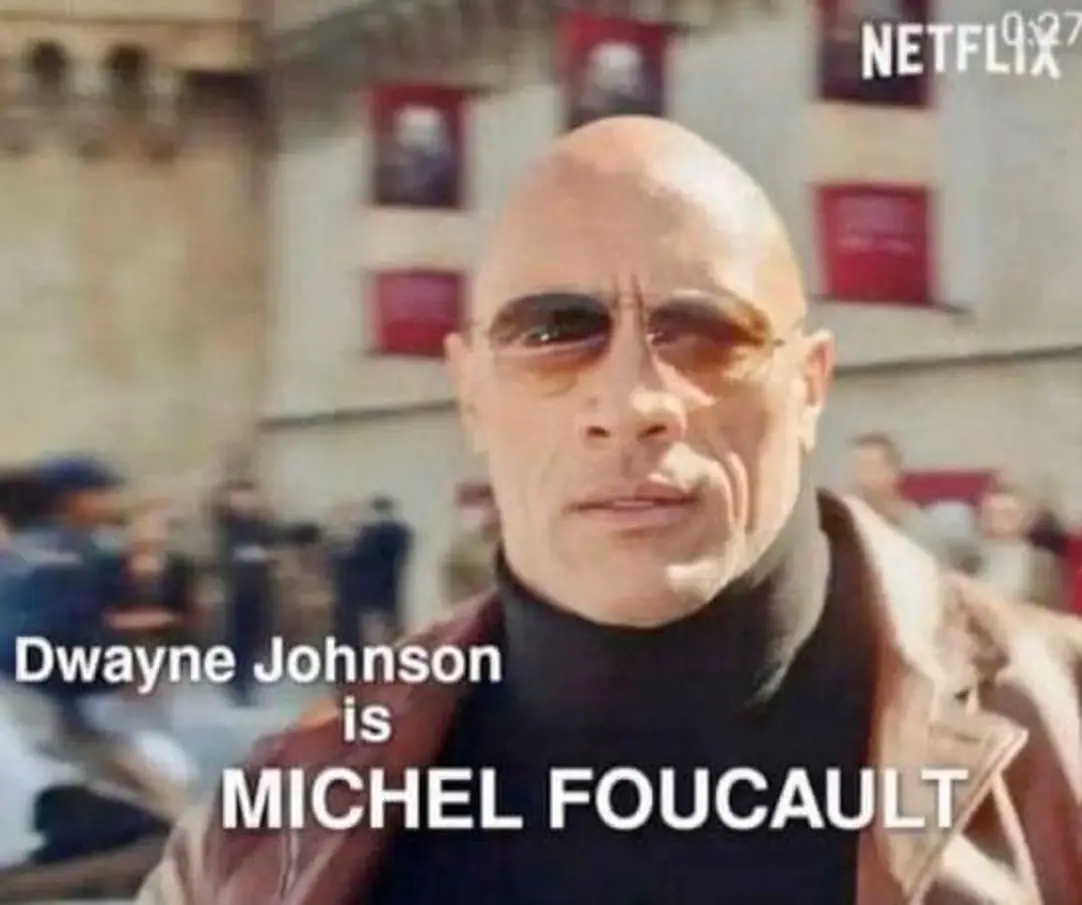
This meme uses the text "Dwayne Johnson is MICHEL FOUCAULT" to create a satirical visual gag that critiques rigid power structures. By replacing the authoritative demeanor of a philosopher with a celebrity image, it mocks the absurdity of equating a specific physical identity with abstract concepts. In the context of Queer Post-structuralism, it also satirizes the "othering" of pop culture icons, subverting expectations and deconstructing societal hierarchies.
simple-description (llama3.2-vision_11b)
The meme is a screenshot from a video where Dwayne "The Rock" Johnson is reading the Wikipedia entry for "Post-Structuralism" in a mockumentary-style film. The text "Dwayne Johnson is Michel Foucault" is overlaid on the image, implying that the actor is mistakenly identified as the famous French philosopher Michel Foucault, known for his work on post-structuralism.
detailed-analysis (gemma3-27b-vision)
Okay, here's an analysis of the image, broken down into sections as requested. It's important to note that this image, explicitly linking Dwayne "The Rock" Johnson to Michel Foucault, is inherently playful and prompts deconstruction rather than providing a straightforward example of any of these theories. I'll embrace that and analyze the implication of the juxtaposition, rather than treat it as a simple representation.
Visual Description
The image is a close-up shot of Dwayne "The Rock" Johnson. He is wearing a dark turtleneck sweater, and dark-tinted round glasses. He has a slight scowl and is looking directly at the camera. The lighting is natural, possibly outdoors or in a well-lit interior. The background is blurry, suggesting a crowd of people or a public space. The image is overlaid with text: "Dwayne Johnson is MICHEL FOUCAULT." A small Netflix logo and a timecode "0:07" are in the upper right corner. The overall aesthetic is one of a film or television still. It’s a highly incongruous visual.
Foucauldian Genealogical Discourse Analysis
This image demands a Foucauldian analysis due to the explicit reference to Michel Foucault. Foucault’s method of genealogy investigates how power operates through discourse. The very act of equating Dwayne Johnson with Foucault is a deliberate disruption of established categories.
- Discourse & Power: What discourses are being challenged here? Typically, Foucault is associated with academic discourse, philosophy, and intellectual history. Dwayne Johnson is associated with performance, entertainment, physicality, and mass culture. Linking them implies that power operates through all of these domains. The image asks us to question why we categorize these figures as separate.
- Genealogy: A genealogical approach would investigate the historical emergence of both "Dwayne Johnson" as a cultural figure and "Michel Foucault" as a philosophical authority. How have these figures been constructed through various discourses over time? What institutions and practices helped shape their images and influence?
- Power/Knowledge: Foucault argued that power and knowledge are inextricably linked. This image suggests that knowledge (of Foucault’s ideas) can be embodied by a pop-cultural figure like Johnson, and that this embodiment itself becomes a form of power. The image suggests a different way to access Foucauldian concepts – not through books, but through embodiment.
- The Panopticon: We could even draw connections to the Panopticon, Foucault’s metaphor for disciplinary power. Johnson’s very public persona, constantly “on display,” and subject to the gaze of fans and media, can be seen as a contemporary manifestation of the Panoptic structure.
Postmodernism
This image embodies several key elements of postmodernism:
- Intertextuality: It explicitly references two disparate figures – a philosopher and an actor – creating a new meaning through their juxtaposition. It’s a blending of high and low culture.
- Deconstruction: The image challenges established categories and hierarchies. The conventional distance between philosophical thought and popular entertainment is collapsed.
- Playfulness & Irony: It’s a deliberately absurd pairing, suggesting a rejection of grand narratives and a celebration of ambiguity.
- Simulation & Hyperreality: The image highlights the constructed nature of both "Dwayne Johnson" and "Michel Foucault" as public figures. They are performances of identity, simulations that often overshadow the "real."
Critical Theory
From a critical theory perspective, this image can be seen as a commentary on the cultural production of authority and knowledge.
- Hegemony: The image subverts the traditional hegemony of academic authority. By associating a mass-culture figure with a high-theory philosopher, it challenges the notion that knowledge is solely confined to institutions of learning. It could be interpreted as a commentary on how cultural authority is constructed and maintained.
- Critique of Representation: The image is inherently about representation. It’s a playful but pointed question about who gets to be an authority, and how are authorities constructed in different domains?
Important Note: I have not included sections on Marxist Conflict Theory or Queer Feminist Intersectional Analysis. While those theoretical frameworks could be applied, they feel less directly relevant to the core meaning of this image, which is primarily a commentary on knowledge, power, and representation. Attempts to shoehorn those frameworks in would likely feel strained and speculative.
Let me know if you’d like me to explore any of these sections in more depth!
simple-description (llama3.2-vision)
This meme is a photo of Dwayne "The Rock" Johnson with a caption that reads "Dwayne Johnson is Michel Foucault". The joke is that Michel Foucault was a French philosopher, and the meme is implying that Dwayne Johnson, a professional wrestler and actor, is somehow also a renowned philosopher like Foucault. The humor comes from the absurdity of the comparison.
tesseract-ocr
ae = 2 => = "e 3 re Dwayne Tie | Ne | : atl ee i\ j