First Seen
2024-04-27T00:16:04+00:00
simple-description (qwen3.5_2b-q8_0)
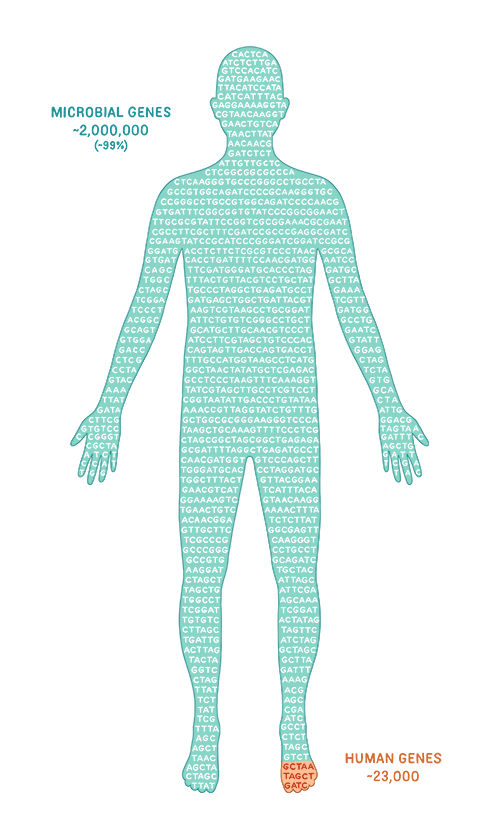
This silhouette meme plays on the concept of gender fluidity and identity construction, which are central tenets of queer post-structuralism. The image suggests that the "human" form is merely a small, static shape within a vast fluid biological landscape, challenging the idea of a fixed binary gender. The text humorously deconstructs the concept of a solid "human" by revealing that the "Human Genes" (23,000) are a tiny fragment of the massive "Microbial Genes" (2,000,000), implying that our biological identity is a small, constructed code rather than a natural, unchangeable essence.
simple-description (llama3.2-vision_11b)
The meme is a visual representation of the human genome, with a large number of nucleotide bases (A, C, G, and T) arranged to form a human shape. The text "Queer - Post-Structuralism" is written in a small font at the top of the image. The meme is a clever play on the idea of the human genome being a complex and nuanced system, with the "Queer" and "Post-Structuralism" labels serving as a humorous commentary on the idea that even the most complex systems can be reduced to a simple, human-like shape.
detailed-analysis (gemma3-27b-vision)
Okay, here's an analysis of the image broken down into the requested sections. I'll state upfront that some of these theoretical frameworks very loosely apply, as the image itself is fairly direct, but I'll do my best to engage with the prompts as requested.
Visual Description
The image presents a silhouetted human figure filled with DNA nucleotide sequences (A, T, C, G). The body is largely composed of sequences presented as if floating, and a lot of repeating segments. The composition is divided into two color-coded sections. The vast majority of the figure (roughly 99%) is colored in a cool blue/teal/turquoise palette, representing approximately 2,000,000 microbial genes. The bottom right portion of the figure (a small segment, representing 1%) is colored in a warmer reddish-orange, denoting around 23,000 human genes. The nucleotide sequences are densely packed, creating a textured effect. The image explicitly highlights the overwhelming numerical dominance of microbial genes in relation to human genes within the body. The overall effect is a visual representation of the microbiome and its role in comprising a human being.
Foucauldian Genealogical Discourse Analysis
This image lends itself well to a Foucauldian analysis focused on the historical construction of "the body" and the power/knowledge systems that define it.
- The Body as Discourse: Foucault argued that the body isn’t a neutral, biological entity, but a site produced by discourses. This image actively challenges traditional discourses on the body. It de-centers the human as the sole originator of being. The body is no longer simply a human entity, but a complex ecology composed of mostly microbial life. It disrupts the notion of a self-contained, autonomous human body.
- Genealogy of the 'Human': The image invites a genealogical examination of how the concept of "human" has been constructed through scientific discourse. Traditionally, the human has been defined by its own genetic material. This image, by emphasizing the dominance of microbial genes, suggests the ‘human’ is, in a very real sense, a composite – a collection of genetic material not wholly its own. This pushes us to consider how our definition of humanity needs to be reworked.
- Power/Knowledge: The visual itself is a form of knowledge production. By foregrounding the microbiome, the image shifts the focus of medical discourse and perhaps, our understanding of health and disease. It suggests that power dynamics are shifting, from a focus on treating the "human" genome, to a consideration of the much larger and more complex microbial ecosystem within the human body. Who controls the discourse about health and wellness, and how that changes when the microbiome is recognized as key, is a question raised by the image.
Critical Theory
This image can be viewed through a critical lens, particularly with regards to assumptions about selfhood and the nature of being.
- Deconstruction of the Subject: The image challenges the Enlightenment notion of the autonomous, rational subject. The human form is literally filled with something “other” – a microbial ecosystem. This undermines the idea of a unified, self-contained individual. The 'self' is less a singular entity and more of a dynamic, complex system that exists in relation to others.
- Alienation: While seemingly positive in highlighting the interconnectedness of life, the image could be interpreted as a form of alienation. If a majority of “you” isn't "you" in the traditional sense, what does that mean for the sense of self? It suggests that the boundaries of the self are far more porous and fluid than we often assume.
- Reification: The image reifies the concept of the body as a biological machine. It takes a highly complex process – the interplay of countless organisms – and represents it in a simplified, visual format. While informative, this simplification can obscure the nuances of the microbial ecosystem.
Marxist Conflict Theory
This is where applying the framework becomes more tenuous, but possible connections can be drawn.
- Internal Colonization: We can metaphorically see the microbial ecosystem within the human body as a form of internal colonization. The microbes, while generally beneficial, operate autonomously within the host. This can be interpreted as a power dynamic, where the host provides the environment, and the microbes 'colonize' and exploit its resources.
- Class Struggle: Extending the metaphor, the human and microbial genes could represent different "classes" within the body. The human genes, in a traditional understanding, are the "ruling class," responsible for directing the body’s overall function. The microbial genes, despite being vastly more numerous, are "subordinate," carrying out essential, but largely unseen, labor. (This is a very stretched metaphor, of course.)
- Exploitation: The human body could be seen as exploiting the labor of the microbes, benefiting from their metabolic processes, while providing them with a stable environment. (Again, a tenuous connection).
Postmodernism
The image aligns with several tenets of postmodern thought.
- Deconstruction of Grand Narratives: The image disrupts the traditional "grand narrative" of human exceptionalism. By highlighting the dominance of microbial genes, it challenges the idea that humans are the apex of evolution or the sole arbiters of life.
- Fluidity and Instability: The image emphasizes the fluidity and instability of boundaries. The distinction between "self" and "other," between "human" and "microbe," is blurred. This aligns with the postmodern emphasis on the instability of meaning and the constructed nature of reality.
- Fragmentation: The image itself is fragmented – composed of individual nucleotide sequences. This visual fragmentation reflects the postmodern rejection of unified, totalizing systems of thought.
Queer Feminist Intersectional Analysis
This is where the connections can be the most nuanced and compelling.
- Challenging Biological Essentialism: The image directly challenges the notion of a fixed, biologically determined "human." The overwhelming presence of microbial genes demonstrates that the body isn't a sealed unit, but a dynamic, interconnected ecosystem. This dismantles essentialist arguments about gender, race, or other social categories, demonstrating that “nature” itself is fluid and mutable.
- Symbiotic Relationships & Collaboration: The image can be read as a metaphor for interdependence and collaboration, themes often central to queer and feminist thought. The success of the body depends on the harmonious co-existence of human and microbial genes, mirroring the need for diverse perspectives and collaborative efforts to achieve social justice.
- De-centering the Human: The image actively de-centers the human, giving agency and prominence to non-human entities. This mirrors the feminist project of deconstructing patriarchal power structures and centering marginalized voices and perspectives.
- Body as Borderlands: The body can be seen as a borderland, a space where different entities intersect and interact. The microbial ecosystem represents the “other” within the body, challenging the notion of a pure, homogenous self. This concept resonates with queer and feminist theories of embodiment and identity.
I hope this detailed analysis provides a thorough exploration of the image through the lenses of these various theoretical frameworks. Let me know if you'd like me to elaborate on any particular point.
simple-description (llama3.2-vision)
The meme is an image of a person with their body made up of DNA sequences, with the text "Genetic Code" written above it. The image is a play on the idea that humans are made up of genetic code, but it's taken to an absurd level by using actual DNA sequences to form the person's body. The text "Genetic Code" is written in a bold, modern font.
tesseract-ocr
panes Geartety MICROBIAL GENES ee ~2,000,000 rat 38%) ye (99%) (oe Seastasaay Faroese foarte pereaeretren hey Pe he peciirenaateere aa un Be Reena serene He Bees ponarererrssearens esl TAG TAAN iemeray Veen pay vee paras kere recent eeear pea hee Ria ass Yaad Pes en Had ray yeas Ba Bad ba RA fi ea AS Ssh HUMAN GENES wy 23,000