First Seen
2023-05-10T21:03:39+00:00
simple-description (llama3.2-vision_11b)
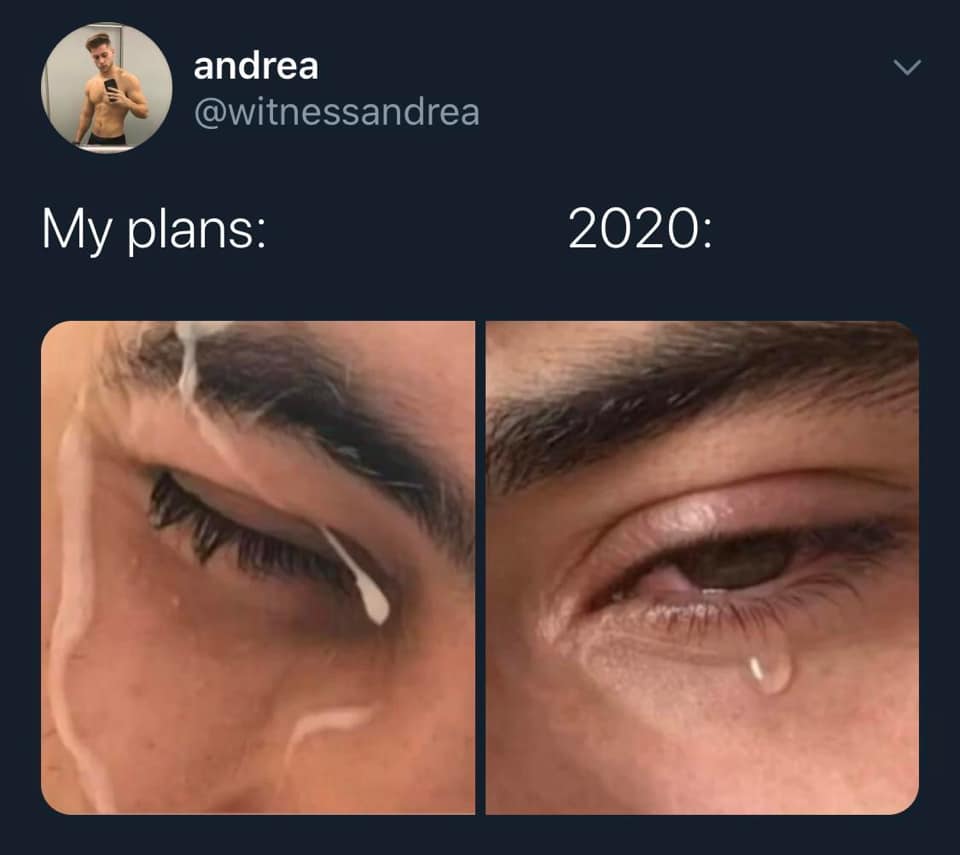
The meme is a humorous take on the challenges of planning for the future, particularly for members of the LGBTQ+ community. It features a photo of a person with a messy, disheveled look, with the caption "my plans" and "2020" written above and below it, respectively. The meme is a relatable commentary on the unpredictability of life and the challenges of navigating one's identity, particularly during a tumultuous year like 2020.
detailed-analysis (gemma3-27b-vision)
Okay, let's break down this meme using the requested theoretical frameworks.
Visual Description
The image is a two-panel meme juxtaposing a close-up of a woman’s eye with a single tear in each panel. The panels are labeled "My plans:" and "2020:". The lighting and focus are similar in both, emphasizing the vulnerability of the eye and the singular, falling tear. The color palette is neutral, drawing attention to the emotion and the direct comparison. The image relies on a universally understood symbol – a tear – to convey sadness, disappointment, or emotional distress. The meme's power rests on the immediate recognition of this symbol and its association with the shared experience of 2020. The creator's Twitter handle and username are visible above the image.
Foucauldian Genealogical Discourse Analysis
This meme can be analyzed through Foucault's concepts of discourse and power/knowledge.
- Discourse of “Planning”: The “My plans:” side represents a specific discourse of self-optimization, future orientation, and control. Modern society privileges planning and goal-setting as markers of success and responsible citizenship. The implicit expectation is one of agency and control over one’s future.
- Discourse of 2020: The “2020” side disrupts this discourse. The tear signifies a breakdown of control and a surrender to external forces. 2020, marked by the COVID-19 pandemic, social unrest, and global instability, became a symbol of unforeseen circumstances and the limits of individual agency.
- Power/Knowledge: The meme re-articulates how we understand planning and the future. 2020 produced a “truth” that planning could be rendered meaningless by events beyond individual control. This re-articulation is not about a 'true' versus 'false' understanding, but about how power operates through discourse to shape our understanding of the world.
- Genealogy: The meme represents a "genealogy" of the present (the impact of 2020) by showing how the discourse of planning has been historically constituted and how it was challenged by specific events.
Critical Theory
Applying a Critical Theory lens (drawing from thinkers like the Frankfurt School), we can see the meme functioning as a form of social critique.
- Domination and Control: The "My plans:" side represents a societal expectation of rational planning, which can be seen as a form of control – a pressure to conform to a linear, predictable life trajectory. This echoes Adorno and Horkheimer’s ideas about the "instrumental reason" of the Enlightenment, where everything is seen as a means to an end (in this case, achieving plans).
- Critique of Progress: 2020 shattered the illusion of linear progress. The tear represents a loss of faith in the idea that human agency can overcome all obstacles. It suggests a disillusionment with the narratives of control and efficiency that dominate modern society.
- The Role of Culture: The meme itself is a cultural artifact that reflects and reinforces a collective experience of disappointment and vulnerability. It operates as a form of shared mourning for lost expectations and unfulfilled plans.
- Ideology: The meme indirectly challenges the ideology of control and individualism, suggesting that external forces – historical events, pandemics, societal structures – often have more power than individual willpower.
Postmodernism
From a Postmodern perspective, this meme embodies several key principles:
- Rejection of Grand Narratives: The meme actively undermines the “grand narrative” of progress, planning, and human control. 2020 exposed the limitations of these narratives and demonstrated the chaotic and unpredictable nature of reality.
- Simulacra and Simulation: The meme is a simulacrum – a representation that stands in for the reality of 2020. The tear represents the emotion of disappointment, but it is not the actual experience itself.
- Fragmentation and Discontinuity: The juxtaposition of “My plans” and “2020” highlights the fragmentation and discontinuity of experience. The meme suggests a loss of coherence and meaning in a world defined by uncertainty.
- Playfulness and Irony: The meme’s use of a simple, relatable image and contrasting labels creates a sense of playful irony. It acknowledges the absurdity of making plans in the face of unpredictable events.
- Deconstruction: The meme "deconstructs" the idea of planning by showing how it can be easily undone by external forces.
Queer Feminist Intersectional Analysis
While not immediately obvious, a Queer Feminist Intersectional reading can illuminate some subtle meanings:
- Vulnerability & Emotional Labor: The tear, traditionally associated with femininity and emotionality, can be seen as a representation of the disproportionate emotional labor often expected of marginalized groups. Women, queer individuals, and people of color frequently experience increased emotional burdens and are often expected to be resilient in the face of adversity.
- Disruption of Linear Time: The pandemic and societal upheaval disrupted traditional understandings of time, particularly for those who were already marginalized. The meme reflects a loss of control over the future and a sense of being stuck in a perpetual present. This disruption is especially felt by individuals whose lives are already characterized by instability and precarity.
- Interlocking Systems of Oppression: 2020 exacerbated existing inequalities, with marginalized communities disproportionately affected by the pandemic, economic downturn, and social unrest. The tear can be seen as a symbol of collective grief and frustration with these systemic injustices.
- Rejecting "Strong" Masculinity: The tear challenges traditional notions of "strength" and emotional stoicism. By embracing vulnerability, the meme subverts hegemonic masculinity and embraces a more nuanced understanding of human emotion.
Important Note: These are just interpretations, and the meme is open to multiple readings. The power of the meme lies in its ability to resonate with a broad audience and evoke shared experiences.
simple-description (llama3.2-vision)
This meme is a humorous comparison between a person's expectations (represented by a smiling face with a thumbs up) and their actual experience (represented by a crying face with a red X). The text above the images reads "My plans: vs. 2020:". The meme pokes fun at the idea that 2020 was a particularly difficult and chaotic year, implying that many people's plans and expectations were severely disrupted.
tesseract-ocr
a) andrea 4 @witnessandrea My plans: 2020: =: _wae ms . ‘ — | Me P , _? a an 2 . , - -