First Seen
2023-05-10T21:03:39+00:00
simple-description (llama3.2-vision_11b)
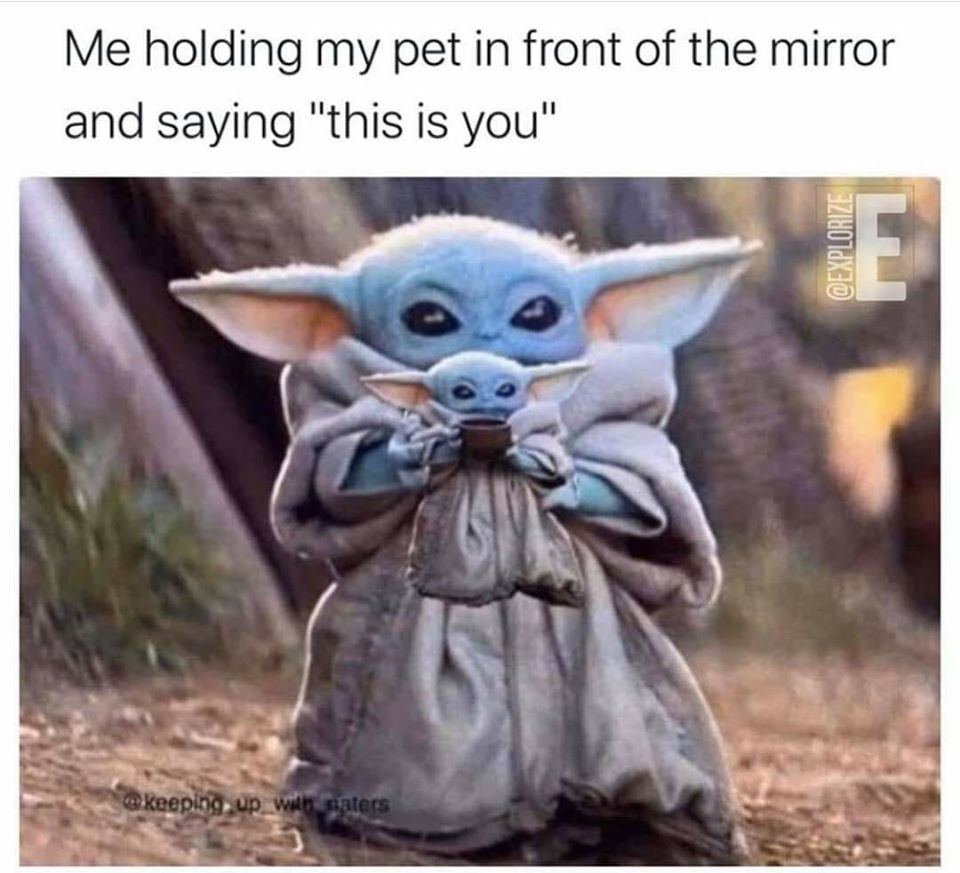
This meme is from the perspective of the LGBTQ+ community, specifically queer individuals who have experienced marginalization and self-acceptance struggles. The image depicts a character from the Star Wars franchise, "Baby Yoda" (also known as "The Child"), holding a mirror and making a sassy remark about his own appearance, "I am the one who looks at you." The meme is a humorous take on the idea of self-acceptance and love, poking fun at the idea of someone trying to find validation in a mirror, only to realize it's themselves staring back.
detailed-analysis (gemma3-27b-vision)
Okay, here's an analysis of the image and caption, broken down into the requested theoretical frameworks. I’ll indicate where a specific framework doesn't strongly apply.
Visual Description
The image features "Baby Yoda" (officially known as Grogu) from the Disney+ series The Mandalorian. Grogu is presented in a strikingly recursive image – he is holding a miniature version of himself. He's swaddled in a dark, robe-like garment, the texture suggesting a rough woven material. The backdrop is blurred greenery, likely an approximation of the show’s settings. The lighting is dramatic, casting shadows that emphasize Grogu’s large eyes and the cuteness of the miniature doll. The image is meme-formatted, with text overlaid at the top reading "Me holding my pet and saying ‘this is you’". The bottom shows a watermark for "@keeping_up_with_sisters" and "@explore".
Foucauldian Genealogical Discourse Analysis
This meme is very rich for Foucauldian analysis.
- Discourse of "Cuteness" and Infantile Power: The meme relies heavily on the discourse of "cuteness," specifically as it relates to animals and, increasingly, infantilized figures. This discourse is productive - it creates expectations about how we relate to and treat creatures and objects perceived as cute. Baby Yoda is a perfect example of how this discourse functions. He is designed to elicit nurturing responses, effectively wielding “power” through perceived helplessness. This power isn’t repressive in the traditional sense, but it shapes our behavior and affects.
- Genealogy of the "Pet" Construct: The meme invites us to consider the genealogy of the concept of a "pet." What historical and social forces led to the creation of this category? What power dynamics are embedded within the owner-pet relationship? The act of projecting self-identity onto the pet challenges the clear distinction between owner and owned, and asks us to consider how we define those boundaries.
- Power/Knowledge: The image demonstrates how knowledge about Baby Yoda (his status as a cultural icon, his vulnerability, his cuteness) contributes to the power he wields over viewers. We respond to him in predictable ways because of this pre-existing knowledge. The caption “this is you” is a subtle yet subversive act; it inverts the power dynamic by suggesting the pet reflects the owner, and possibly holds a degree of understanding of the owner's self.
Critical Theory (Specifically, Frankfurt School)
The meme taps into a broader cultural anxiety about identity and authenticity in a hyper-mediated world.
- Culture Industry: Baby Yoda himself is a product of the culture industry. His commodification and saturation across various media formats (memes, merchandise, etc.) contribute to a loss of individuality and genuine experience. The meme implicitly critiques this process by highlighting the absurdity of projecting our identities onto manufactured objects.
- False Consciousness: The caption "this is you" is potentially a manifestation of “false consciousness”. It can be read as a form of self-deception, where the individual projects their desired self onto the pet, obscuring their own complexities and contradictions.
- Erosion of the Individual: The meme hints at a blurring of boundaries between self and other, a key theme in critical theory. The identification with a "cute" exterior can be seen as a retreat from the difficult work of self-reflection and a surrender to superficiality.
Marxist Conflict Theory
While not the primary lens through which to view this meme, there are subtle connections:
- Commodification of Affection: Baby Yoda and the act of "cute" affect are commodities. Disney benefits financially from our emotional responses to this character. The meme implicitly acknowledges the capitalist logic at play – even our feelings are subject to economic exploitation.
- Alienation: The act of projecting self-identity onto a pet can be interpreted as a form of alienation. The individual feels disconnected from their own self, and seeks to find a reflection of it in an external object.
- Distraction: Meme culture, in general, can be seen as a form of “opiate of the masses” – a distraction from real social and economic problems. The meme provides a momentary escape into a world of cuteness, diverting attention from more pressing concerns.
Postmodernism
This meme is very postmodern:
- Intertextuality: The meme relies on intertextuality – the viewer must recognize Baby Yoda and his cultural significance to understand the joke. It layers a contemporary observation ("holding my pet") with a reference to popular culture.
- Simulacra and Simulation: Baby Yoda himself can be seen as a simulacrum – a copy without an original. He is a fictional character brought to life through special effects and marketing, and his image is endlessly reproduced and circulated online. The act of identifying with this simulacrum is a key feature of postmodern culture.
- Playfulness and Irony: The meme embraces a playful and ironic tone. It doesn’t offer a serious message or moral lesson; instead, it invites us to laugh at the absurdity of our own behavior.
- Deconstruction of Identity: The caption “this is you” is a form of deconstruction. It disrupts the conventional understanding of identity by suggesting that we are not fixed and stable beings, but rather fluid and malleable constructs.
Queer Feminist Intersectional Analysis
This is the least directly applicable framework, but we can draw some connections:
- Infantilization and Power: The focus on "cuteness" and baby-like qualities can connect to larger power dynamics related to infantilization, where beings perceived as vulnerable are often subject to control or exploitation. The meme implicitly asks us to consider how we relate to and treat those we perceive as "helpless," and to question the power imbalances that may exist.
- Challenging Binaries (Self/Other): By projecting identity onto the pet, the meme subtly challenges the strict separation between self and other. This can be seen as a feminist move, as it disrupts the patriarchal notion of the autonomous, self-sufficient individual.
- Emotional Labor: The expectation of providing care and affection to a pet (and the emotional connection that comes with it) is often gendered, falling disproportionately on women. The meme can be interpreted as a commentary on this dynamic. However, it is an indirect connection.
Let me know if you'd like me to expand on any of these analyses or explore other theoretical frameworks!
simple-description (llama3.2-vision)
The meme is a still image of a character from the Star Wars franchise, specifically the child version of the character known as "Baby Yoda" from the series "The Mandalorian". The character is shown looking at its own reflection in a mirror, with a puzzled expression. The text above the image reads "Me holding my pet in front of the mirror and saying 'this is you'".
tesseract-ocr
Me holding my pet in front of the mirror and saying "this is you" Se / Gj a cE 4 Aly\* ek "A y i X | > a 7] ‘y \ ; a a — A as 5 > >. a F4 , Ws ces is 7 ss F cl ~ Ps ~~ -