First Seen
2023-05-10T21:03:39+00:00
simple-description (llama3.2-vision_11b)
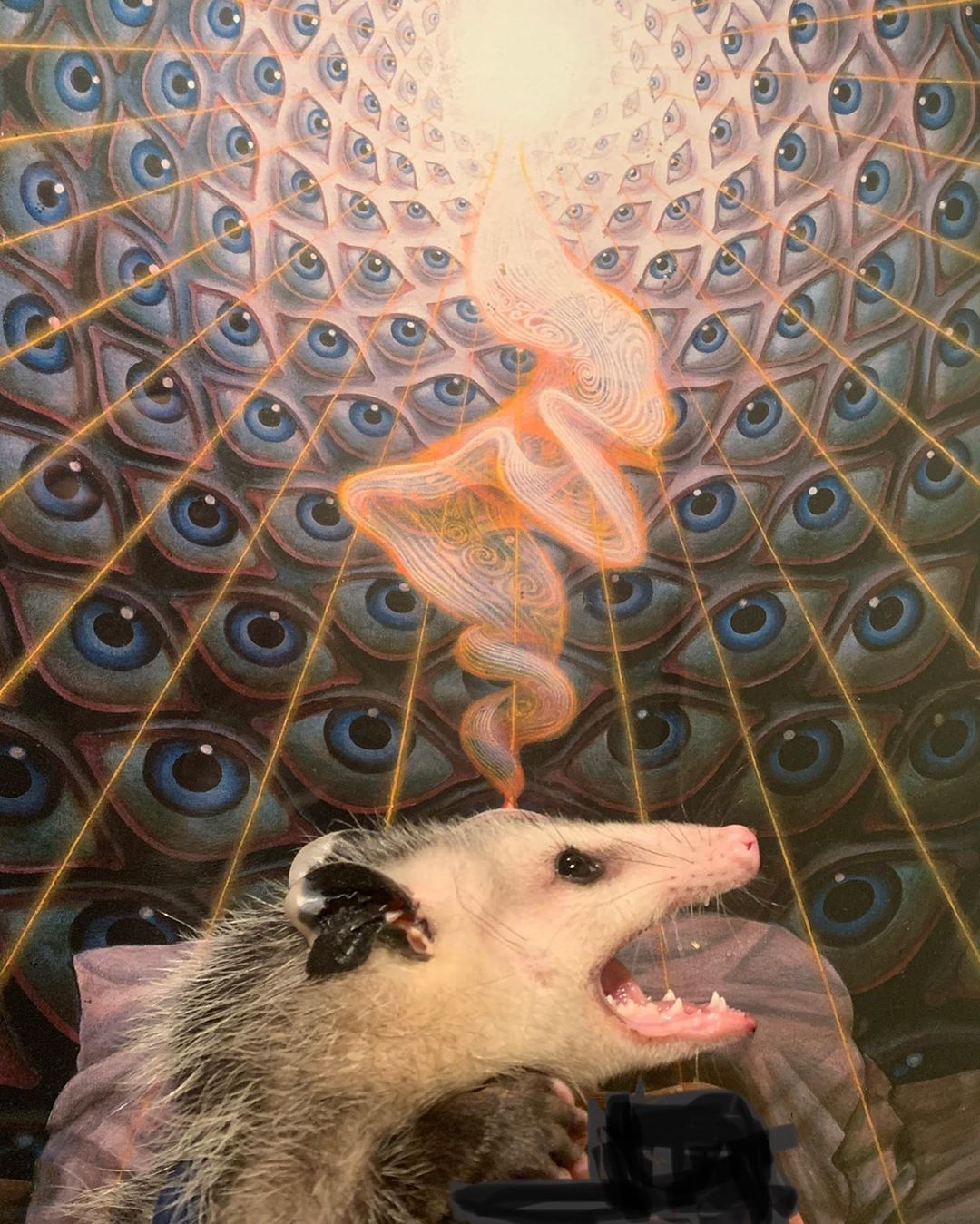
The meme features a picture of a cartoonish, anthropomorphized opossum with a shocked expression, surrounded by a psychedelic background with swirling patterns and eyes. The text overlay reads "when you're trying to be a lesbian but your brain is still a hetero trashcan". The meme is a humorous take on the challenges of navigating one's identity and the complexities of human psychology.
detailed-analysis (gemma3-27b-vision)
Okay, let's analyze this visually striking and conceptually layered image, breaking it down through the requested theoretical lenses.
Visual Description
The image is a digitally manipulated artwork with a surreal and slightly unsettling aesthetic. It features a close-up of a North American opossum with its teeth bared in a grimace or snarl, positioned in the foreground. The opossum appears to be gripping what looks like a camera or optical device. The background is dominated by a radiating pattern of numerous, highly detailed human eyes. The eyes seem to be focused on a central, luminous figure—a ghostlike, vaguely human form rendered in a swirling, fiery orange, appearing as though ascending toward a bright light source at the very top of the frame. The overall color palette is a mix of muted browns and grays for the opossum, contrasted with the vibrant orange and the cool blues and greens of the eyes. The effect is a visually dense and complex composition that evokes a sense of being watched, or perhaps witnessing a strange, otherworldly spectacle.
Foucauldian Genealogical Discourse Analysis
This image lends itself richly to a Foucauldian reading. The pervasive eyes are the most obvious entry point. They represent the ultimate in panoptic surveillance—a structure where the subject believes they are constantly being watched, even if there isn't a physical watcher. The opossum, with its grasp on the camera, can be interpreted as representing the mechanism of observation and the subject of it.
- Discourse and Power/Knowledge: The image suggests a discourse around surveillance, control, and the construction of reality through observation. The "knowledge" generated by these eyes isn't neutral; it's a system of power that defines and categorizes. The opossum, traditionally a “lowly” creature, seemingly wields the power of observation, turning the panoptic gaze back upon itself.
- Genealogy: A genealogical investigation might trace the history of how we've come to understand the opossum. Historically, opossums have been seen as scavengers, often associated with the margins of society. Here, the opossum is central to the image and seemingly in control of the viewing apparatus, suggesting a shift in that discourse.
- The Ascending Figure: The spectral figure could be seen as an embodiment of idealized power structures, the "truth" being constructed and enforced by the all-seeing eyes.
Critical Theory
This image can be read as a critique of several aspects of modern society through the lens of Critical Theory, specifically referencing the Frankfurt School:
- Commodification of the Gaze: The opossum wielding a camera suggests a commodification of the gaze – observation has become a tool for consumption and control, perhaps mirroring the surveillance capitalism of our current era.
- Alienation & Reification: The ghostly figure ascending is strangely abstract and dehumanized. It points to the alienation of individuals from their own spirituality or sense of self, and reification of abstract concepts (like "enlightenment" or "truth") into something distant and inaccessible.
- The Culture Industry: The hyper-detailed, saturated imagery feels like an overload of information – reflective of the bombardment of images and stimuli in a consumer culture.
Postmodernism
The image screams Postmodernism in its self-referentiality, mixing of genres, and questioning of grand narratives.
- Deconstruction of Representation: The composition actively challenges any straightforward interpretation. It’s a collage of disparate elements (animal, eyes, spectral form, technology) that resist being easily categorized. The opossum is not a “natural” subject for such a dramatic composition, so the image rejects realistic representation.
- Simulacra and Simulation: The ghostly figure is a simulation of enlightenment or ascension. It’s a “copy of a copy” that has lost touch with any original reality, fitting Baudrillard’s concept of simulacra.
- Rejection of Metanarratives: The image doesn’t present a unified or coherent story. It intentionally avoids any grand narrative of spiritual enlightenment, instead presenting a fragmented and ambiguous vision.
Queer Feminist Intersectional Analysis
This is where the analysis becomes a little more nuanced and dependent on interpretation, but there are avenues to explore.
- Marginalized Subjectivity: The opossum is an animal typically associated with the margins, a “low” creature in the hierarchy of nature. Placing it at the center of this image can be seen as an act of subversion, giving voice to a marginalized subjectivity.
- The Gaze & Power Dynamics: The multitude of eyes could be read as a patriarchal gaze, constantly watching, judging, and controlling. The opossum, by wielding the camera, returns the gaze, potentially reclaiming agency.
- Intersectional Vulnerability: The ghostly figure, while ambiguous, could be interpreted as embodying vulnerability and dispossession. In an intersectional framework, this could relate to the experiences of individuals marginalized by multiple systems of oppression (race, gender, class, etc.).
- Deconstruction of the Ideal: The spectral, ethereal quality of the ascending figure could be viewed as a deconstruction of traditional ideals of beauty, spirituality, or perfection, particularly those imposed by patriarchal or dominant cultures.
Important Note: Interpretation is subjective, and this image is open to multiple readings. The connections made here are potential avenues for analysis based on the theoretical frameworks you provided. The power of the image lies in its ambiguity and the space it creates for viewers to project their own meanings onto it.
simple-description (llama3.2-vision)
The meme is an image of a cartoonish, anthropomorphic opossum with a shocked expression, its eyes and mouth wide open. The text "when you realize you've been eating trash your whole life" appears above the opossum. The image is likely meant to be humorous and relatable, poking fun at the idea that some people may not realize the quality of their food until later in life.
tesseract-ocr
PALS (© VE ) iPAQ Ly @ e’¢ : oven a * “ ry € wy Si 6 @, 9) “ Es (eo 2 a ) Pp . : - : 4) arn a /\.@, a g € - ) Le | ea % 4.7% . & IT j Zz " e De ee. Qe ail — EOS = Ya , oC. & % 3 a 5 a a ek A Ake oa ; f \ — 2 —) fo Ts = yp ia Ze a ie