First Seen
2023-05-10T21:03:39+00:00
simple-description (llama3.2-vision_11b)
The meme is a reference to the popular song "I Think I'm a Sloth" by the queer artist, Tones and I, but it has been remixed to say "I think I'm a sloth... but I'm actually a sloth in a sloth costume". The image is of a sloth wearing a sloth costume, and the text is a playful commentary on the idea of identity and self-perception.
detailed-analysis (gemma3-27b-vision)
Okay, let's break down this image and the attached text ("gentle gasp 'Trash'") through the lenses you've requested. Note that some of these theoretical approaches will be more relevant than others, and some connections will be more interpretive.
Visual Description
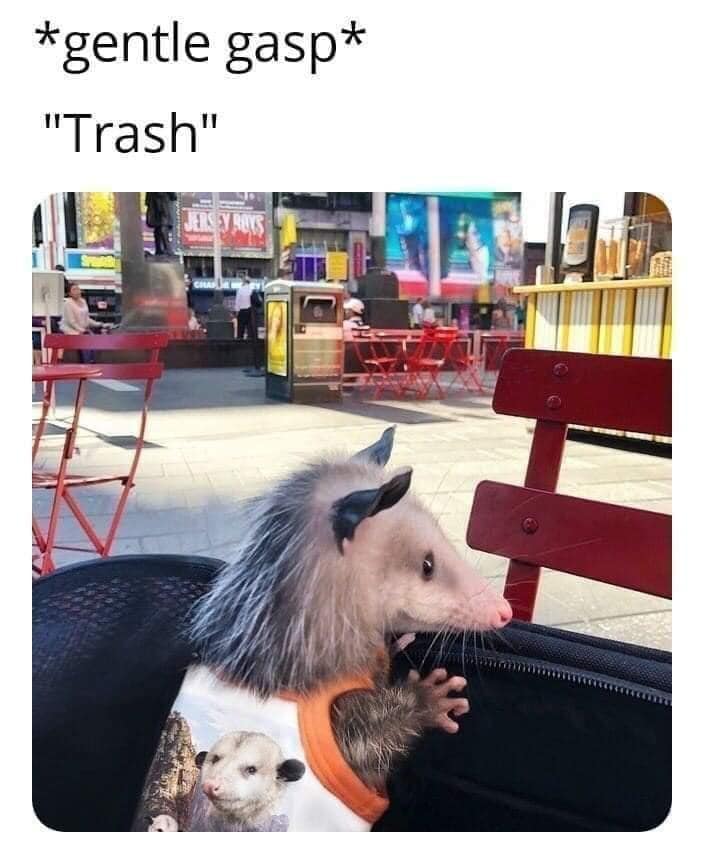
The image depicts an opossum sitting on what appears to be a bar or outdoor seating area. The opossum is the focal point, and it's wearing a miniature jersey – notably, the jersey features images of other opossums. It's posed somewhat anthropomorphically, with its paws resting as if it is observing its surroundings. The background is a blurred cityscape, suggestive of a busy urban environment – Times Square is likely given the bright lights. The overall tone is playful and slightly absurd. The “Trash” text seems to be labeling the opossum, which seems counterintuitive given its endearing pose and clothing.
Foucauldian Genealogical Discourse Analysis
The seemingly simple labeling of the opossum as "Trash" opens a discourse on categorization, power, and the construction of 'normalcy'. A Foucauldian approach asks how this labeling came to be. What historical and social forces lead to the association of opossums (often seen as scavengers, existing on the fringes of human spaces) with the concept of "trash"?
- Discourse: The image participates in a discourse around wild animals in urban spaces, the act of anthropomorphizing animals, and our tendency to categorize the natural world based on human values.
- Power/Knowledge: The power dynamics at play are subtle but present. The act of naming is an act of power. By labeling the opossum "Trash", the observer asserts a human-centric dominance over the animal, defining it within a human framework.
- Genealogy: Looking at the history of how opossums have been viewed – initially as a food source, then as pests, and now increasingly as a symbol of urban resilience – reveals how the meaning of "opossum" has shifted over time. The term "trash" itself has a history of denoting worthlessness, and this historical weight is brought to bear on the animal.
Critical Theory
Critical Theory, particularly through the Frankfurt School, would focus on the image’s commentary on consumer culture and the alienation it creates.
- Commodity Fetishism: The opossum wearing a jersey is a key aspect. It highlights how even wild animals are incorporated into the logic of consumerism. The jersey transforms the opossum into an object of spectacle, masking its natural existence behind a layer of manufactured desire.
- Alienation: The image could be read as a commentary on the alienation of modern life. The opossum, a creature of the wild, is forced into the urban landscape and then dressed in a garment designed for human consumption. This highlights the disconnect between humans and nature, and the commodification of all living things.
- Mass Culture: The blurred, brightly lit background of Times Square emphasizes the image’s participation in a world saturated with mass media and superficiality. The opossum, amidst this backdrop, is another consumable image in a sea of endless spectacle.
Marxist Conflict Theory
From a Marxist perspective, the image speaks to the inherent conflict between humanity and nature, and the exploitation of natural resources.
- Class Conflict (Extended): While not a direct class struggle, the image can be seen as a symbolic representation of the conflict between humans and the natural world. The opossum’s presence in an urban environment represents the encroachment of human civilization on natural habitats. The label “trash” emphasizes the devaluation of nature by capitalist society.
- Alienation from Labor/Nature: The opossum, stripped of its natural habitat and subjected to human observation, embodies the alienation experienced by both the working class and the natural world under capitalism.
- Commodification of Nature: The opossum wearing a jersey is a clear example of the commodification of nature. It turns a wild animal into a consumer product, highlighting the exploitative relationship between humans and the environment.
Postmodernism
The image is inherently postmodern due to its self-aware absurdity, playful irony, and blurring of boundaries.
- Simulacra & Simulation: The opossum in a jersey is a prime example of a simulacrum – a copy without an original. The jersey itself is a simulation of team spirit, and the opossum wearing it is a simulation of a human fan. The image loses its grounding in reality, becoming a hyperreal construction.
- Irony & Pastiche: The image’s juxtaposition of a wild animal and a human garment is inherently ironic. It playfully challenges our expectations and subverts traditional notions of categorization. The opossum's pose is also a form of pastiche, mimicking human behavior.
- Deconstruction of Meaning: The labeling of the opossum as "Trash" deconstructs the conventional meaning of both words. The opossum, despite being labeled "trash", is endearing and visually appealing, challenging our assumptions about value and worth.
Queer Feminist Intersectional Analysis
This analysis is the most interpretive. It’s important to recognize that the connection isn’t overt, but through a queer feminist lens, we can explore themes of marginalization and challenging normative categories.
- Challenging Binaries: The opossum, as a creature existing between wild and urban spaces, can be seen as embodying a rejection of binary oppositions. It doesn’t neatly fit into conventional categories of “nature” vs. “culture”, or “domestic” vs. “wild”.
- Marginalization & Resilience: Opossums are often marginalized creatures, viewed as pests or unwanted scavengers. The opossum's resilience in surviving in urban environments can be read as a metaphor for the struggles faced by marginalized communities. The opossum's adoption of clothing is a type of survival.
- Queer Coding: The opossum’s “refusal” to adhere to societal standards of appearance through its adoption of clothing can be read as an act of queer self-expression and a rejection of normative aesthetics.
Let me know if you’d like me to elaborate on any of these analyses or explore other theoretical frameworks.
simple-description (llama3.2-vision)
This meme features an image of a startled-looking opossum with its mouth open in a comically exaggerated expression. The text above the image reads "gentle gasp 'Trash'" and is meant to convey a sense of shock or surprise at something unexpected. The opossum's reaction is likely meant to be humorous and relatable, implying that someone has said or done something that's left the opossum (and possibly the viewer) stunned.
tesseract-ocr
*gentle gasp* "Trash" REIT ILP re =. op | ea | ] —— mee wi), 6/4.) Sapa Re. “ :