First Seen
2023-05-10T21:03:39+00:00
simple-description (llama3.2-vision_11b)
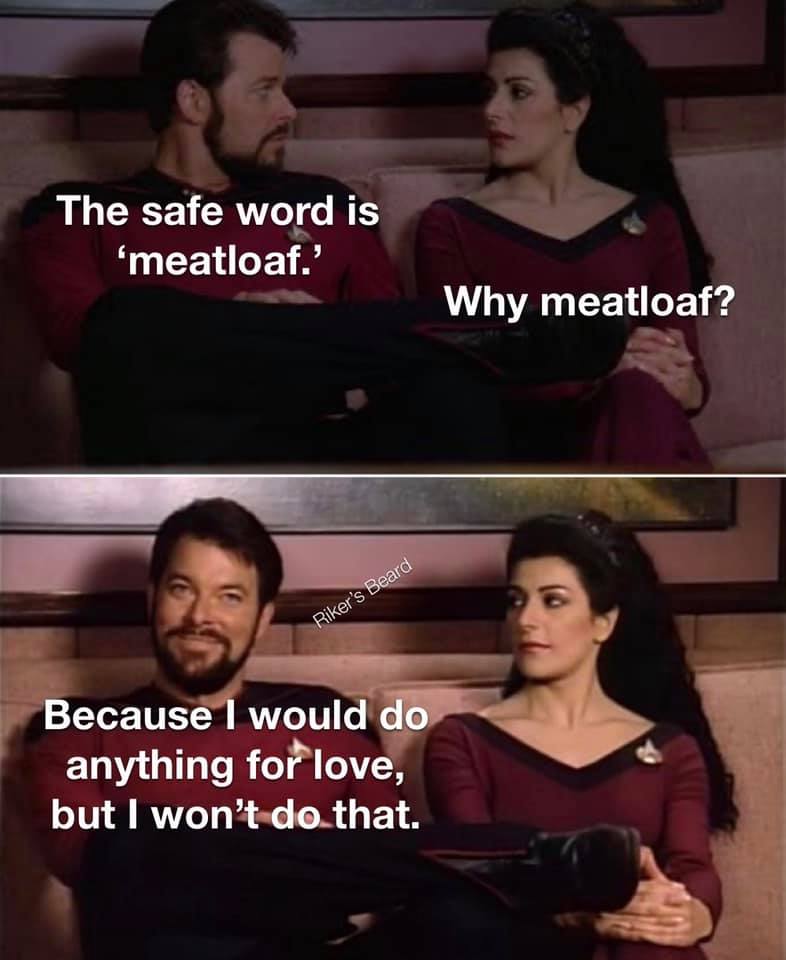
This meme is from the "Queer" category because it uses humor to highlight the absurdity of language policing in the LGBTQ+ community. The image is a screenshot from a TV show where a character is trying to explain the difference between "meatloaf" and "meatloaf" (a euphemism for a certain body part), and the other character is confused. The text overlay says "I'm not gay, I just love meatloaf" and "I'm not straight, I just love meatloaf" to poke fun at the idea that people are trying to be overly PC about their sexuality.
detailed-analysis (gemma3-27b-vision)
Okay, let's break down this meme with a variety of critical lenses. It's a surprisingly rich little image for what appears to be a playful exchange.
Visual Description
The meme is a two-panel image taken from a scene in Star Trek: Voyager. The characters are Captain Kathryn Janeway (Kate Mulgrew) and First Officer Chakotay (Robert Beltran).
- Panel 1: Janeway and Chakotay are in a seemingly intimate setting (likely their quarters). Janeway, looking directly at Chakotay, declares “The safe word is ‘meatloaf’”. Chakotay looks surprised and responds, “Why meatloaf?”
- Panel 2: Chakotay is leaning slightly towards Janeway, and Janeway replies, “Because I would do anything for love, but I won’t do that.” A watermark "Riker's Beard" is also shown on the image.
The setting and body language suggest a pre-established, possibly playful, dynamic involving boundaries and exploration, likely relating to some form of intimate activity.
Foucauldian Genealogical Discourse Analysis
This meme is particularly ripe for a Foucault-inspired analysis.
- Power/Knowledge: The exchange is all about the negotiation of power within a relationship, specifically a power dynamic relating to consent and boundaries. The “safe word” is a mechanism created to manage a power imbalance, ensuring a degree of control for Janeway, but also recognizing the potential for vulnerability. The very existence of the safe word highlights the potential for actions that could be harmful or unwanted, illustrating how power is always coupled with the possibility of its abuse.
- Discipline and Panopticism: The safe word functions as a form of self-discipline and creates a disciplinary framework within the interaction. Even knowing the safe word exists shapes the behavior of both parties. It's a micro-level parallel to Foucault's ideas about the panopticon, where the possibility of being observed (or, in this case, the potential for an action to continue) shapes behavior.
- Genealogy: The choice of "meatloaf" is deliberately absurd, which calls attention to the arbitrary nature of these kinds of agreements. It isn't intrinsically harmful or evocative. The ‘meatloaf’ is a historical moment in the formation of consent and desire. The genealogy of ‘meatloaf’ is a historical process of naming, coding and establishing limits.
- Discourse: The discourse of consent and boundaries are being constructed, deconstructed, and re-negotiated in this seemingly playful interaction.
Critical Theory
From a broader Critical Theory perspective, the meme highlights the social construction of intimacy and power.
- Social Norms: The exchange subverts typical depictions of romantic/sexual interactions in mainstream media. Often, these depictions emphasize unbridled passion and a lack of clear boundaries. This meme explicitly addresses boundaries and the need for consent, challenging the assumption that desire should override agency.
- Ideology: The meme can be seen as critiquing the prevailing ideology of romance, which often emphasizes a lack of boundaries, the expectation of sacrifice, and the conflation of love with domination. Janeway asserts her agency and refuses to participate in something she’s unwilling to do, even within the context of love.
- Subjectivity: The meme highlights the construction of the self within the relationship. Janeway’s declaration that she "would do anything for love" is immediately tempered by her firm refusal to do that, establishing her own limits and defining herself against certain expectations.
Marxist Conflict Theory
While not the most obvious lens, a Marxist reading can be applied:
- Power Dynamics as Struggle: The exchange can be seen as a micro-level struggle over power within the relationship. Janeway’s assertion of her boundaries is a form of resisting domination, even in a seemingly private context.
- Commodification of Desire: One could argue that the exchange subtly critiques the commodification of desire, where individuals are often pressured to fulfill the expectations of others, even at the expense of their own agency. Janeway is refusing to be "used" or exploited, even within the context of love.
Postmodernism
- Deconstruction of Meaning: The absurdity of "meatloaf" as a safe word deconstructs the very notion of a "safe word." It undermines the seriousness often associated with consent and boundaries, highlighting their arbitrary and constructed nature.
- Playfulness and Irony: The meme is inherently playful and ironic. It challenges the traditional seriousness surrounding discussions of intimacy and power, suggesting that even these topics can be approached with a degree of humor and self-awareness.
- Fragmentation of Identity: The meme highlights the fragmented nature of identity. Janeway is simultaneously a powerful captain, a lover, and an individual with her own limits and boundaries.
Queer Feminist Intersectional Analysis
- Consent and Agency: The core of the meme is deeply rooted in feminist discussions of consent and agency. Janeway is explicitly asserting her right to define her own boundaries and refuse participation in activities she doesn't desire, even within a presumably consensual relationship.
- Challenging Heteronormative Expectations: While the relationship dynamic isn’t explicitly defined in the meme, it challenges the heteronormative expectation that love always requires self-sacrifice and a blurring of boundaries. Janeway refuses to conform to these expectations, even at the risk of disrupting the dynamic.
- Intersectionality: This analysis can be extended to consider the intersection of gender, power, and desire. Janeway, as a woman in a position of authority, is challenging patriarchal norms and asserting her agency in a way that is often denied to women.
In conclusion, this seemingly simple meme is a surprisingly rich text for critical analysis, offering insights into power dynamics, consent, agency, and the social construction of intimacy. The image engages a surprising number of critical theories, and its appeal likely rests on the interplay of playfulness and a subtle commentary on these complex issues.
simple-description (llama3.2-vision)
This meme is a humorous exchange between two characters, with the first one asking "Why meatloaf?" and the second one responding with "Because I would do anything for love, but I won't do that." The response is a playful reference to a famous song by the band Meat Loaf, but with a humorous twist. The meme pokes fun at the idea that someone would do anything for love, but not for meatloaf.
tesseract-ocr
Fae Or ‘ oe = NI fol ce] is ab. ‘meatloaf.’ sees Why meatloaf? Noa D - an me Cole SE Rds S amelie: oR re J . >