First Seen
2023-05-10T21:03:39+00:00
simple-description (llama3.2-vision_11b)
The meme is a humorous take on the stereotype that "men who like pineapple on pizza" are also likely to be more open-minded and accepting of LGBTQ+ individuals. The image features a split-screen comparison between a "man who likes pineapple on pizza" and a "man who likes pineapple on pizza, but also likes a good queer romance" - implying that the latter is more likely to be queer-friendly. The text "feminine" is written in a bold, playful font to emphasize the contrast between the two stereotypes.
detailed-analysis (gemma3-27b-vision)
Okay, here's an analysis of the image, broken down into the sections you requested. I'll indicate when a section isn't particularly applicable.
Visual Description
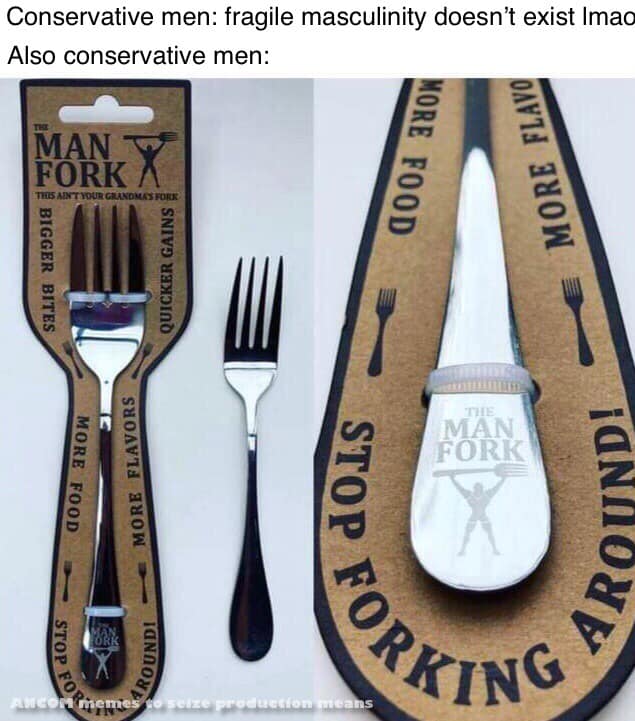
The image shows a packaged product: "The Man Fork". It's a large, oversized fork. The packaging is cardboard-like, mimicking a retail product. Around the fork's body and spoon bowl are slogans in all caps: "BIGGER BITES," "QUICKER GAINS," "MORE FLAVORS," "MORE FOOD," and "STOP FORKING AROUND!" The packaging includes a logo with a stylized image of a fork and the words "The Man Fork." The text at the top of the image says "Conservative men: fragile masculinity doesn't exist lmao" and then "Also conservative men" below, implying a sarcastic juxtaposition. At the bottom of the image is the text “AMOGUS memes to seize production means”. The overall impression is a deliberate parody of hyper-masculine marketing targeted toward men, leveraging exaggerated claims of functionality and appeal to primal desires (more food, bigger bites).
Foucauldian Genealogical Discourse Analysis
This image is highly fertile ground for a Foucauldian analysis. The "Man Fork" functions as an object within a discourse surrounding masculinity.
- Discursive Formation: The image isn't about a fork. It's about the creation and circulation of ideas about what it means to be a man. The fork becomes a site where power/knowledge operates. The packaging's assertions ("bigger bites," "quicker gains") aren't about eating; they're about performing masculinity. They're connected to power, dominance, and control (over food, over experience, over others).
- Genealogy of Masculinity: The genealogy would trace how the concept of "manliness" has been constructed through history. The "Man Fork" taps into historically constructed ideas about men being providers, dominant, powerful, and having a large appetite – all traits that have been socially constructed and historically valorized in many cultures. The fork is positioned as a tool to perform these constructed attributes.
- Power/Knowledge: The image demonstrates how knowledge and power are intertwined. The creators of this product are asserting a particular definition of masculinity, and through marketing and consumption, they attempt to normalize it. The phrase "Stop Forking Around!" isn't about proper dining etiquette; it's a command to embody a certain assertive, uninhibited, "manly" behavior.
Critical Theory
This image is a strong example of how ideology functions.
- Commodification of Identity: The "Man Fork" takes a socially constructed identity (masculinity) and turns it into a commodity. It suggests that you can buy your way into being a "real man." This is a classic example of how capitalism appropriates and sells back identities, reinforcing dominant ideologies.
- False Consciousness: The image can be interpreted as a critique of "false consciousness" – the idea that individuals are unaware of the true nature of their social and economic conditions. Those who buy into the "Man Fork" marketing might be unknowingly accepting and perpetuating limiting and harmful definitions of masculinity.
- Culture Industry: The packaging itself exemplifies the principles of the culture industry (as described by Adorno and Horkheimer). It's a mass-produced, standardized product designed to create desire and conformity, rather than critical thought or genuine self-expression.
Marxist Conflict Theory
The image can be analyzed through a Marxist lens by examining the class dynamics and the commodification of even basic needs and identities.
- Commodification of Desire: The "Man Fork" isn't selling a functional tool; it's selling a feeling – a feeling of power, dominance, and satisfaction. This commodification of desire is a core element of capitalist ideology.
- Alienation: By turning even the act of eating into a performance of masculinity, the image highlights the alienation inherent in capitalist society. Individuals are encouraged to define themselves through consumption rather than through authentic self-expression.
- Ideological Control: The marketing surrounding the fork functions as a form of ideological control, reinforcing existing power structures and class divisions. By associating masculinity with consumption, the image reinforces the idea that individuals must buy their way into social acceptance and status.
Postmodernism
The image is highly self-aware and ironic, hallmarks of postmodernism.
- Hyperreality & Simulation: The "Man Fork" isn't about a real need; it's a simulation of a need created by marketing. The packaging is a parody of marketing itself, creating a layer of hyperreality where the line between the real and the artificial is blurred.
- Deconstruction of Meaning: The image deconstructs the traditional meaning of masculinity. By presenting it as something that can be bought and consumed, it undermines its authenticity and complexity.
- Irony & Parody: The entire concept is presented with a heavy dose of irony and parody. The slogans are exaggerated and absurd, suggesting that the creators are aware of the ridiculousness of hyper-masculine marketing.
Queer Feminist Intersectional Analysis
This is a crucial lens for analyzing this image.
- Toxic Masculinity & Its Performance: The "Man Fork" embodies and reinforces harmful stereotypes about masculinity. The emphasis on "bigger bites," "quicker gains," and dominating consumption practices contributes to a culture of toxic masculinity.
- Gender Performance & Social Construction: The image highlights how masculinity is not inherent but a performance. The fork is a prop in this performance, suggesting that men must actively embody certain traits to be considered "real men."
- Intersectionality & Exclusion: The image implicitly excludes anyone who doesn’t conform to this narrow definition of masculinity. It reinforces the idea that there is only one "right" way to be a man, marginalizing those who are queer, non-binary, or who simply don’t subscribe to traditional gender roles. The underlying assumption is that only certain bodies/genders/expressions are allowed the "performance" of dominance.
- Critique of Heteronormativity: The image subtly reinforces heteronormative expectations by associating masculinity with dominance and consumption. It implicitly suggests that men must fulfill certain roles to be considered attractive or desirable.
I've tried to provide a thorough analysis across these different theoretical frameworks. Let me know if you'd like me to elaborate on any particular point or explore a different angle.
simple-description (llama3.2-vision)
This meme is a humorous comparison between two types of men: "conservative men" and "liberal men" (implied by the use of "feminine" labels). The meme presents a split-screen image of two different types of forks, with the "conservative men" fork labeled as "The Man Fork" and the "liberal men" fork labeled as "The Woman Fork". The text on the image reads "Conservative men: Forks with pointed tips and sharp edges. Liberal men: Forks with rounded tips and soft edges."
tesseract-ocr
Conservative men: fragile masculinity doesn’t exist Imac Also conservative men: _— iz \ A ee ace S ’ ‘e | a SUE “— | zs : he \ Be ; — Pa) oO £2 ih ay 4c a <a s*