First Seen
2023-05-10T21:03:39+00:00
simple-description (llama3.2-vision_11b)
The meme features a photo of a person in a provocative outfit, with a sign that reads "I can explain the meme" and a caption that says "I'm not arguing, I'm just explaining why I'm right". This meme is a humorous example of queer culture and identity, poking fun at the idea that some people feel the need to explain or justify their actions or choices. The meme is likely to resonate with members of the queer community who have experienced similar situations.
detailed-analysis (gemma3-27b-vision)
Here's an analysis of the image, broken down into the requested sections where applicable. Note that some sections will be more substantial than others, given the specific content.
Visual Description
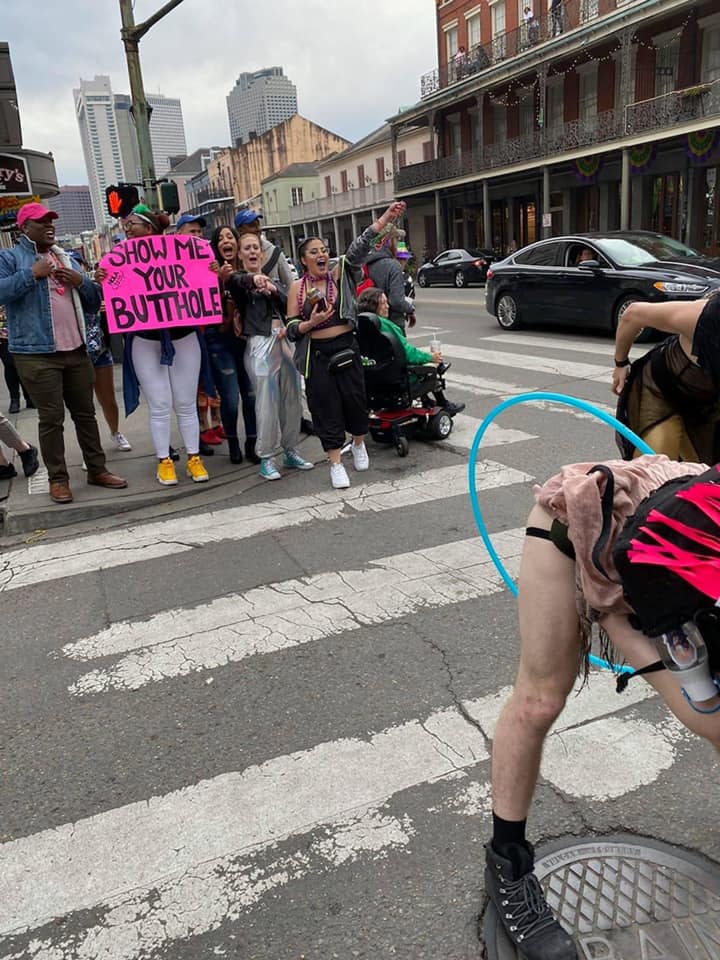
The photograph captures a street scene, likely during a protest or parade. A pedestrian crossing is prominent, with a person performing a hoop dance (or a similar acrobatic act) in the foreground, partially obscuring the view. The person is dressed in a revealing outfit with black boots and visible thigh-highs. A crowd of people stands on the sidewalk, some holding signs. The most prominent sign reads, "SHOW ME YOUR BUTTHOLE" in pink letters on a black background. The street scene is lined with buildings featuring cast-iron balconies characteristic of New Orleans architecture. A black car is parked along the street. The day appears overcast. The overall impression is vibrant, provocative, and potentially confrontational.
Queer Feminist Intersectional Analysis
This image is ripe for a Queer Feminist Intersectional analysis. The sign itself is deliberately shocking and disruptive. It challenges norms around sexuality, privacy, and the body. The demand "SHOW ME YOUR BUTTHOLE" is a direct rejection of societal taboos and a reclamation of the body, particularly of marginalized genders. This can be seen as an act of queer defiance.
The fact that this happens in a public space, likely a protest or parade, suggests an effort to make these previously silenced or private demands visible and to challenge the prevailing heteronormative and patriarchal structures.
The performer’s outfit, while revealing, is also an expression of agency and self-representation. It resists the male gaze and reclaims the right to define one's own body.
An intersectional approach acknowledges how this act connects to broader struggles related to gender, sexuality, class, race, and other forms of oppression. The location in New Orleans, with its rich cultural history and complex social dynamics, adds another layer to this analysis. New Orleans has historically been a site of cultural and sexual liberation, but also of economic inequality and racial injustice.
Foucauldian Genealogical Discourse Analysis
Using a Foucauldian framework, we can examine how the image challenges the discourse of power/knowledge surrounding the body, sexuality, and public display. Foucault argued that power is not simply repressive, but productive; it creates categories and discourses that define what is considered "normal" or "deviant."
The sign is a direct challenge to the normalizing discourses surrounding bodies and sexuality. It disrupts the idea of a "private" versus "public" body, and it rejects the idea that certain body parts are inherently shameful or obscene. The performer’s action can be seen as a subversion of the discourses surrounding appropriate behavior and public display.
By bringing these taboo subjects into the public sphere, the image aims to destabilize the existing power structures and create space for alternative ways of thinking about the body and sexuality. Foucault's concept of "counter-conducts" - ways of resisting and challenging dominant power structures - is clearly at play here.
Critical Theory
From a Critical Theory perspective, the image can be seen as a demonstration against the societal norms that govern bodily autonomy and sexuality. The protest likely questions the systems of control—cultural, political, and economic—that reinforce these norms. The disruptive nature of the image, particularly the sign, suggests an effort to expose and critique the underlying power dynamics that perpetuate oppression. This is also a challenge to the commodification of the body, as the performers are rejecting the standards set by societal and consumer ideals.
Marxist Conflict Theory
While less direct than the other analyses, a Marxist lens can still be applied. The challenge to social norms and public display of the body could be seen as a form of resistance against a system that benefits from maintaining social control and hierarchies. The image questions the capitalist structures that benefit from maintaining certain ideals and norms.
Postmodernism
The image fits within a Postmodern framework. The deliberate shocking nature of the sign and performance challenges traditional notions of decorum, taste, and meaning. It embodies a deconstruction of established norms and a rejection of grand narratives. The image embraces irony, ambiguity, and pastiche. The mixing of provocation and performance art are very indicative of postmodern aesthetics.
Important Note: These analyses are interpretations, and other perspectives could be equally valid. The photograph is open to multiple readings, depending on the theoretical framework used.
simple-description (llama3.2-vision)
The meme depicts a person in a provocative and humorous situation, likely at a public event or festival, with a focus on their rear end. The image includes the text "Show me your butt" and "Show me your butt hole" written on a sign, which is being held by the person in the center of the image. The overall tone is playful and irreverent, with a dash of silliness and a nod to the idea of being a bit cheeky.
tesseract-ocr
\. A (cae Lew ><al ma Sete Gull) bE Tn te... Oe ee ie dl AR /SHOM Meh e VR aC _ we res NOUR ee <h s a ————————— ! i LT a a “I 2 (a . A A ) : nl ae : Aas ‘ ah ee — STN AL ae | yh! ae 2 — FL a =—_— - aS = > ~ —— -—— i 3 1 a ir aN ®& — get ————— : , ie ae eee Sree ar —-&& s ae ME ct. a gt HN pelle © eS MR NS