First Seen
2023-05-10T21:03:39+00:00
simple-description (llama3.2-vision_11b)
This meme is from the "Queer" category, which refers to content that is LGBTQ+ related. The meme is a screenshot from a video where a young boy is upset that his parents won't let him play with a certain toy, but the caption "I can't play with the toy because I'm a boy" is replaced with "I can't play with the toy because I'm a boy, I'm a boy, I'm a boy".
detailed-analysis (gemma3-27b-vision)
Here's an analysis of the meme, broken down into sections as requested. Note that not every theoretical framework will apply in a robust way – I’ll indicate when a section is less strongly applicable.
Visual Description
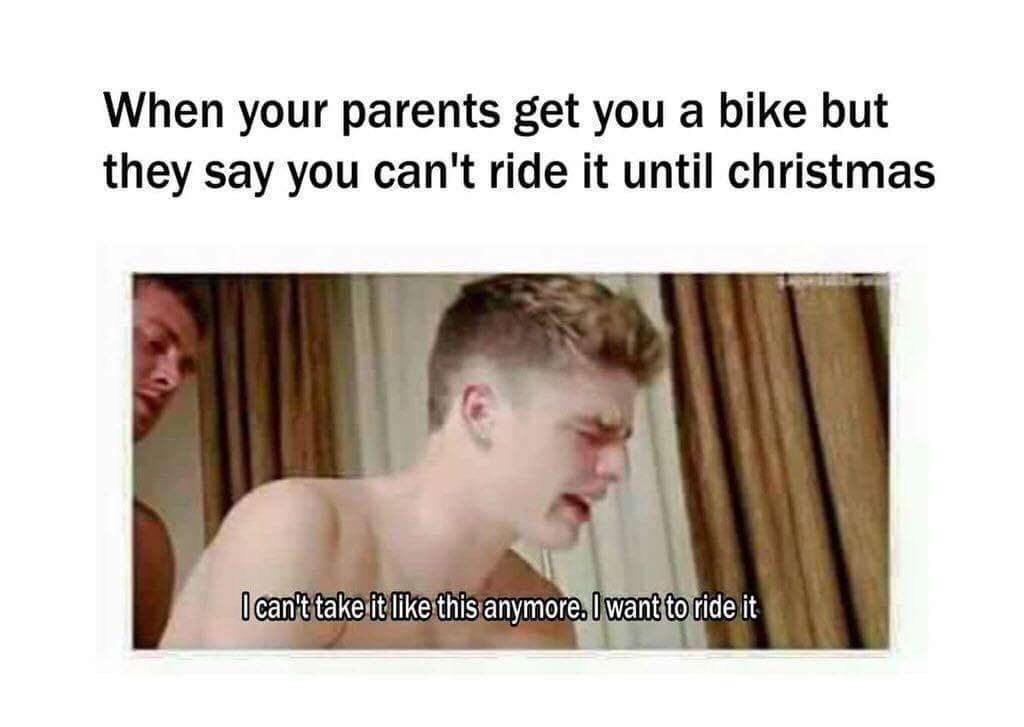
The image is a still from a film (likely a dramatic scene) featuring a young man with what appears to be make-up, simulating tears and possible bruising on his face. He is close up to the camera, and clearly distressed. The background consists of heavy, draped, gold-colored curtains. The image is captioned with the text "When your parents get you a bike but they say you can't ride it until Christmas" and then "I can't take it like this anymore. I want to ride it.” The jarring contrast between the visual distress and the mundane (and relatively minor) situation of a delayed bike ride is central to the meme’s humor. The distressed actor's facial expression appears heavily exaggerated.
Foucauldian Genealogical Discourse Analysis
This meme invites a Foucauldian reading in terms of power dynamics and the production of subjectivity. The "bike" functions as an object of desire, but its withholding by the "parents" (authority figures) creates a power imbalance. The delay until Christmas isn’t about the bike itself, but about the parents’ assertion of control.
- Discourse: The discourse surrounding gift-giving, anticipation, and parental authority shapes the experience of the “bike.” Parents often use gifts as a means of conditioning behavior ("you'll get this if you're good"). The meme subverts this by dramatizing the perceived injustice of a delayed gratification.
- Power/Knowledge: The parents wield power by controlling access to the desired object. This isn’t necessarily malicious; it’s a typical exercise of parental authority. However, the meme exaggerates the impact to critique that authority. The knowledge that "parents control gifts" is a social construct used to enforce obedience.
- Genealogy: A genealogical approach might trace how the practice of delaying gratification and using gifts as rewards/punishments developed culturally. The meme highlights the absurdity of applying such a tactic to a seemingly innocuous desire (riding a bike).
Critical Theory
The meme operates as a critique of consumer culture and the relationship between desire and control.
- Commodity Fetishism: While not a central element, the bike represents a commodity. The distress isn't about the function of the bike, but about the frustration of not having access to the symbol of enjoyment.
- Alienation: The young man’s exaggerated suffering points to a broader sense of alienation. He’s alienated from the simple pleasure of riding a bike, and from the agency to fulfill his own desires. This is amplified by the performative nature of the scene and the overreaction to a minor inconvenience.
- The Culture Industry: The meme leverages dramatic imagery to communicate a simple frustration. This points to the way the culture industry (film, media, etc.) over-dramatizes everyday experiences, influencing our perceptions of what constitutes a crisis.
Marxist Conflict Theory
The connection to Marxist theory is weaker, but present. The relationship between the child and the parents can be seen as a microcosm of class struggle.
- Power Imbalance: The parents (representing authority) control the means of production (the bike) and the child (representing the worker) is denied access to the fruits of that production.
- False Consciousness: The child's suffering is a response to an artificially constructed barrier (the waiting period). He has been conditioned to accept this delay, perpetuating the authority of the parents.
- Commodity Fetishism (again): The bike becomes a symbol of desire, and the struggle to obtain it overshadows the actual function of the object.
Postmodernism
The meme embodies several postmodern characteristics.
- Pastiche/Intertextuality: The meme appropriates imagery from a dramatic film (likely a melodrama) and applies it to a trivial situation, creating a jarring juxtaposition. It draws on existing cultural tropes to convey meaning.
- Hyperreality: The exaggeration of the emotions and the dramatic presentation of a mundane problem creates a hyperreal experience – an imitation that exceeds the reality.
- Deconstruction: The meme deconstructs the traditional authority of parents and the seriousness of delayed gratification. It reveals the arbitrary nature of these constructs.
- Irony/Parody: The meme relies heavily on irony and parody, subverting expectations and challenging conventional norms.
Queer Feminist Intersectional Analysis
This is the least applicable framework. While one could argue that the meme critiques traditional power structures (such as patriarchal family dynamics), the meme doesn't inherently engage with issues of gender, sexuality, or intersectionality. However, the heightened emotional expression, and particularly the exaggerated depiction of distress, could be read through a lens of challenging traditional expectations of masculinity, as dramatic emotional displays are often discouraged in boys. But this is a reach.
I hope this breakdown is helpful! Let me know if you’d like me to elaborate on any specific section.
simple-description (llama3.2-vision)
This meme is a humorous take on a child's frustration with their parents. The image shows a young boy looking upset, with a caption that reads: "When your parents get you a bike but say you can't ride it until Christmas." The text at the bottom of the image says: "I can ride it, I just choose not to."
tesseract-ocr
When your parents get you a bike but they say you can't ride it until christmas | “~ a _ 4s F| { a i t i icanit omceli TERROR ne