First Seen
2023-05-10T21:03:39+00:00
simple-description (llama3.2-vision_11b)
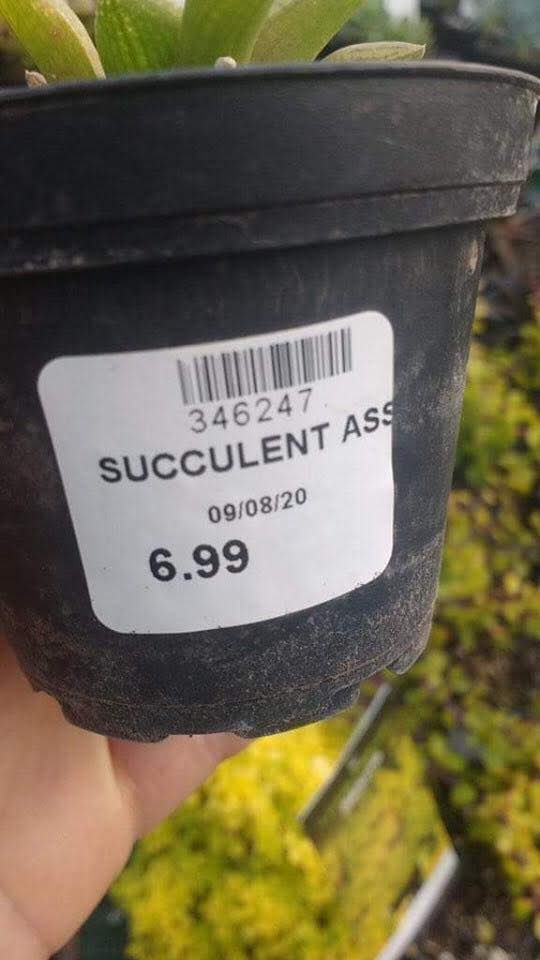
The meme is a screenshot of a grocery store price tag on a plant with the name "Queer" and a price of $6.99. The text "Queer" is written in a bold, playful font, implying that the plant's name is a humorous and ironic reference to the LGBTQ+ community. The price tag's use of a plant's name as a category label is a clever and humorous subversion of expectations.
detailed-analysis (gemma3-27b-vision)
Okay, here's an analysis of the image, broken down into the requested theoretical sections. It's worth noting that applying all these lenses can feel a bit overdetermined (layered interpretations onto a seemingly simple object), but the exercise demonstrates the versatility of these theoretical frameworks.
Visual Description
The image shows a small, black plastic pot containing a succulent plant. The succulent is pale green, with tightly packed leaves. A white label is adhered to the pot, displaying a barcode, the text "SUCCULENT ASS" in bold uppercase lettering, a date ("090820"), and a price of "6.99". The pot is surrounded by other plants, suggesting a garden center or nursery setting. The image has a slightly blurred quality, focusing primarily on the labelled pot.
Foucauldian Genealogical Discourse Analysis
This image is a powerful example of how language constructs and normalizes certain ideas, and how power operates through naming. The label “SUCCULENT ASS” is, on the surface, a humorous or playful branding attempt. However, through a Foucauldian lens, we can see it as an example of disciplinary power at work.
- Discourse & Classification: The naming of the plant, associating it with the human form, immediately categorizes it in a way that goes beyond botanical classification. The "ass" label isn't about the plant’s properties, but about projecting human meaning onto it.
- Power/Knowledge: The act of naming is an act of power. Whoever labeled the plant has the power to define its meaning and market it accordingly. This creates a regime of truth - the idea that this playful naming is acceptable or even desirable.
- Genealogy: By tracing the historical roots of the word “ass” and its association with sexuality, pleasure, and even derision, we can see how the label taps into pre-existing power dynamics and cultural understandings. It draws on a long history of linking bodies (specifically, often female bodies) to nature and the "primitive".
The label isn’t just a joke, but an instance of how power constructs meaning and reinforces societal norms around bodies and nature.
Critical Theory
Drawing on the Frankfurt School, we can see this image as reflecting broader societal tendencies towards commodification and instrumental reason.
- Commodification: The succulent is not simply a plant; it’s a commodity with a price tag. The label, even in its playful vulgarity, is designed to enhance its market value. The plant's inherent qualities are secondary to its ability to generate profit.
- Instrumental Reason: The label can be seen as an example of reducing the plant to a means to an end – selling a product. Its intrinsic value as a living organism is ignored in favor of its exchange value.
- Culture Industry: The playful label is a tactic employed by the “culture industry” to create attention and reinforce consumer culture. It's a superficial and manufactured appeal that distracts from deeper concerns about nature, sustainability, or even the plant's well-being.
- Alienation: This commodification and focus on exchange value contribute to alienation. We become disconnected from the intrinsic value of the natural world, reducing it to mere objects for our consumption.
Marxist Conflict Theory
From a Marxist perspective, the image demonstrates the exploitation of nature for capitalist gain.
- Means of Production: The succulent itself represents a natural resource – a "means of production" – being turned into a commodity.
- Class Struggle: While not directly showing class struggle, the image can be seen as part of a broader system of exploitation. The labeling and marketing of the plant are aimed at maximizing profit for the owners of the nursery, while the plant itself is a passive object being used for their benefit.
- Commodity Fetishism: The playful label contributes to commodity fetishism – the obscuring of the labor and natural resources involved in producing the commodity. We focus on the playful label and the price, rather than the environmental impact of growing and transporting the plant.
- Surplus Value: The $6.99 price represents the surplus value extracted from the natural resource (the plant) and the labor involved in its cultivation and sale.
Postmodernism
This image embodies several key concepts of postmodernism.
- Simulacra & Simulation: The label creates a simulacrum – a copy without an original. The plant isn't inherently "an ass"; the label constructs this meaning, creating a reality that is detached from any objective truth. It’s a self-referential sign, drawing attention to its own artificiality.
- Intertextuality: The label plays on cultural connotations of the word "ass" and invites viewers to make associations with sexuality, humor, and popular culture. It isn't a standalone meaning, but relies on a network of existing texts and meanings.
- Playfulness & Irony: The label is deliberately playful and ironic. It challenges conventional expectations of plant labeling and subverts the seriousness often associated with botanical descriptions.
- Deconstruction: The label undermines the traditional authority of botanical classification. By associating the plant with a body part, it disrupts the "natural" order and reveals the constructed nature of all categorization systems.
Queer Feminist Intersectional Analysis
This image offers fertile ground for queer feminist intersectional analysis, particularly concerning objectification, body politics, and the gendering of nature.
- Objectification & the Female Body: The label, associating the plant with "ass," directly evokes the hypersexualization and objectification of the female body. It maps a body part onto a natural object, reinforcing the idea that bodies are objects to be viewed and consumed.
- Gendering of Nature: Historically, nature has often been feminized and associated with sexuality. This label reinforces that connection, potentially perpetuating harmful stereotypes about women and their relationship to the natural world.
- Intersectional Perspective: The impact of this labeling is likely to be experienced differently based on various social identities. For example, a Black woman might experience this labeling differently than a white man, due to the historical and ongoing hypersexualization of Black women's bodies.
- Power Dynamics: The label reflects a power dynamic where the act of naming and categorizing is dominated by a specific perspective (likely male, heterosexual, and dominant) and imposed onto both the plant and potentially onto those who view it.
- Subversion & Reappropriation: While potentially problematic, the label could also be interpreted as a playful subversion of norms, reclaiming and reappropriating language previously used to control and oppress. However, this is dependent on the intent and reception of the labeling.
Hopefully, this provides a detailed and layered analysis of the image using the requested theoretical frameworks! Let me know if you'd like me to expand on any particular aspect.
simple-description (llama3.2-vision)
This meme is a humorous image of a plant pot with a price tag that reads "0.00" but has a handwritten note that says "$6.99". The text "In 2-3 sentences, describe this meme for someone who cannot see it." appears above the image, which is a play on the typical format of describing an image for someone who cannot see it.
tesseract-ocr
ee ae Fi ee my un r succuLeNT i 99/08/2° 6.99 oe f Ny V4