First Seen
2023-05-10T21:03:39+00:00
simple-description (llama3.2-vision_11b)
The meme is a humorous take on the idea of a "morning routine" and the struggle of being queer in a heteronormative society. The image shows a person applying lipstick, but the text "I put on my makeup" is crossed out and replaced with "I put on my identity". The meme pokes fun at the idea that being queer is a form of "identity" that one must "put on" in order to be accepted.
detailed-analysis (gemma3-27b-vision)
Okay, here's an analysis of the image provided, broken down into the requested sections. It's important to remember that these are interpretations, and the depth to which each lens fully applies is open to debate. I’ll indicate when a section is particularly thin or speculative.
Visual Description
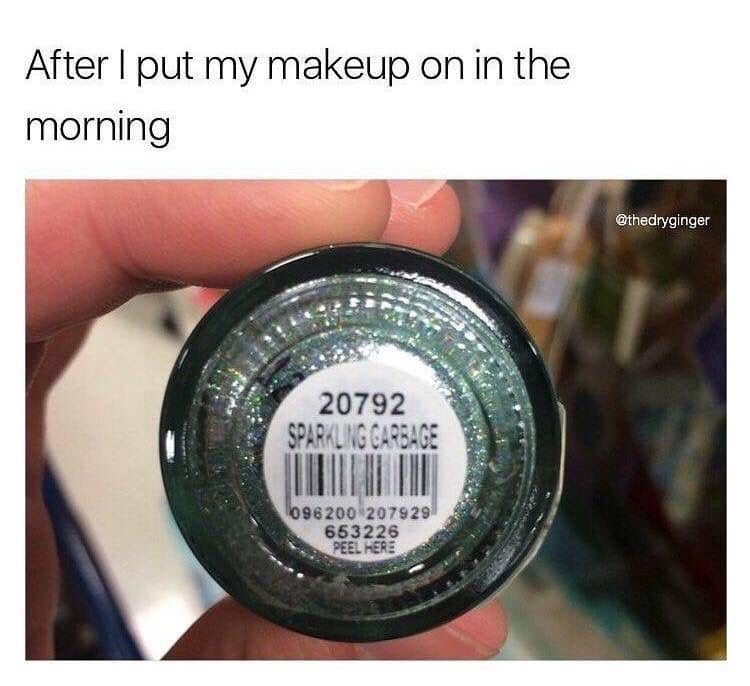
The image shows the underside of a cosmetic container, likely for glittery eyeshadow or similar makeup. The container is round and dark green/black. What's immediately striking is the label affixed to the underside. Instead of the product name, the label reads, in large letters: “SPARKLING GARBAGE”. Below this is a barcode and a small message “PEEL HERE”. The context given by the caption, "After I put my makeup on in the morning," suggests a satirical or ironic contrast between the intention of makeup application (to enhance or transform) and the self-perceived result. The image is slightly blurry and the focus is on the label. The lighting is somewhat dim.
Foucauldian Genealogical Discourse Analysis
A Foucauldian reading focuses on how power operates through discourses that produce knowledge and shape our understanding of reality. In this image, the discourse of beauty and self-presentation is being actively disrupted.
- Discourse of Beauty: Historically, the discourse of beauty has been constructed (not natural!) through practices like makeup, often linked to ideas of femininity, social acceptability, and even economic value. Makeup is framed as a way to mask or correct perceived flaws.
- Power/Knowledge: The label "SPARKLING GARBAGE" functions as a counter-discourse. It undermines the established discourse by suggesting that the effort to "beautify" oneself ultimately results in something valueless or even negative. It questions the very production of truth within the beauty industry – the industry claims makeup enhances, but the label implies it produces, at best, frivolous ornamentation.
- Genealogy: Tracing the genealogy of this “sparkling garbage” discourse would involve looking at how concepts of self-fashioning and artifice have been historically viewed. Traditionally, artifice (like makeup) was often associated with deception or moral failing. This label may be a modern reflection of that historical anxiety, re-articulated in a cynical, humorous form.
- Power Relations: The label represents a playful but potent subversion of the power dynamics inherent in the beauty industry. It isn't about rejecting makeup altogether, but rather questioning the meanings and values assigned to it.
Critical Theory (Frankfurt School)
Critical Theory examines the role of culture in maintaining social control and promoting ideology.
- Culture Industry: The beauty industry functions as part of the "culture industry", producing standardized products (including beauty standards) that encourage conformity and passive consumption.
- Commodification of the Self: The image highlights how the self becomes commodified. Individuals are encouraged to view themselves as projects to be perfected through consumption, and makeup is one key tool in that process.
- Alienation: The label “sparkling garbage” suggests a sense of alienation – a disconnect between the effort put into applying makeup and the perceived outcome. It hints at the inauthenticity of the beauty standard, and the way it can lead to self-disgust.
- Critique of Enlightenment Reason: The cynicism embedded in the label can be read as a post-Enlightenment critique. The expectation that reason and self-improvement will lead to happiness is challenged. Instead, the image suggests that even in the pursuit of beauty, one may end up feeling like “garbage”.
Marxist Conflict Theory
A Marxist analysis would center on class conflict and the ways in which ideology supports capitalist structures.
- Consumer Culture: The beauty industry thrives on consumer culture, creating needs and desires that drive profit. The image, while satirical, still engages with this system. The individual bought the makeup, perpetuating the cycle of consumption.
- False Consciousness: The label can be seen as a momentary rupture in “false consciousness” – a brief realization that the promises of the beauty industry are illusory. The individual recognizes that the product doesn't deliver on its promise of transformation.
- Commodification of Women's Bodies: In a patriarchal capitalist system, women’s bodies are often commodified, and beauty standards contribute to this process. The beauty industry profits from insecurities, selling products that promise to fix perceived flaws.
- Class & Beauty: Access to beauty products is often tied to socioeconomic status. The image doesn't directly address this, but it acknowledges the inherent issues with the superficiality of the beauty industry, and the fact that the market preys on insecurities.
Postmodernism
A postmodern reading would emphasize the deconstruction of grand narratives, the fluidity of identity, and the embrace of irony and pastiche.
- Rejection of Authenticity: Postmodernism questions the very concept of authenticity. The label "SPARKLING GARBAGE" satirizes the pursuit of a "true" or "natural" self. It suggests that all appearances are constructed, and that even the effort to create a polished image is ultimately meaningless.
- Irony & Self-Reflexivity: The image is deeply ironic. The caption and label work together to create a self-reflexive statement about the absurdity of the beauty ritual.
- Deconstruction of Meaning: The label challenges the conventional meanings associated with beauty products. It disrupts the expected narrative of transformation and empowerment.
- Playfulness with Signifiers: The term "sparkling garbage" is a deliberate juxtaposition of contrasting signifiers. It creates a new meaning that is both humorous and unsettling.
Queer Feminist Intersectional Analysis
This lens looks at how power operates at the intersections of gender, sexuality, race, class, and other social categories.
- Beauty Standards & Gender: Traditional beauty standards are often deeply gendered and contribute to the oppression of women. They reinforce the idea that women must conform to certain expectations in order to be considered valuable.
- Commodification of Women’s Bodies & Sexuality: The beauty industry profits from the sexualization and commodification of women's bodies.
- Intersectional Critique: The image doesn't explicitly address issues of race, class, or sexuality. However, it offers a critique of the overall power structures that shape beauty standards and contribute to the oppression of marginalized groups.
- Subversion of Feminine Norms: The label "sparkling garbage" can be seen as a subversive gesture that challenges traditional notions of femininity. It suggests that the effort to conform to these norms is ultimately futile and even degrading.
Important Notes:
- Context is Key: The interpretation of this image depends heavily on the context in which it's encountered. (e.g., a meme on social media will be received differently than a piece of art).
- Multiple Interpretations: Many of these lenses overlap, and the image can be interpreted in multiple ways.
- Speculation: Some of these analyses involve a degree of speculation, as the image itself doesn’t offer explicit clues about the creator’s intentions.
I hope this detailed breakdown is helpful! Let me know if you’d like me to elaborate on any particular section.
simple-description (llama3.2-vision)
This meme features a photo of a bottle of nail polish with a humorous label. The text on the label reads "In 2-3 sentences, describe this meme for someone who cannot see it." The image is a play on the common request to describe a visual for someone who cannot see it, and the label's text is a clever and humorous twist on the usual request.
tesseract-ocr
After | put my makeup on in the morning gel worn Gea a Pi My es Se 4 ‘ ay 20792 She Fey Seco Ae ie ‘ 96200207829 4 :