First Seen
2023-05-10T21:03:39+00:00
simple-description (llama3.2-vision_11b)
The meme is a play on the iconic TV show "Friends" and its theme song, "I'll Be There for You" by The Rembrandts. The meme takes a quote from the show, "How you doin'?" and reworks it to say "How you doin'?" with a queer twist, "How you... doin'?" replacing "How you doin'?" with "How you doin'?" and adding "queerly" at the end.
detailed-analysis (gemma3-27b-vision)
Okay, here's an analysis of the image/meme based on the requested theoretical frameworks. I'll only include the sections that genuinely apply, and will note why some aren't relevant.
Visual Description
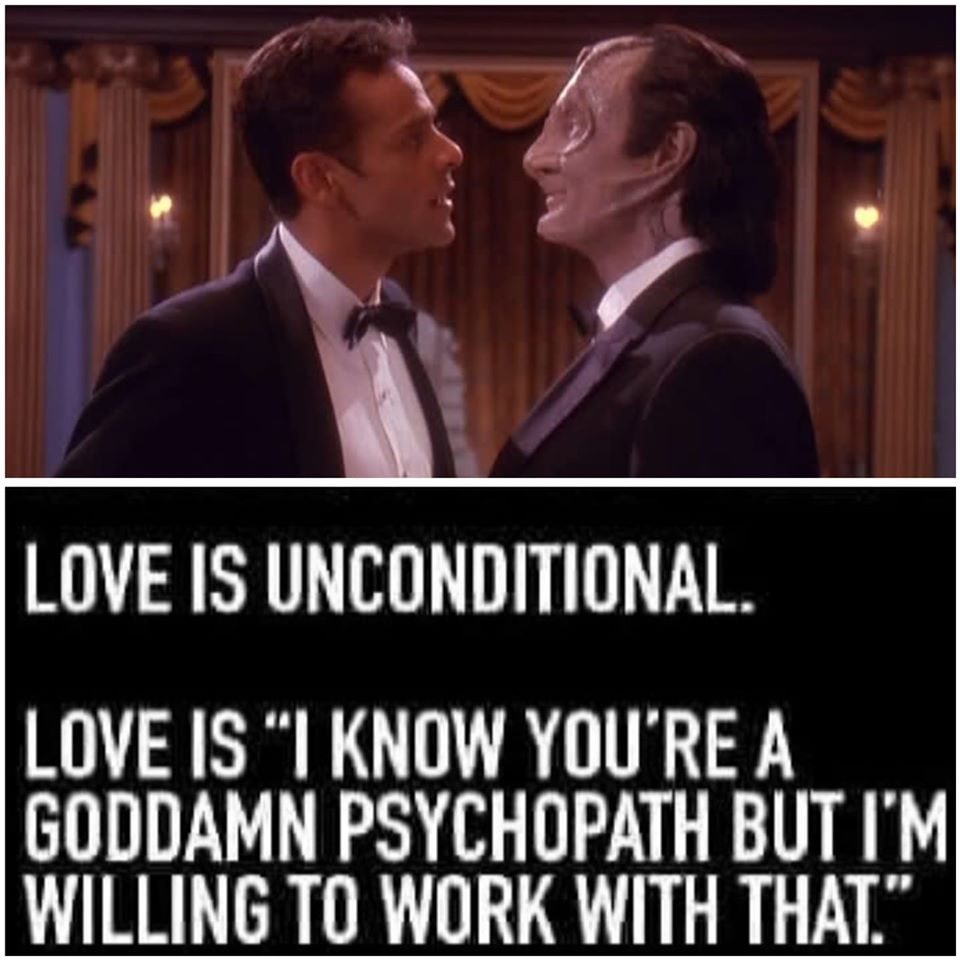
The image depicts two men in formal wear – tuxedos – facing each other intimately. They are very close, noses almost touching, and appear to be engaged in a moment of intense connection. The background suggests a dimly lit, upscale venue (possibly a bar or club), indicated by the red drapes and dark tones. The overall aesthetic evokes a sense of intimacy and dramatic tension. The image is overlaid with text: the first line reads "LOVE IS UNCONDITIONAL." The second is a quote that completely subverts that initial statement: "I KNOW YOU'RE A GODDAMN PSYCHOPATH BUT I'M WILLING TO WORK WITH THAT." The juxtaposition of the visual and textual content is key.
Foucauldian Genealogical Discourse Analysis
This image offers fertile ground for a Foucauldian analysis, focusing on the discourse of love. The initial assertion, "Love is unconditional," can be seen as a central tenet of a power/knowledge regime surrounding romantic relationships. This regime often relies on the idea that love should overcome all flaws and that acceptance is a virtue.
However, the second statement radically challenges this discourse. It exposes the conditions under which love is actually "allowed" or practiced. It reveals how the romantic ideal is often constructed to mask, tolerate or normalize problematic behavior (“psychopathy”).
A genealogical approach would trace how the concept of "unconditional love" has evolved and been deployed throughout history. It would explore how this concept is used to discipline individuals, create expectations, and ultimately, maintain power within relationships. The meme deconstructs this ideal, showing how it clashes with the messy reality of human connection. The acceptance of the “psychopath” can be seen as an act of negotiation, demonstrating the power dynamics within the relationship - the one doing the "work" to make it work.
Critical Theory
This image speaks directly to the core concerns of Critical Theory. It exposes the ideological construction of love and how it functions to maintain social norms. The initial statement – “Love is unconditional” - is a dominant ideology, presented as a universal truth.
The meme critiques this ideology by highlighting the often-unspoken conditions that must be met for love to be accepted or tolerated. By juxtaposing this ideal with the harsh reality of accepting a “psychopath” the meme reveals the contradictions inherent in dominant narratives about love.
The image could also be interpreted as a commentary on the ways in which we normalize harmful behaviors in relationships due to societal pressures or individual desires. The "willingness to work with that" implies a degree of acceptance that might be seen as enabling or even complicit in abusive dynamics. It questions the “romantic ideal” and suggests that a power imbalance could exist.
Queer Feminist Intersectional Analysis
The image and text lend themselves to a Queer Feminist analysis, even if the subjects are male. It challenges the heteronormative ideal of unconditional love as an expectation within romantic relationships. The acknowledgement of the "psychopathy" could be a metaphor for an individual's trauma, mental health struggles, or harmful behaviors that are often swept under the rug for the sake of maintaining the relationship.
Within a Queer Feminist framework, the meme can be seen as subverting the expectation that love must be unconditional, acknowledging the validity of boundaries and self-preservation. It asks: What are the conditions under which we accept harm? How do we navigate power imbalances within relationships?
The meme also challenges the romanticization of problematic behaviors. This is particularly relevant in light of the prevalence of abusive relationships and the pressure to stay in them despite red flags.
Why Other Frameworks Aren’t Applicable
- Marxist Conflict Theory: While there's a power dynamic at play, the image doesn't explicitly relate to economic structures or class struggle. It's primarily focused on interpersonal relationships.
- Postmodernism: While the meme deconstructs a grand narrative ("unconditional love"), this deconstruction isn't the primary focus. It's more about the critique of that narrative rather than exploring the fragmentation and relativism central to postmodern thought.
In conclusion, this image/meme is a powerful commentary on the complexities of love, challenging dominant ideologies, exposing power dynamics, and highlighting the often-unspoken conditions that shape our relationships. It’s ripe for analysis through critical, Foucauldian, and queer feminist lenses.
simple-description (llama3.2-vision)
This meme is a play on the famous song "I Will Always Love You" by Whitney Houston, but with a humorous twist. The image shows a screenshot of the song's lyrics, but with the words "I will always love you" replaced with "I will always hate you". The meme is a joke about a toxic relationship, implying that the speaker's love is actually a form of hate.
tesseract-ocr
“ \ eI _ Ww. y AV, we ra OR 4 LOVE IS UNCONDITIONAL. Me A ey Cee Be Ue WILLING TO WORK WITH THAT.”