First Seen
2023-05-10T21:03:39+00:00
simple-description (llama3.2-vision_11b)
This meme is a playful take on the classic "I love you" phrase, but with a queer twist. The image shows a humorous rewording of the phrase, replacing "love" with "lust", implying a more intimate and passionate connection between two people. The text reads: "I lust you, but only as much as I lust after my own ego. Don't @ me."
detailed-analysis (gemma3-27b-vision)
Okay, let's break down this billboard image through various theoretical lenses.
Visual Description
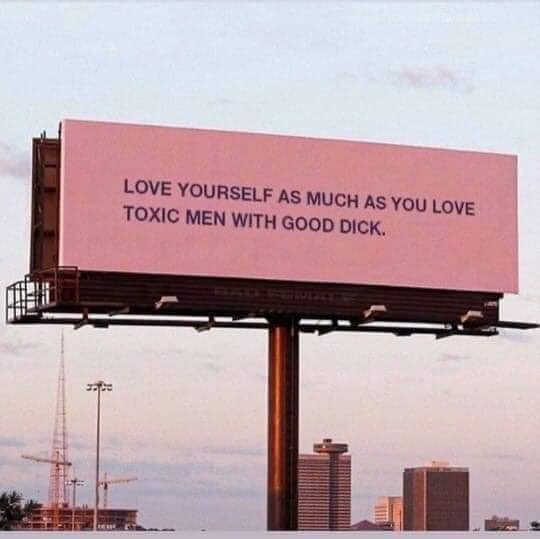
The image showcases a billboard against a pastel, somewhat hazy twilight sky. The billboard is painted a soft, muted pink. Large, black sans-serif lettering boldly states: "LOVE YOURSELF AS MUCH AS YOU LOVE TOXIC MEN WITH GOOD DICK." The billboard is supported by a substantial dark metal structure. In the background, a cityscape is visible, with some industrial/construction elements (cranes, building silhouettes) partially visible. The overall aesthetic is clean and minimalist, but the text immediately grabs attention due to its jarring and provocative content. The pink background somewhat softens the directness of the message, but doesn't diminish its punch.
Queer Feminist Intersectional Analysis
This billboard is incredibly rich for a queer feminist intersectional analysis. Several layers are at play:
- Deconstructing the "Good Dick" Trope: The statement directly confronts the societal prioritization of male sexual performance (represented by "good dick") as something women are often conditioned to desire, tolerate, or even need for validation. It actively links this desire to a harmful archetype – the "toxic man."
- Challenging Internalized Misogyny: The message asks women to value themselves equally to a source of (often fleeting) pleasure or validation. This implicates the way society conditions women to seek external validation, particularly through relationships. The implied question is: "Why do we often prioritize the pleasure/attention of harmful men over our own well-being?"
- Recognizing the Complexity of Desire: It acknowledges that desire is often messy and contradictory. Someone can still be attracted to a "toxic" person while simultaneously understanding the harm they pose. It doesn't condemn the desire itself, but pushes for a reevaluation of its value in relation to self-worth.
- Intersectionality: The billboard's power lies in its potential to resonate across multiple identities. It's not just about gender; it also touches on power dynamics, emotional labor, and the ways marginalized groups are often conditioned to accept less than they deserve. A Black woman, a trans woman, or a disabled woman may experience the pressures to tolerate harmful behavior in unique and compounded ways.
- The Power of Direct Language: The blunt, almost abrasive language ("toxic men," "good dick") is intentional. It rejects the politeness and euphemisms often used to discuss these issues.
Foucauldian Genealogical Discourse Analysis
Applying a Foucauldian lens reveals the power dynamics embedded within the billboard's message.
- Discursive Formation: The statement actively disrupts a dominant discourse – the one that normalizes or even romanticizes harmful behaviors in men (often framed as "alpha" traits, "boys will be boys," etc.). It deconstructs the idea that a man's sexual appeal excuses or mitigates his toxicity.
- Power/Knowledge: The billboard demonstrates how power operates through the creation and dissemination of knowledge. Historically, the discourse surrounding relationships has been largely shaped by patriarchal norms. This billboard aims to challenge that historical knowledge by presenting an alternative understanding of self-worth.
- Genealogy of "Toxic Masculinity": The term "toxic man" itself is relatively recent. Tracing its genealogy would reveal how the concept of harmful masculinity emerged as a critique of traditional gender roles and power structures. The billboard leverages this newer understanding to challenge ingrained assumptions.
- Subjectification: The billboard invites a shift in how individuals subjectify themselves—that is, how they understand their own value and agency. It implicitly suggests that self-worth shouldn't be contingent upon the approval or attention of others, particularly those who are harmful.
- Disruption of Norms: The billboard is deliberately shocking because it disrupts conventional norms about what can be openly discussed and challenged in public space.
Postmodernism
From a postmodern perspective, this billboard exemplifies several key characteristics:
- Deconstruction: The billboard deconstructs the traditional hierarchies that place male sexual performance (and the men who possess it) at the center of female desire. It flattens those hierarchies, arguing for the equal value of self-love.
- Fragmentation: The message is deliberately fragmented and provocative. It doesn't offer a neat or comfortable solution, but rather forces viewers to grapple with uncomfortable contradictions.
- Playfulness with Language: The bluntness of the language ("good dick") is a form of playfulness that challenges conventional standards of politeness and decorum.
- Rejection of Grand Narratives: The billboard doesn't propose a universal truth or overarching ideology. It's a localized, fragmented intervention that encourages individual reflection and resistance.
- Irony and Meta-Commentary: There's an element of irony. The billboard is about the insidious ways we've been conditioned to value toxic behavior in men, and it uses that very conditioning (desire) to draw attention to the problem.
Critical Theory
A Critical Theory analysis highlights how the billboard exposes and challenges social inequalities and power structures.
- Ideology Critique: The billboard critiques the dominant ideology that often glorifies or excuses harmful male behavior. It exposes how this ideology serves to maintain patriarchal power structures.
- Alienation: The billboard suggests that women may be alienated from their own needs and desires due to societal conditioning. They may prioritize the pleasure of others over their own well-being, leading to feelings of emptiness and dissatisfaction.
- Emancipation: The billboard implicitly calls for emancipation—liberation from these harmful ideologies and the empowerment of individuals to value themselves independently.
- Commodification of Sexuality: While not directly about commodification, it touches on how societal expectations around sexuality (particularly female sexuality) are often tied to power dynamics and control.
- Raising Consciousness: The billboard functions as a form of "consciousness-raising." It’s designed to disrupt habitual ways of thinking and encourage viewers to question the norms that govern their relationships and self-perception.
Marxist Conflict Theory
While not immediately obvious, some elements of Marxist Conflict Theory can be applied.
- Power Dynamics and Exploitation: Patriarchal structures can be seen as a system of power where women's emotional labor and desire are exploited to maintain male dominance. The billboard highlights this dynamic by exposing the ways women may prioritize harmful men over their own well-being.
- False Consciousness: The billboard suggests that women may be operating under a "false consciousness"—a state of being unaware of their own oppression and exploitation. The message aims to disrupt this false consciousness and encourage women to recognize their own worth.
- Social Reproduction: The billboard implicitly critiques the ways patriarchal norms are reproduced across generations. It suggests that challenging these norms is essential for creating a more equitable society.
I hope this detailed breakdown is helpful. The billboard is a powerful and provocative piece of art that invites a lot of nuanced analysis! Let me know if you'd like me to elaborate on any of these points.
simple-description (llama3.2-vision)
This meme is an image of a billboard with a humorous message. The text reads: "Love yourself as you love toxic men." It's a darkly comedic take on the common phrase "love yourself as you love your [partner/child/family member]," but with a twist that pokes fun at the idea of toxic relationships.
tesseract-ocr
LOVE YOURSELF AS MUCH AS YOU Love TOXIC MEN WITH GOOD Dick, ae - ee ee “He | ; B a, iT = Bi | _ ies