First Seen
2023-05-10T21:03:39+00:00
simple-description (llama3.2-vision_11b)
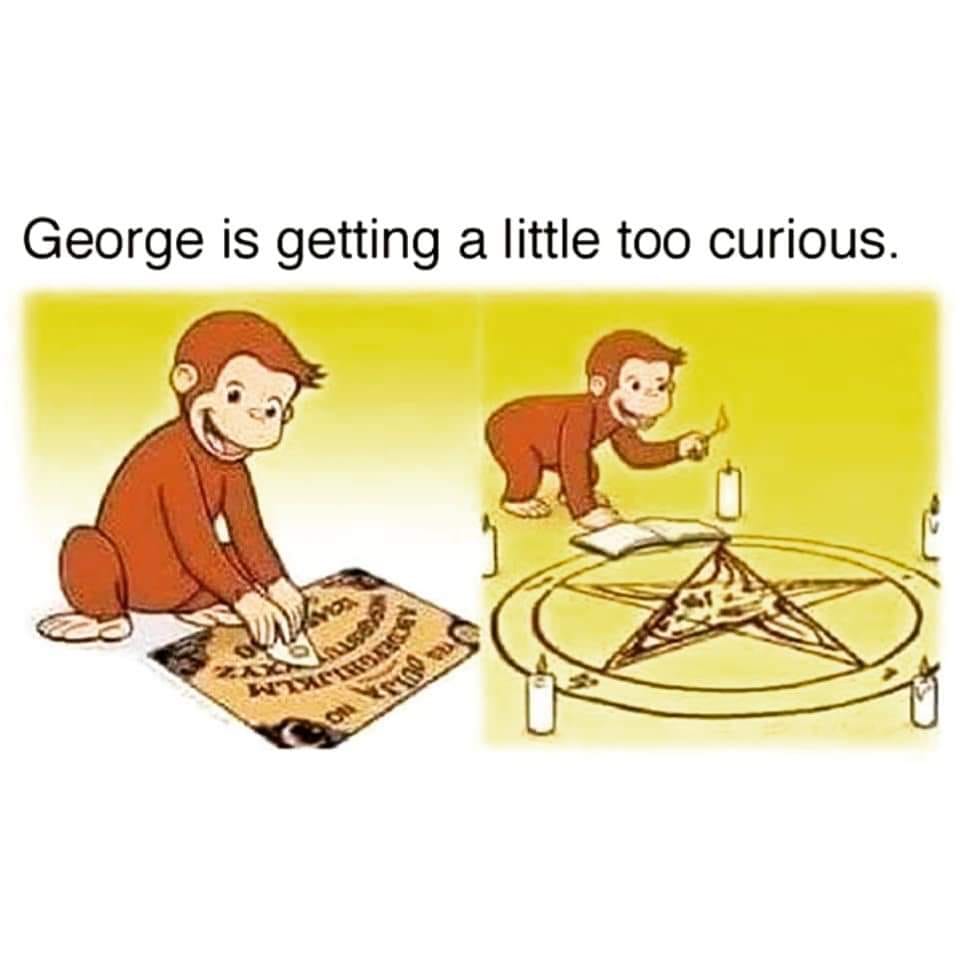
The meme is a playful take on the classic children's book character Curious George, who is now exploring the world of queer culture. The image shows Curious George sitting at a Ouija board, with the text "I'm curious about queer stuff" above it. The meme is poking fun at the idea that someone who is curious about queer culture is somehow "different" or "weird", implying that being curious about something is a bad thing.
detailed-analysis (gemma3-27b-vision)
Okay, let's break down this meme featuring Curious George in a decidedly un-Curious-George-like situation, through the lenses you've requested. It's a surprisingly rich image for analysis!
Visual Description
The meme is a two-panel image. The first panel shows Curious George, the iconic monkey, seated on a rug with what appears to be indecipherable text. He looks inquisitive, as usual, with a slightly puzzled expression. The second panel shows George standing within a large, drawn pentagram on a yellow floor. He's holding what seems to be a small lighter and attempting to ignite candles placed around the pentagram’s points. The background is simple, suggesting an interior space. The text above the panels reads, “George is getting a little too curious.”
Foucauldian Genealogical Discourse Analysis
This meme offers a compelling entry point for a Foucauldian analysis. Consider how ‘curiosity’ itself is a discourse – a way of talking about knowledge, learning, and the boundaries of acceptable exploration. The meme disrupts this discourse. Traditionally, George’s curiosity is celebrated as positive and leading to harmless (if sometimes messy) adventures. Here, it’s positioned as transgressive, potentially dangerous, and associated with occult practices.
A genealogical analysis would look at the historical development of the association of curiosity with "dark arts." We can trace how the pursuit of knowledge outside of established power structures (church, state, etc.) has often been framed as subversive or even demonic. The pentagram, as a symbol of witchcraft, is central to this. The meme historicizes George's curiosity – it’s no longer simply innocent exploration but a connection to a long history of marginalized knowledge systems.
The meme implies a power dynamic – those in power (historically, often religious institutions) have defined what is “acceptable” curiosity and labeled anything outside those boundaries as dangerous or evil. George, embodying innocent curiosity, now appears as a potential threat to that established order.
Critical Theory
From a Critical Theory perspective (particularly drawing on Frankfurt School thought), the meme can be viewed as a critique of Enlightenment rationality. The Enlightenment championed reason and the pursuit of knowledge as liberating forces. However, Critical Theory argues that this rationality has been used to justify domination and control.
George, historically a symbol of innocent exploration, is now engaging in a ritualistic practice often associated with the irrational, the mystical, and the pre-Enlightenment. This subversion can be seen as a critique of the limitations of purely rational thought and a suggestion that there are other ways of knowing and experiencing the world. It questions the very categories of “rational” and “irrational,” suggesting that they are socially constructed. The meme suggests that even “innocent” curiosity can lead to places that challenge established power structures.
Marxist Conflict Theory
While more indirect, a Marxist reading can be applied. The pentagram, historically used by groups outside the mainstream (and often those resisting established authority), can be seen as a symbol of class struggle or resistance. George, in attempting to perform the ritual, is symbolically aligning himself with those who challenge the status quo.
The knowledge associated with the occult or alternative belief systems is often marginalized and suppressed by dominant ideologies (which serve the interests of the ruling class). George's curiosity, in this context, is a form of seeking counter-knowledge that potentially threatens the established order. It's a symbolic act of questioning the dominant narrative.
Postmodernism
The meme’s playful subversion of the familiar Curious George narrative is fundamentally Postmodern. It deconstructs the established meaning of George’s character. We are used to associating him with innocence and benign exploration. The meme purposefully juxtaposes that expectation with the darkly ironic image of him performing a satanic ritual.
It highlights the instability of meaning. There is no single, fixed interpretation of "curiosity." It's open to multiple readings, depending on the cultural context and individual perspective. The meme revels in the irony and ambiguity, challenging the notion of a singular, coherent narrative. It is, in essence, a playful parody that exposes the constructed nature of meaning.
Queer Feminist Intersectional Analysis
This is the most challenging lens to apply, but potentially rich. Historically, practices associated with witchcraft and the occult have been linked to marginalized genders and sexualities. Women, in particular, were often accused of witchcraft, and the occult provided a space for alternative forms of knowledge and empowerment.
The meme can be read as a reclamation of that history. George, a non-human primate, occupies a liminal space, disrupting traditional gender and species categories. His “curiosity” can be seen as a form of queer exploration – a questioning of boundaries and a challenging of norms. The use of a beloved children’s character to subvert this imagery further emphasizes the disruption of power dynamics. It suggests that even seemingly harmless characters can embody subversive potential.
I've tried to cover all the requested angles. Let me know if you'd like me to expand on any particular area!
simple-description (llama3.2-vision)
The meme features a cartoon character named Curious George, who is known for his curiosity and love of exploration. In this image, George is depicted sitting at a Ouija board, which is a device used to communicate with spirits. The text that appears in the image reads, "George is getting a little too curious."
tesseract-ocr
George is getting a little too curious. SS t oy — foe Sp CES) ce