First Seen
2023-05-10T21:03:39+00:00
simple-description (llama3.2-vision_11b)
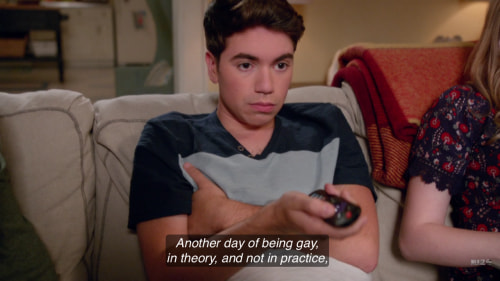
The meme is a screenshot from a TV show where a character is reading a book with a title that says "The Gay Agenda". The character is shocked and confused, with a caption that says "I'm reading the gay agenda and it's just... being gay". This meme is a humorous take on the stereotype that LGBTQ+ individuals are somehow plotting to take over the world with their "gay agenda", and is a lighthearted way to poke fun at this outdated and inaccurate notion.
detailed-analysis (gemma3-27b-vision)
Okay, here's an analysis of the image, broken down into sections using the frameworks you've requested. I'll only include sections where the frameworks genuinely apply, given the content of the image and caption.
Visual Description
The image depicts a young man seated on a light beige sofa, looking somewhat morose. He’s holding a remote control and is crossed-armed, suggesting defensiveness or sadness. He has dark hair and appears to be of a relatively young age. The lighting is warm, giving a domestic feel, and there is a portion of another person visible to the right, seated on the sofa with a floral patterned shirt. The background is a typical living room setting, with a wall-mounted television and subtle decor. The image is digitally captured and appears to be a screenshot from a television program (given the digital overlay with the quote). The quote says, “Another day of being gay, in theory, and not in practice.”
Queer Feminist Intersectional Analysis
This is where the strongest analytical lens applies. The caption – "Another day of being gay, in theory, and not in practice" – is powerful. It speaks to the complexities of queer identity and the disconnect between self-identification and lived experience.
-
Internalized Homophobia/Heteronormativity: The phrase reveals a tension between the individual’s internal sense of self ("being gay") and the external barriers preventing expression or experience. It suggests that societal pressures – internalized homophobia, heteronormative expectations – are inhibiting his ability to live as his authentic self. The "theory" versus "practice" dynamic suggests that he might intellectually understand and accept his sexuality, but is struggling to navigate the world as an openly gay man.
-
Intersectionality: The statement implicitly speaks to intersectionality. The difficulty in "practicing" being gay isn’t just about sexuality; it is likely intertwined with other aspects of his identity (race, class, age, etc.). These other identities could compound the challenges. For example, a queer person of color might face a different set of obstacles than a white queer person.
-
Performance of Identity: The caption implicitly acknowledges the ‘performance’ inherent in identity formation. There's a pressure to conform or to hide aspects of oneself, and a disconnect between the internal sense of self and the external presentation.
-
Feminist Framework: A feminist lens highlights how societal expectations and power structures historically marginalize LGBTQ+ individuals. The struggle to "practice" being gay can be seen as a consequence of patriarchal systems that prioritize heteronormativity and suppress non-normative expressions of gender and sexuality.
Foucauldian Genealogical Discourse Analysis
While less central than the Queer Feminist Intersectional analysis, a Foucauldian lens can illuminate the dynamics at play.
-
Discursive Formation of Sexuality: Michel Foucault argued that sexuality isn’t a natural, pre-existing force, but is constructed through discourse – the ways we talk about, categorize, and regulate sex and desire. The statement “Another day of being gay, in theory, and not in practice,” reveals how discourse shapes lived experience. Societal discourse has historically defined ‘gayness’ in ways that can be limiting, restrictive, or even pathologizing.
-
Power/Knowledge: Foucault’s concept of power/knowledge suggests that power operates through knowledge. The dominant discourses surrounding sexuality create categories (gay, straight, bisexual) and define what is considered "normal" or "deviant." These definitions, in turn, shape power relations. The phrase implies that the subject is being governed by those power structures that restrict the “practice” of being gay.
-
Genealogy: A genealogical approach would look at the historical shifts in the discourses of sexuality to understand how the current limitations arose. By tracing the historical construction of "gayness," we can uncover the power relations that continue to shape identity and experience.
Critical Theory
A critical theory approach can also be useful, though less directly applicable than the previous frameworks.
-
Social Construction of Reality: Like Foucauldian analysis, critical theory emphasizes that reality is socially constructed. The experience of being gay isn’t simply a matter of individual desire, but is shaped by social, cultural, and political forces.
-
Ideology: The statement suggests a disconnect between the stated ideals of inclusivity and the lived reality of a queer individual. This can be seen as evidence of ideological contradictions – the ways in which dominant ideologies (e.g., heteronormativity) mask or perpetuate inequality.
-
Alienation: The phrase “in theory, and not in practice” hints at a sense of alienation – a feeling of disconnection from one’s true self or from society. The individual is alienated from the full expression of his identity due to social constraints.
Note: Marxist Conflict Theory is not particularly relevant to the analysis of this image and caption, as the primary tension isn’t rooted in class struggle or economic disparities. While social inequality undoubtedly intersects with sexuality, the core issue expressed in the image is about identity formation and social constraints.
Let me know if you’d like me to elaborate on any of these points or delve deeper into a specific theoretical framework.
simple-description (llama3.2-vision)
The meme is a screenshot from the TV show "The Office" where the character Andy Bernard is awkwardly trying to explain a complex concept. The image shows Andy's confused expression, with his arms crossed and a look of frustration. The text overlayed on the image reads: "I'm not saying I'm gay, I'm just saying I like to wear...".
tesseract-ocr
= |") en pes EA \Sise iihgser