First Seen
2023-05-10T21:03:39+00:00
simple-description (llama3.2-vision_11b)
The meme is a screenshot from the British baking competition show "The Great British Baking Show" where a contestant, who is queer, is trying to explain their experience of being queer to the judges. The contestant says "I've been in the closet for 25 years" and then quickly adds "I've been baking for 25 years" as a way to deflect from their personal life and focus on their baking skills. The meme is a humorous way to poke fun at the idea that people often try to change the subject when asked about their personal lives.
detailed-analysis (gemma3-27b-vision)
Okay, here's an analysis of the meme, broken down into the sections you requested. I'll note at the start which sections don't apply as strongly.
Visual Description
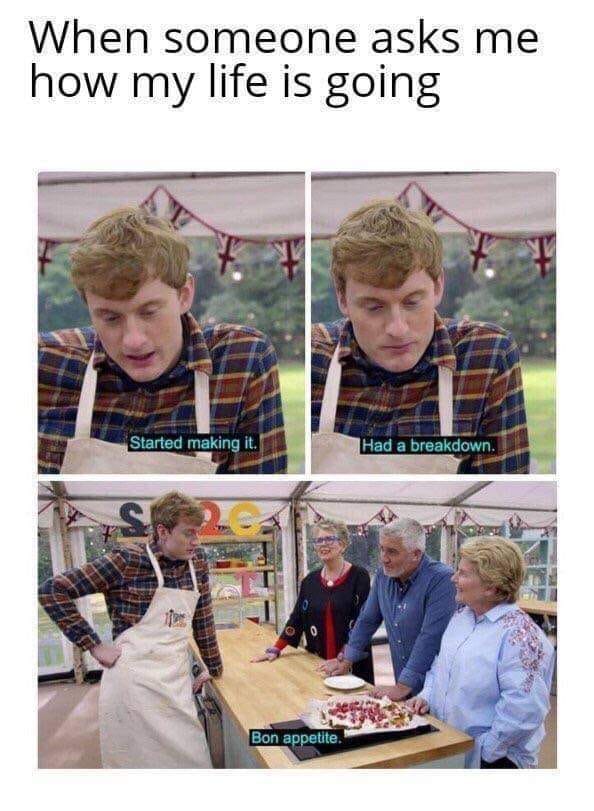
The meme is a three-panel image utilizing screenshots from The Great British Baking Show.
- Panel 1: A man (Paul Hollywood) wearing an apron with a slightly determined, but hopeful expression. Text: "Started making it."
- Panel 2: The same man, still wearing the apron, with a markedly more stressed and strained expression. Text: "Had a breakdown."
- Panel 3: The man (Paul) stands before Mary Berry and another man, presenting a plate with a somewhat defeated expression. Mary Berry and the other man offer the phrase "Bon appetite."
The humor comes from the juxtaposition of aspirational beginning ("Started making it") with an emotional collapse ("Had a breakdown") followed by a seemingly normal offering of food. The setting of a baking show adds a layer of ironic contrast.
Foucauldian Genealogical Discourse Analysis
This meme works beautifully through a Foucauldian lens. It highlights how our "selves" and experiences are constructed through discourse – in this case, the discourse surrounding personal well-being and societal expectations.
- Power/Knowledge: The question "How's life going?" isn't a neutral inquiry. It's laden with expectation that life should be progressing according to certain norms (productive, stable, happy). The meme illustrates the power this expectation holds. A 'good' life, in this discourse, involves making something, achieving, being a certain way. Any deviation (the breakdown) is seen as a failure.
- Genealogy: The meme points to the historical construction of this discourse. The pressure to present a successful, "made" life is a product of capitalism and the modern emphasis on individual achievement. We've internalized the idea that our worth is tied to our productivity.
- Discipline & Normalization: The question acts as a form of disciplinary power, subtly enforcing norms. The phrase "Bon appetite" after the breakdown is chilling. It's a normalization of emotional labor and an expectation to keep going even after experiencing internal struggles. It suggests we are expected to perform "normal" regardless of our internal state.
Critical Theory
This meme is inherently critical of modern life, specifically the emphasis on self-optimization and relentless productivity.
- Alienation: The meme illustrates the alienation common in modern society. The man is attempting to “make” something (life, success, a baking creation) but finds the process deeply unsettling.
- The Culture Industry: The baking show setting is pertinent. The Great British Baking Show is a carefully constructed representation of wholesome competition, but also embodies the pressure to perform, to create, and to be judged. The meme uses this framing to critique the larger system.
- False Consciousness: The "Bon appetite" response in the final panel represents a form of false consciousness. It’s a superficial acceptance of the situation, masking the underlying emotional struggle. It asks us to ignore the genuine distress and simply consume (literally and figuratively) life as it's presented.
Marxist Conflict Theory
A Marxist reading focuses on the inherent contradictions within capitalist systems that produce this feeling of breakdown.
- Class and the Pressure to Achieve: While not explicitly about class, the meme speaks to the pressure on individuals, particularly in advanced capitalist societies, to be productive and successful. This pressure is unevenly distributed, and often intensifies for those in precarious economic positions.
- Commodification of Self: Under capitalism, everything, including our emotions and well-being, is commodified. The pressure to present a “made” life is tied to the idea that our value is tied to our productivity and achievements, which can then be translated into economic success.
- Alienation from Labor: The baking itself is a form of labor. The man's breakdown indicates a disaffection from the labor required to produce this “made” life. The process of creation has become disconnected from any genuine fulfillment.
Postmodernism
The meme embodies several key tenets of postmodernism.
- Irony & Pastiche: The meme is ironic. It juxtaposes aspiration with failure, and a wholesome setting with a dark underlying message. It utilizes the imagery of a popular culture show (pastiche) to comment on broader societal issues.
- Deconstruction of Meaning: The meme challenges the notion of a stable, coherent self. The man is presented as fragmented – hopeful, then broken, then simply offering a product. It suggests that meaning is not inherent but rather constructed and constantly shifting.
- Rejection of Grand Narratives: The meme rejects the grand narrative of progress and self-improvement. It acknowledges the absurdity of expecting linear success and highlights the emotional toll of striving for perfection.
Queer Feminist Intersectional Analysis
While not central, an intersectional lens can add another layer of understanding.
- Emotional Labor: The meme implicitly touches upon the emotional labor often placed on marginalized genders. There's a societal expectation for women and gender-nonconforming people to maintain composure and present a “put-together” image, even when experiencing internal struggles. The "Bon appetite" reinforces this expectation.
- Pressure to Conform: The breakdown could be seen as a rejection of normative expectations, particularly those related to success, productivity, and maintaining a certain image.
- Intersection of Mental Health & Systemic Issues: The meme doesn’t explicitly address intersectionality, but it acknowledges the toll that systemic pressures can take on individual mental well-being. Those with multiple marginalized identities may experience this pressure more acutely.
I hope this detailed analysis is helpful! Let me know if you'd like me to expand on any of these points.
simple-description (llama3.2-vision)
The meme features a screenshot from a British baking show, with a contestant (Nigel Owens) looking unimpressed. The image shows him with a scowl on his face, and the text "I've made a cake" appears at the top. The caption "When someone asks how your life is going" is written above the image, and the response "I've made a cake" is written below it.
tesseract-ocr
When someone asks me how my life is going a ae Eee foot ama) Loot = ex is Ain. { ¥ coms : — 5; 4s i rhe A Tt eee a SS > -é ~\ sare Ran LN , = a i, | a a wa aa Fis] eer | fa og Te 4