First Seen
2023-05-10T21:03:39+00:00
simple-description (llama3.2-vision_11b)
This meme is a playful take on the classic "I'm sorry" phrase, with a nod to the queer community. The image likely features a photo of a young woman with a cheeky expression, and the text "I'm sorry I'm not sorry" is written above it. The meme is a lighthearted way to poke fun at the idea of apologizing, with a wink to the LGBTQ+ community's tendency to own their queerness and not be sorry about it.
detailed-analysis (gemma3-27b-vision)
Okay, here's an analysis of the image of Tilda Swinton as Matilda, broken down into sections as requested, focusing where the concepts are applicable. It's a bit of a playful intellectual exercise given the source material, but I’ll attempt to apply these frameworks rigorously.
Visual Description
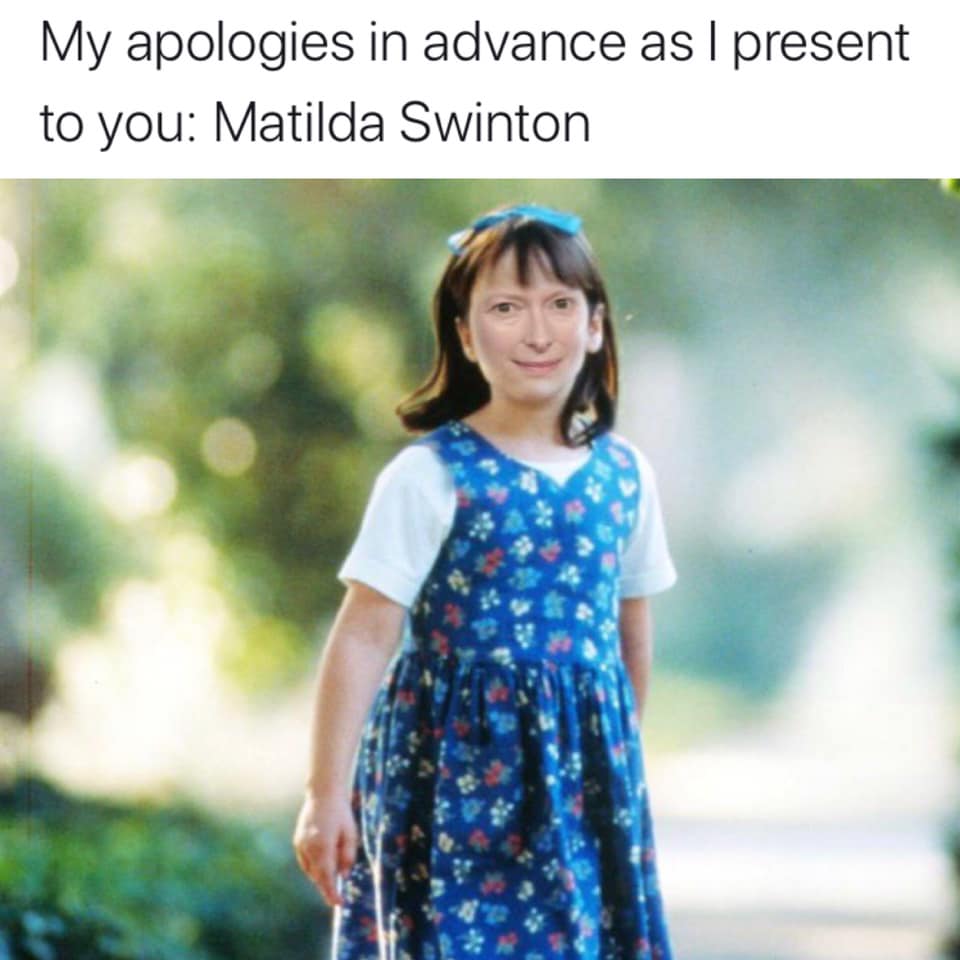
The image shows Tilda Swinton, acting in the role of Matilda Wormwood from the 1996 film adaptation of Roald Dahl’s novel Matilda. She's standing outdoors in a lush, somewhat blurred green background, suggesting a park or garden. She’s wearing a vintage-looking dress with a white top and a blue floral pattern. Her hair is styled in a short, bobbed cut. She has glasses and a direct gaze at the camera. The lighting is bright and warm, lending a somewhat nostalgic and innocent quality to the image. The overall aesthetic is deliberately quaint and suggests a time removed from our current moment.
Foucauldian Genealogical Discourse Analysis
This image is fertile ground for a Foucauldian analysis. The very presentation of Tilda Swinton as Matilda, an ostensibly young girl, is a demonstration of the constructed nature of identity, childhood, and gender.
- Discourse: The discourse of "childhood" is a historical construct—what is considered “childhood” is not natural but a set of evolving norms, expectations, and power relations. This image actively disrupts those norms. Swinton, a mature adult, embodies a child, questioning the very boundaries of what we think of when we imagine ‘youth’.
- Power/Knowledge: The image also plays with the power dynamics embedded in representations of children. The child is often positioned as innocent, powerless, needing protection. Swinton's performance, and the image itself, subverts this. Her gaze is intelligent and self-possessed—she is not the passive object of our gaze. She knows something.
- Genealogy: Tracing the "genealogy" of childhood representations would reveal how the image of the child has been used in media, literature, and art to serve specific ideological purposes—to reinforce societal norms, to appeal to sentimentality, or to exercise control. The casting of Swinton is a direct critique of those historical constructions. It highlights the performance of childhood, rather than its assumed naturalness.
Critical Theory
Critical Theory, stemming from the Frankfurt School, would likely view this image as a site of tension between idealization and reality.
- Ideology: The image challenges the dominant ideology of childhood as inherently innocent and fragile. Swinton’s performance highlights the intelligence, agency, and potential for rebellion within Matilda.
- Culture Industry: The film Matilda (and by extension, this image) can be seen as part of the “culture industry,” creating and disseminating narratives that reinforce or challenge existing social norms. Swinton’s casting disrupts the expectation of a “natural” child actor, prompting critical reflection on the construction of childhood within media.
- Emancipation: A critical theorist might argue that the image has the potential to be emancipatory, allowing viewers to question the dominant representations of childhood and see the child as a complex and capable subject.
Marxist Conflict Theory
While not immediately obvious, a Marxist interpretation is possible.
- Social Class & Power: The novel and film Matilda critique the neglect and mistreatment of children by self-absorbed parents—a reflection of the alienation and exploitative dynamics of capitalist society. The Wormwood family represents a bourgeois class disconnected from genuine human connection.
- Symbolic Struggle: Matilda’s intelligence and rebellion can be interpreted as a symbolic struggle against the oppressive forces of conformity and materialism. Her reading and learning are acts of resistance against a system that prioritizes consumption over intellectual development.
- Image as Commodity: The image itself, like any media product, is a commodity produced for consumption. A Marxist critique would analyze the economic forces that shaped the production and distribution of the film and the image.
Postmodernism
This image strongly leans into postmodern interpretations.
- Blurring of Boundaries: The casting of an adult actress as a child dismantles conventional notions of representation and authenticity. This blurring of boundaries between performer and character, adult and child, is characteristic of postmodern aesthetics.
- Intertextuality: The image relies on our prior knowledge of the novel and film Matilda. It is an intertextual reference, drawing meaning from the context of the source material.
- Self-Reflexivity: The image is inherently self-reflexive. It draws attention to the constructed nature of representation and challenges the notion of a “real” or authentic childhood.
- Simulation: Swinton simulates childhood, creating a hyperreal image that questions the very concept of "reality." The image doesn't represent childhood; it performs it.
Queer Feminist Intersectional Analysis
This is where it gets particularly interesting, given the subtextual potential.
- Disrupting Norms: The image challenges traditional gender roles and expectations. The casting of Swinton, a non-binary actor, as a child disrupts the gendered assumptions associated with childhood.
- Agency & Power: Matilda’s intelligence and independence can be read as a rejection of patriarchal norms. She asserts her agency and resists being defined by societal expectations.
- Intersectionality: A queer feminist analysis would consider how Matilda’s identity intersects with other forms of oppression, such as class and education.
- Nonconformity: Matilda's nonconformity and intellectualism can be seen as a form of queer resistance—a rejection of the heteronormative expectations placed on children.
I hope this breakdown provides a thoughtful and multi-layered analysis of the image. Let me know if you’d like me to expand on any particular aspect.
simple-description (llama3.2-vision)
This meme is a humorous take on a common social media etiquette. It features a picture of a young girl, likely from a popular meme, with a caption that reads: "My apologies in advance as I am about to do something annoying/obnoxious. In the style of a 90s kid, I'm going to say... 'I'm sorry' (in a grating, over-the-top, childlike voice).
tesseract-ocr
My apologies in advance as | present to you: Matilda Swinton * ¥ /, _ <<. 7 No = t ! f , Ld > , ys ” £29 : a. a F Aad . «i 4 “, ‘ ae Fi 7 ’ Ki Y Pd Y { ea |