First Seen
2023-05-10T21:03:39+00:00
simple-description (llama3.2-vision_11b)
The meme is a playful critique of the traditional notion of love and relationships. It features a photo of a same-sex couple with the caption "I love you" and the response "I love you too, but don't expect me to move in with you or anything." The meme is poking fun at the societal expectation that a romantic relationship should lead to cohabitation, highlighting the absurdity of this assumption.
detailed-analysis (gemma3-27b-vision)
Here's an analysis of the image, broken down into the requested theoretical frameworks, only where those frameworks clearly apply.
Visual Description
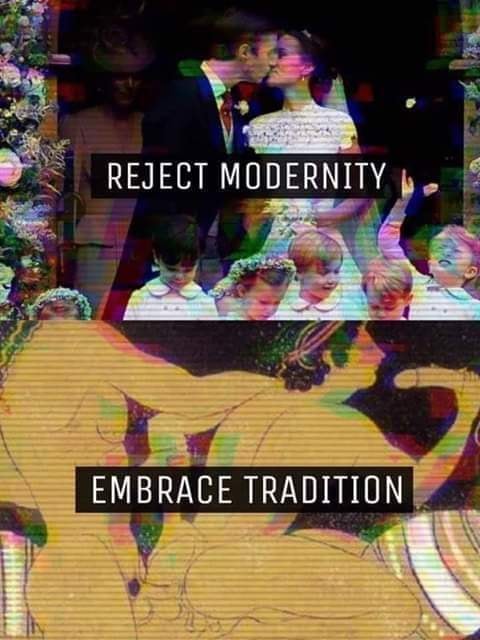
The image is a composite, digitally altered, and evocative piece. It prominently features a wedding scene in the upper portion, showing a couple kissing, with flower girls in white dresses behind them. The scene appears to be quite opulent, suggesting a traditional or high-status wedding. The lower portion features a grainy, distorted image of a woman, partially obscured, with visible cleavage. Overlaid on the image are text phrases in large, bold white letters: “REJECT MODERNITY” and “EMBRACE TRADITION.” The image has a noticeable digital distortion effect, reminiscent of VHS static or glitches. This visual texture, combined with the stark text, creates a sense of intentional disruption and tension.
Foucauldian Genealogical Discourse Analysis
This image presents a fascinating example of how power operates through discourse. The pairing of "Reject Modernity" and "Embrace Tradition" isn't simply a statement of preference. It's a discourse constructing a binary. A Foucauldian genealogical analysis would trace the historical development of these concepts – "modernity" and "tradition" – and how they came to be imbued with specific meanings.
- Power/Knowledge: The image suggests that tradition is positioned as natural and good, while modernity is presented as something to be rejected. This isn't an objective truth, but a power/knowledge relationship. Those who benefit from traditional power structures (often patriarchal, hierarchical) are actively shaping this discourse.
- Disciplinary Power: The image subtly suggests a desire for control over bodies and behaviors. "Embracing tradition" often implies adhering to specific roles and norms. The distorted, grainy image of the woman, contrasts against the clear image of the wedding party. It could be interpreted as how women in modern society are pressured to fit within patriarchal structures.
- Genealogy of Tradition: The "tradition" being invoked isn’t monolithic. It's a specific version of tradition, likely one rooted in a particular historical, cultural, and social context (and likely one that benefits those in power). This image doesn’t ask what tradition is being embraced, but asserts its inherent value.
Critical Theory
The image is a strong example of a cultural critique. It embodies key concerns of Critical Theory:
- Ideology: The binary "Reject Modernity/Embrace Tradition" functions as an ideology. It’s not just a statement of preference, but a way to legitimize certain power structures. The image suggests that "tradition" offers stability and meaning, while "modernity" is somehow corrupting or destructive.
- Domination: The image implies that modernity is something to be overcome. This is likely linked to a feeling of alienation or loss of control in a rapidly changing world. By romanticizing “tradition,” the image might be seeking to restore a perceived lost order. It could also be a reactionary response to societal shifts challenging existing hierarchies.
- The Culture Industry: The image is itself a product of the "culture industry" (Adorno and Horkheimer). It’s a manufactured image designed to evoke specific emotions and encourage a certain worldview.
Marxist Conflict Theory
From a Marxist perspective, the image can be seen as reinforcing class and gender hierarchies:
- Ideological Control: The image is a form of ideological control used to maintain the status quo. By glorifying "tradition," it legitimizes the existing power structures and discourages challenges to them.
- Reproduction of Social Relations: The wedding scene implies a specific social order and the reproduction of traditional family structures. These structures often serve to reinforce class and gender inequalities.
- Alienation and Nostalgia: The rejection of modernity can be interpreted as a response to the alienation of capitalist production. There's a nostalgic appeal to a simpler past, ignoring the realities of hardship and oppression that often existed within those "traditional" societies.
Queer Feminist Intersectional Analysis
This image is loaded with problematic implications when viewed through a Queer Feminist Intersectional lens:
- Heteronormativity: The wedding scene explicitly reinforces heteronormative ideals of marriage and relationships. This excludes and marginalizes LGBTQ+ individuals and relationships.
- Patriarchy: The emphasis on "tradition" often means upholding patriarchal structures where men hold power and women are relegated to subordinate roles.
- Objectification of Women: The grainy image of the woman in the lower portion, with its focus on her cleavage, contributes to the objectification of women and reinforces a male gaze.
- Intersectionality: The image lacks any consideration of the intersectionality of oppressions. It’s a privileged view that ignores the experiences of those who don't fit within the narrow confines of traditional gender, class, or racial norms.
Postmodernism
The image itself exhibits certain postmodern characteristics:
- Fragmentation & Juxtaposition: The composite nature of the image, combining different elements (wedding scene, grainy photo, text) creates a fragmented and disorienting effect.
- Meta-Commentary: The image is self-aware. It’s not simply presenting a scene but making a statement about modernity, tradition, and the ways in which we construct meaning.
- Simulacra & Simulation: The image is a simulacrum – a copy without an original. It’s a constructed representation of reality that has become detached from any underlying truth.
In conclusion, this image is a complex and provocative piece that raises important questions about power, ideology, and the ways in which we understand the past, present, and future. It's particularly problematic when examined through a queer feminist lens, due to its reinforcement of patriarchal and heteronormative norms.
simple-description (llama3.2-vision)
The meme is a humorous image that pokes fun at the idea of "embracing tradition" in a modern context. The image likely features a stereotypical "traditional" setting, such as a wedding or a family gathering, with a caption that says "Embrace Tradition" and a second caption that says "Reject Modernity" in a contrasting, bold font. The image is likely meant to be ironic or satirical, highlighting the tension between traditional values and modernity.
tesseract-ocr
-, oe we \ * 43 PTT abm TN UA ; / 2 ae VT § Z 25 Ss , yi — ys. we : ‘i A a a? = . See. SS em, op, ED, \ “hye S&S — Fa = = — x —— a, tS —— = (DSS