First Seen
2023-05-10T21:03:39+00:00
simple-description (llama3.2-vision_11b)
The meme is a humorous comparison between the living spaces of the wealthy and the poor, highlighting the stark contrast between their environments. The image shows a luxurious, high-end apartment with a clean and tidy living room, while the "bottoms" apartment is depicted as a cluttered and messy space, implying that the wealthy are often oblivious to the struggles of those living in poverty.
detailed-analysis (gemma3-27b-vision)
Okay, let's break down the image and its caption ("no top: a bottoms apartment") through the lenses you've provided. It's a bit of a playful prompt, so we'll lean into the interpretations that emerge from that.
Please note: This analysis requires a degree of assumption/speculation, as we're dealing with a meme-like caption and visual. I'll flag where I'm making those assumptions.
Visual Description
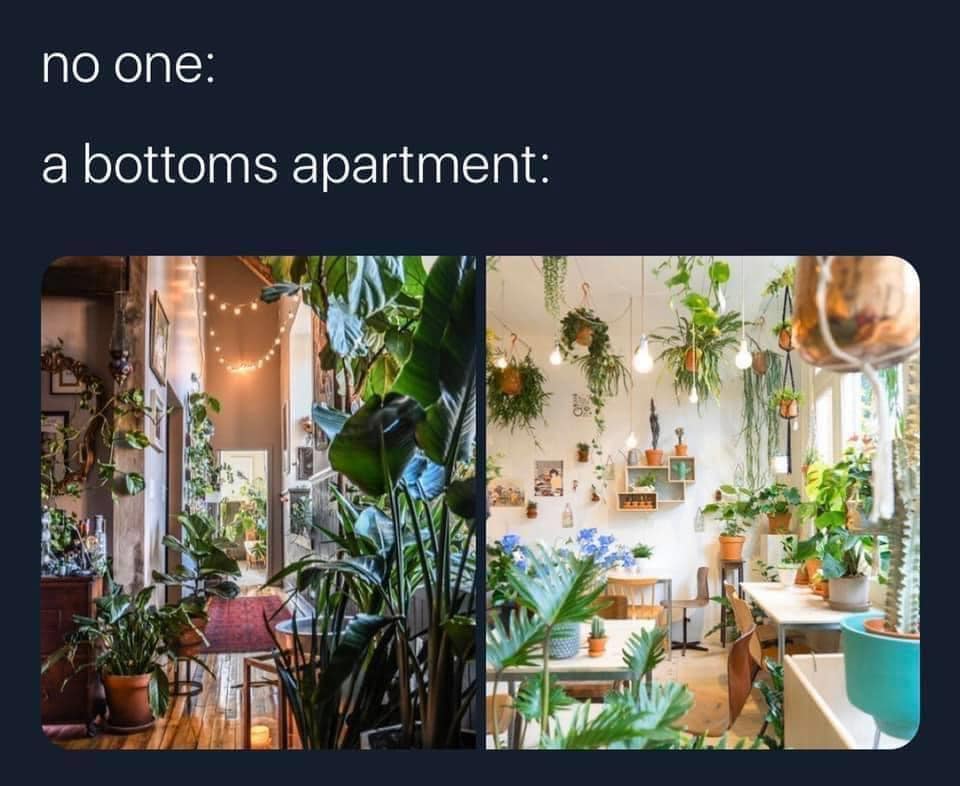
The image depicts two rooms, clearly parts of the same interior space, heavily decorated with an abundance of lush, green houseplants.
- Overall Aesthetic: The space is warm, inviting, and intensely organic. It leans toward a bohemian or maximalist style. The abundance of plants creates a dense, jungle-like effect.
- Color Palette: Dominantly greens, browns, and wood tones, creating a very natural feel. Accents of reds/burgundies (in rugs) and the turquoise chair introduce some color contrast.
- Lighting: The light appears soft and filtered, possibly from natural sources (large windows) combined with string lights. This creates a relaxed, intimate atmosphere.
- Furniture: A mix of vintage and eclectic furniture is visible. There are dining tables with chairs, and what appears to be a seating area.
- Key Details: The sheer number of plants is overwhelming, both hanging and potted, filling almost every available space. There are also what appear to be artwork and decorative items on the walls, contributing to the maximalist aesthetic.
Queer Feminist Intersectional Analysis
This is where the caption "no top: a bottoms apartment" becomes central. Let’s unpack it:
- Subversion of Binary: The caption deliberately plays with BDSM terminology ("top" and "bottom") to subvert traditional power dynamics. It implies that the space embodies characteristics traditionally associated with those who identify as "bottoms" – receptivity, nurturing, pleasure-seeking (without the need for dominance).
- Domesticity & Gender: Traditionally, domestic spaces have been associated with femininity and a passive role. This space, however, is not necessarily passive. While the abundance of plant life evokes care and nurturing, it's a powerful and almost overwhelming display of life. It's a domestic space that feels active and thriving.
- Rejecting Hierarchies: The phrase "no top" suggests a rejection of hierarchical structures in relationships and life generally. This resonates with queer and feminist ideals of equality and non-dominance. It implies a space built on shared pleasure, comfort, and mutual support.
- "Softness" as Strength: The abundance of plants and the warm lighting contribute to a sense of "softness" often devalued in patriarchal society. This analysis suggests that "softness" is a form of strength, an assertion of care and a rejection of the aggressive, hyper-masculine norms.
- Intersectionality: This lens can be stretched to consider the intersection of class and care. The ability to maintain such an abundant plant collection requires resources, both financial (buying the plants) and time (caring for them), suggesting a certain level of privilege.
Postmodernism
- Playfulness & Irony: The caption itself is an example of postmodern playfulness. It appropriates a sexually charged term ("top/bottom") and applies it to a domestic setting in a deliberately ironic way.
- Deconstruction of Norms: Postmodernism is concerned with deconstructing grand narratives and questioning established norms. The caption challenges the traditional power dynamics inherent in the "top/bottom" binary and applies it to a seemingly unrelated domain (interior design).
- Mixing of Signifiers: The image combines different signifiers – plant life, domestic space, BDSM terminology – creating a complex and ambiguous meaning. There’s no single, straightforward interpretation.
- Blurring Boundaries: Postmodernism often blurs the boundaries between high and low culture, serious and playful. The caption's mixing of sexual connotations with domesticity exemplifies this.
Critical Theory
- Spatial Politics: Critical Theory looks at how spaces are not neutral but are constructed and laden with meaning. The "bottoms apartment" is not just a room; it's a statement about power, pleasure, and relationships. It challenges the notion of the home as a site of traditional power dynamics.
- Ideology & Representation: The image and caption represent a specific ideology – one that values receptivity, pleasure, and non-dominance. It's a counter-representation to the often-dominant narratives of power and control.
- The Panopticon & Domestic Space: While less direct, a Critical Theory reading could consider how domestic spaces are often surveilled and regulated, even internally. This space, however, feels less about control and more about creating a space of refuge and pleasure.
Disclaimer: These are interpretations, and a different reader might draw different conclusions. The strength of this image is its ambiguity and its ability to evoke multiple layers of meaning, depending on the perspective of the viewer.
Let me know if you'd like me to focus on any specific lens in more detail, or explore other theoretical frameworks.
simple-description (llama3.2-vision)
This meme is a humorous comparison between two vastly different living spaces. The image on the left shows a beautifully decorated, upscale apartment with lush greenery and elegant furniture, while the image on the right shows a cluttered, messy apartment with trash and disorganization. The text above the images reads "no one: / a bottoms apartment:"
tesseract-ocr
no one: a bottoms apartment: Lae 4 F i Pd ' an % i = Progr Pa S| ™ ma i iF si (B a ee | Cn mm { Ce] 1 nis i Ree |S SN AMES Se cae Ea aN cs “Sk e ag a. me ar i Ne » TiN WA 2 mr SS <i aN a aX lara Ww # y | AA di 7 Pils im Nv SPST re Vi i ee 2a co ey | ee A Se |