First Seen
2023-05-10T21:03:40+00:00
simple-description (llama3.2-vision_11b)
The meme is a photo of a Quonset hut, a type of prefabricated metal building, with a caption that reads "When you finally have enough money to build a Quonset hut but you're still living in a cardboard box." The image is humorous because it pokes fun at the idea of someone who is struggling financially but has the means to build a more substantial structure, yet is still choosing to live in a temporary or makeshift space.
detailed-analysis (gemma3-27b-vision)
Okay, here's an analysis of the image, broken down into sections according to the requested theoretical frameworks. I'll only include sections that seem relevant to the image's content and possibilities for interpretation.
Visual Description
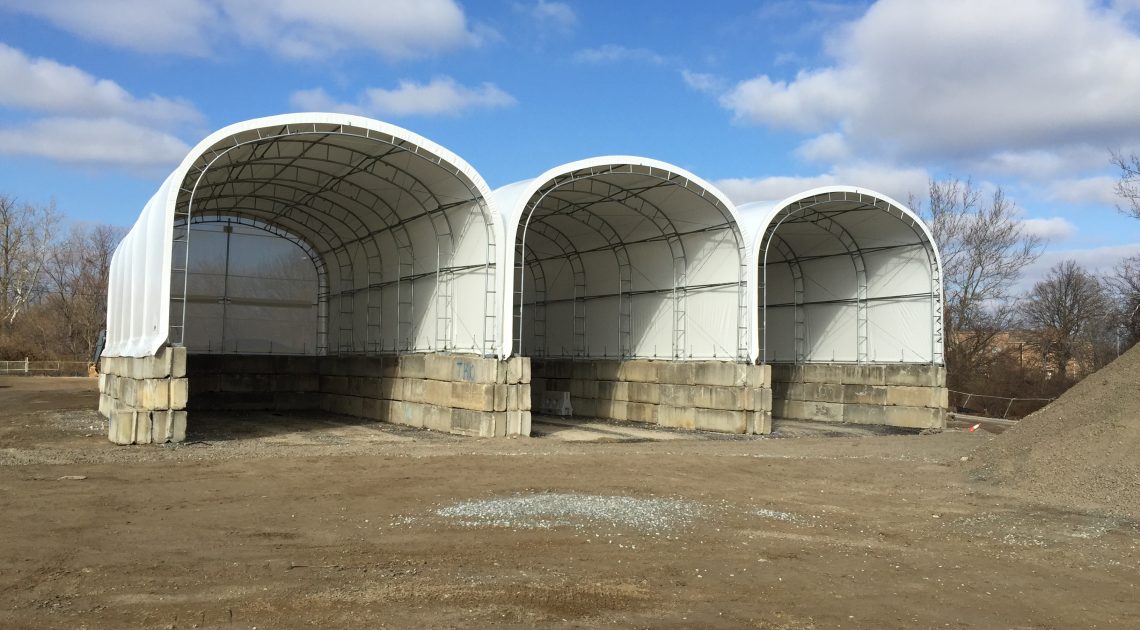
The image depicts a row of three identical, white, arched structures resting on concrete bases. These look like temporary or semi-permanent shelters or storage facilities, likely made from a flexible material stretched over a metal frame. The structures are open at one end, revealing dark interiors. They are set on a large, flattened expanse of dirt/earth with some scattered gravel. In the background, a line of bare trees suggests a transitional season (likely early spring or late autumn). A green, grassy space is visible beyond the trees. The sky is blue with puffy, white clouds. The overall impression is one of utility, construction, and perhaps impermanence, as the structures don’t feel like permanent buildings. There is a sense of being on the edge of something—a construction site, a depot, or an industrial area.
Foucauldian Genealogical Discourse Analysis
This image lends itself well to a Foucauldian interpretation. These structures can be read as sites of disciplinary power. While appearing neutral, they contain and categorize whatever is stored within. The arched form itself is significant; it evokes both shelter and confinement.
- Genealogy: Tracing the history of these structures, or similar ones, would reveal how they have come to be associated with control and organization. Think of their predecessors – warehouses, barns, temporary military shelters – all spaces designed to manage flows of materials and people.
- Power/Knowledge: The structures’ very existence suggests a knowledge system around categorization, storage, and control. Someone has decided that something needed to be stored in a specific way, and this decision reflects underlying power relations. What is being stored, who controls access, and for what purpose? These questions reveal the knowledge-power nexus at play.
- Discipline & Normalization: The identical nature of the structures suggests a desire for standardization and efficiency. By providing uniform storage, they contribute to a system that reinforces particular norms and expectations around how materials are categorized and managed. Anything that doesn’t fit neatly into these spaces becomes "abnormal" and potentially problematic.
The dirt and construction suggest this is an active site—a site where power is being enacted through the organization of space.
Critical Theory
From a Critical Theory perspective, these structures represent a manifestation of instrumental reason. They are designed for a specific purpose – storage, protection – and are judged solely on their efficiency in achieving that goal.
- Alienation: The structures are fundamentally dehumanizing. They are purely functional, devoid of aesthetic or symbolic value. They treat whatever is inside as mere objects to be managed, ignoring any intrinsic worth. This reflects a broader tendency in modern society to reduce everything to quantifiable metrics and utilitarian purposes.
- The Culture Industry: While not directly part of the culture industry, the standardized and efficient nature of these structures reflects the logic of mass production and the desire for control that underlies it. They are a part of the broader system that prioritizes efficiency over meaning and individuality.
- Domination: The structures can be seen as a physical manifestation of power relations. The act of containing and categorizing objects—or even people—is inherently an exercise of power.
Marxist Conflict Theory
From a Marxist lens, these structures can be analyzed in terms of the relationships of production and the control of resources.
- Means of Production: These structures are a part of the means of production – the tools and infrastructure used to create and distribute goods. They represent an investment in organizing the physical world to facilitate economic activity.
- Class Conflict: Who owns these structures and what is being stored within them can tell us something about the distribution of wealth and power in society. Are they owned by a corporation, a government agency, or a private individual? What is the purpose of the stored materials—profit, defense, or public service? These questions reveal underlying class interests.
- Commodification: The structures themselves are commodities—objects produced for exchange in the market. Their existence reflects the broader process of commodification that transforms everything, including space and shelter, into a source of profit.
The image evokes a sense of industrial activity and the organization of labor. The dirt and construction suggest ongoing development and the pursuit of economic growth.
Let me know if you'd like me to elaborate on any of these sections or explore other theoretical perspectives.
simple-description (llama3.2-vision)
This meme is an image of a large, empty, white building with a metal frame, surrounded by a dirt yard. The building is labeled "The Last Place on Earth" and has a sign on the door that says "Abandon All Hope, Ye Who Enter Here". The image is a humorous take on the idea of a post-apocalyptic wasteland, where the building is the only remaining structure.
tesseract-ocr
3 s Wer a) 5 yy é = ( ‘ ia. AY ow + = | E — alk a = v r HH Aen PS ite rae yen | > If |) a) ee