First Seen
2024-03-16T06:52:08.210984+00:00
simple-description (qwen3.5_2b-q8_0)
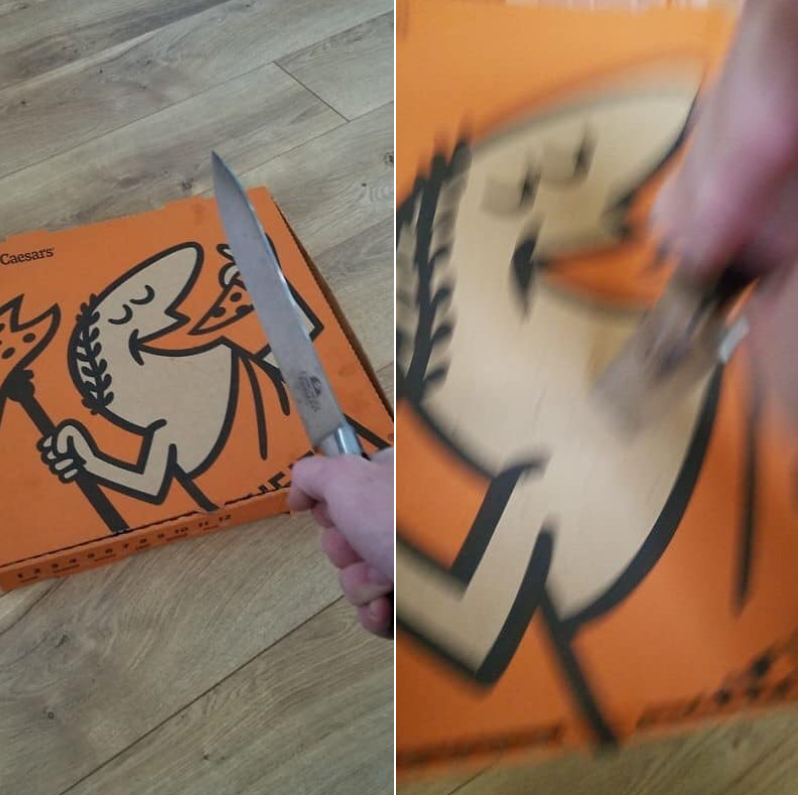
This meme uses the Roman context of the brand "Caesars" and its mascot, whose costume is traditionally covered in lilies—a symbol strongly associated with the city of Rome. A person is shown holding a knife next to the box, humorously suggesting that the pizza is high enough that a blade is needed to slice it. The visible text "Caesars" identifies the specific chain whose Italian-style, high-crust pizza is central to this Roman-themed joke.
simple-description (llama3.2-vision_11b)
The meme is a screenshot of a tweet from a Twitter user named @Brent , where they tweet "I'm just going to go ahead and say it. The Roman Empire fell because of poor pizza delivery."
detailed-analysis (gemma3-27b-vision)
Okay, here’s an analysis of the image, broken down by the requested theoretical frameworks. Please note that some frameworks won't be relevant or deeply applicable given the limited visual information. I'll clearly state where that's the case.
Visual Description
The image depicts a hand wielding a sharp kitchen knife, actively cutting into a pizza box. The box is a bright, solid orange color, and features a minimalist, cartoon-like illustration of a figure resembling a Roman emperor (presumably Caesar, given the branding). The illustration shows the figure wearing a laurel wreath and holding what appears to be a slice of pizza. The background is a wooden floor, presumably indoors. The image is slightly blurred, suggesting motion or a quick capture. The focus seems to be on the act of cutting the box, drawing attention to the blade and the forceful interruption of the image on the box.
Foucauldian Genealogical Discourse Analysis
This image is ripe for Foucauldian analysis. The “Caesars” branding itself is a discourse constructing a particular vision of Roman history (and by extension, power and authority). This branding is an appropriation of history used to sell a product.
- Power/Knowledge: The image demonstrates how power operates through seemingly innocuous practices (ordering and consuming pizza). The branding invokes a historical figure and associates that figure’s authority and iconography with a commercial product. The assumption is that by associating the pizza with Caesar, the pizza will gain a sense of quality and perhaps even superiority.
- Discipline and Surveillance: The act of cutting into the box can be seen as an assertion of agency over the branded image. While the branding attempts to impose a certain order/narrative, the cutting disrupts that. It’s a small act of resistance against the all-pervasive consumer discourse.
- Genealogy: A genealogical approach might trace the history of using Roman imagery in marketing, uncovering the shifts in meaning and the construction of specific ideas about "luxury," "authenticity," or "good taste" associated with Roman history. This image functions as one small node within that broader network.
Critical Theory
The image lends itself to critical analysis focused on consumer culture and the commodification of history/imagery.
- Commodification & Spectacle: The pizza box is an example of how even cultural symbols (like a Roman emperor) are reduced to commodities in a capitalist system. The image functions as spectacle, designed to attract attention and drive sales.
- Ideology: The branding aims to establish a particular ideology—that Caesar’s “authority” can be transferred to a pizza, making it more appealing. The consumer is unconsciously invited to accept this equation. The image is a condensed form of this ideological persuasion.
- Alienation: From a critical perspective, the image might reflect a broader alienation from history and authenticity. The Roman emperor is no longer a complex historical figure, but a flattened caricature used to sell a product.
Marxist Conflict Theory
This image can be seen through a Marxist lens as showcasing the inherent contradictions of capitalism.
- Exploitation and Labor: While not directly shown, the pizza itself represents the product of labor. The branding (and the enjoyment of the consumer) obscures the labor involved in growing the ingredients, manufacturing the box, and delivering the pizza.
- False Consciousness: The consumer is encouraged to see the pizza as a source of enjoyment and pleasure, but this obscures the underlying exploitative relations inherent in its production. The branding contributes to this “false consciousness.”
- Class and Consumption: The purchasing of pizza (and the embracing of the branding) can be seen as reinforcing class structures. The branding seeks to create a desire for the product, even if that desire is artificial.
Postmodernism
The image aligns with several tenets of postmodern thought:
- Simulacra and Simulation: The image of Caesar on the box is not the "real" Caesar, but a simulacrum – a copy of a copy, divorced from its historical context. It's a representation that has become its own reality, functioning solely as a marketing tool.
- Deconstruction: The act of cutting the box can be seen as a deconstruction of the branded image. The cut disrupts the complete image and reveals the box’s material form, undermining the illusion of a seamless connection between the product and its historical association.
- Loss of Grand Narratives: The image illustrates a break from traditional historical narratives. The Roman Emperor is no longer presented as a figure of power and authority, but as a playful illustration used to sell pizza.
Queer Feminist Intersectional Analysis
This framework is less directly applicable given the limited visual information. However, we could explore:
- Consumption and Gender: Historically, marketing has often targeted gendered desires and expectations. While not obvious in this image, the marketing of pizza (and the branding) could be analyzed for its underlying gendered assumptions.
- Intersectionality & Power Dynamics: An intersectional analysis would look at how power dynamics intersect in the context of consumption, considering factors like class, race, and gender. The image could be examined to see how the branding might reinforce or challenge existing power imbalances.
- Disrupting Normative Iconography: Cutting into the box could be seen as a form of disruption - a challenge to the normative iconography represented by the Caesar image. However, without additional context, this interpretation is speculative.
Disclaimer: It's important to remember that these are interpretations based on a single image. A more thorough analysis would require additional context and information.
Let me know if you'd like me to elaborate on any of these points or explore a different theoretical perspective!
simple-description (llama3.2-vision)
The meme is a photo of a pizza box with a large hole cut out of it, revealing a "cheesy" (pun intended) surprise inside. The text on the box reads "I'm not saying it's a trap, but there's a hole in the box". The meme is likely a humorous take on the idea of a pizza delivery company's attempt to save money by using a smaller box, but the joke is that the pizza is actually missing, and the hole in the box is a clever (and cheeky) way to explain that.
tesseract-ocr
“a al a rh , \ Ba y? ie 4 S - Ay ; ; a ; ; ¥ Ns -\ | a , ST 4 a PSOE ae LOE a PL A gh eee Mae. 3