First Seen
2023-05-10T21:03:40+00:00
simple-description (llama3.2-vision_11b)
The meme appears to be a visual representation of the 2020 United States presidential election in San Francisco, with a map of the city's voting districts colored by their support for Joe Biden (blue) or Donald Trump (red). The image also includes a chart comparing the election results to the 2016 election, with some districts showing a significant shift in support for Biden.
detailed-analysis (gemma3-27b-vision)
Okay, let's break down this fascinating map overlay with the requested analytical lenses.
Visual Description
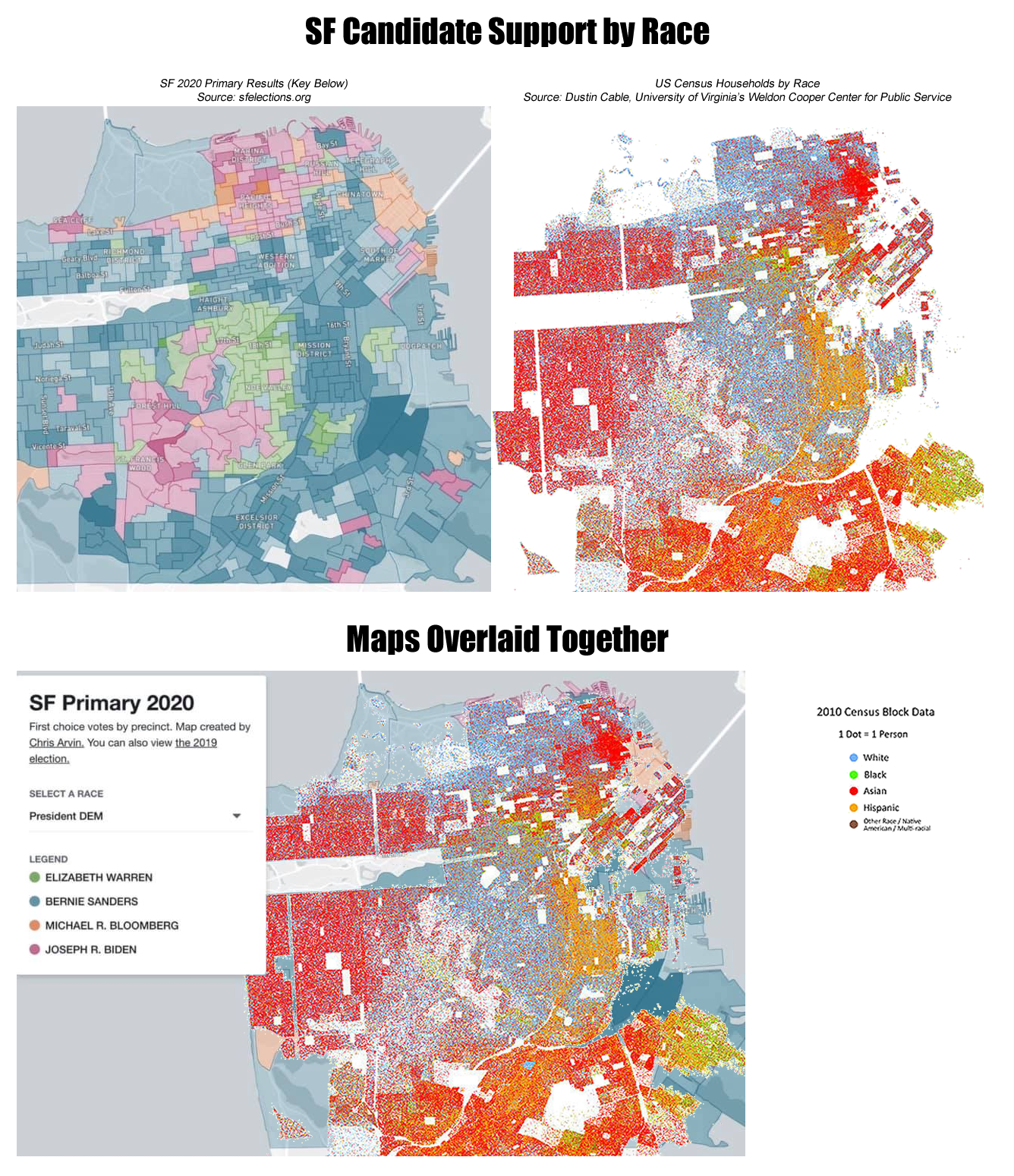
The image presents a series of maps of San Francisco overlaid onto each other. The base map appears to be a topographical or satellite view of the city, providing geographical context. Layered on top are three sets of data visualized as colored areas:
- 2020 Primary Election Results: Color-coded areas represent the first-choice votes in the Democratic primary, broken down by candidate (Elizabeth Warren, Bernie Sanders, Michael Bloomberg, Joe Biden). The colors appear to designate specific neighborhood support, with Warren heavily represented in the Mission District, Sanders a prominent presence in the eastern, working class neighborhoods, Bloomberg and Biden showing some support in areas throughout the city.
- 2010 Census Block Data (Race): This layer displays demographic information from the 2010 US Census, using different colors to represent population density of specific racial/ethnic groups. The map shows areas of high concentration of White, Black, Asian, Hispanic, and Other/Native American/Multi-racial populations.
- One Dot = 1 Person: A layer of dots displays the number of people living in each block, providing an immediate sense of population density.
The overall effect is a complex visual representation of how political preferences correlate with demographic distribution within San Francisco. The use of layering encourages comparison and identification of patterns, although it also creates a potentially overwhelming visual field.
Foucauldian Genealogical Discourse Analysis
From a Foucauldian perspective, this map isn't simply a neutral representation of data; it constitutes knowledge and power relationships.
- Discourse and Power/Knowledge: The map itself is a discourse, a way of organizing and communicating information. By correlating voting patterns with racial demographics, the map implies a relationship between these factors. It is a form of power/knowledge – the way knowledge is produced is intertwined with relations of power. This is because the map's construction (choosing which data to include, how to visualize it, which layers to combine) reflects the priorities and assumptions of the map-maker.
- Genealogy: A genealogical analysis could trace the historical construction of "race" and political affiliation in San Francisco. The map demonstrates how these categories are not natural or fixed, but rather socially constructed through historical processes. For example, the strong support for Sanders in historically working-class and immigrant neighborhoods could be linked to the historical political activism and organizing in those areas.
- Normalization: The map may contribute to normalizing the association of certain racial/ethnic groups with specific political preferences. While it doesn't determine those preferences, it presents them as a given, potentially obscuring the complexities of individual political thought and agency.
- Subjectification: The map contributes to how individuals are categorized and understood as political subjects. By associating people with racial/ethnic groups and then with specific candidates, the map positions individuals within particular political narratives.
Critical Theory
Applying Critical Theory, we can see how the map reveals underlying structures of power and oppression.
- Ideology: The map can be viewed as a manifestation of dominant ideologies. The way in which data is presented – specifically, the focus on racial demographics and candidate support – can reinforce existing social hierarchies and power structures. For example, the concentration of certain candidates in areas with large minority populations could be used to suggest that these groups have different political priorities or preferences than others.
- Representation and Othering: The map creates representations of different racial/ethnic groups. These representations are always partial and incomplete, potentially leading to the "othering" of certain groups – defining them as different or outside the norm. This is particularly true if the map reinforces stereotypes or ignores the diversity within each group.
- Commodification: The map, as a product of data analysis and visualization, can be seen as a form of commodification of political and demographic information. This information can be used for various purposes, including targeted advertising, political campaigning, and social control.
- The Illusion of Objectivity: Critical theory questions the claim of objectivity. The map appears to be an objective representation of data, but it is, in fact, a subjective construction that reflects the values and biases of the map-maker.
Marxist Conflict Theory
From a Marxist perspective, this map highlights the relationship between class, race, and political affiliation.
- Class Struggle: The distribution of candidate support can be interpreted through the lens of class struggle. Sanders, traditionally seen as a candidate appealing to working-class voters, receives strong support in neighborhoods with high concentrations of working-class and immigrant populations. This suggests that class consciousness and economic inequality play a significant role in shaping political preferences.
- Racial Capitalism: The map demonstrates how race and capitalism are intertwined. Racial inequalities are often rooted in economic exploitation, and racial groups may have different economic interests. The map suggests that different racial groups may have different political preferences based on their economic circumstances.
- Superstructure & Base: The map can be seen as part of the superstructure (political and ideological institutions) built upon the base (economic relations of production). The distribution of political support is influenced by the underlying economic structures that shape class relations and racial inequalities.
- False Consciousness: Some might argue that the map reveals a form of "false consciousness" among certain groups – a lack of awareness of their own class interests. This could explain why some groups support candidates who do not necessarily represent their economic interests.
Postmodernism
A postmodern reading of the map would emphasize its constructed nature and the impossibility of a single, objective truth.
- Deconstruction: The map can be deconstructed to reveal its underlying assumptions and biases. By questioning the categories used to organize the data (e.g., "race," "candidate"), we can expose the arbitrary nature of these categories.
- Fragmentation and Hybridity: The map represents a fragmented and hybrid reality. The layering of different data sets creates a complex and often chaotic visual field. There is no single, coherent narrative or meaning.
- Simulacra and Simulation: The map can be seen as a simulacrum – a copy without an original. It is a representation of reality that is increasingly detached from the real thing. The map may create a sense of hyperreality – a more real-than-real experience that is based on artificial constructs.
- Rejection of Grand Narratives: The map challenges the idea of grand narratives or universal truths. It suggests that there are multiple perspectives and interpretations of reality. There is no single, objective way to understand the relationship between race and political affiliation.
Queer Feminist Intersectional Analysis
This lens focuses on the interplay of multiple systems of oppression, considering how race, gender, sexuality, and class intersect to shape political experiences.
- Intersectionality: This map allows us to examine how race intersects with other axes of identity to influence political preferences. For example, we might consider how the political preferences of Asian women differ from those of Asian men, or how the political preferences of Black LGBTQ+ individuals differ from those of heterosexual Black individuals.
- Marginalization and Visibility: The map can reveal patterns of marginalization and visibility. Areas with high concentrations of marginalized groups may exhibit distinct political preferences, reflecting their experiences of discrimination and oppression. However, it's important to avoid essentializing these groups – recognizing the diversity within each group and the complexity of their experiences.
- Power Dynamics: The map highlights power dynamics within and between different groups. For example, we might consider how the political preferences of dominant racial/ethnic groups influence the political landscape, or how the political preferences of marginalized groups are often overlooked or ignored.
- Resistance and Agency: The map can also reveal patterns of resistance and agency. Areas with high concentrations of marginalized groups may exhibit strong political activism and organizing, reflecting their efforts to challenge oppression and demand social justice.
- Critique of Categorization: Queer theory would critique the binary and rigid categorization of race, gender, and sexuality, recognizing the fluidity and complexity of these identities. This critique would challenge the map’s reliance on these categories and raise questions about their validity.
I hope this detailed analysis, covering various theoretical lenses, is helpful! Let me know if you'd like me to elaborate on any particular aspect or apply a different lens.
simple-description (llama3.2-vision)
This meme is a map of the United States, showing how voters in each county supported different presidential candidates in the 2020 election. The map uses a color-coded system, with blue representing Democratic votes and red representing Republican votes. The text at the top reads "SF" (San Francisco) and the meme is captioned "SF Candidate Support by Race".
tesseract-ocr
SF 2020 Primary Results (Key Below) US Census Households by Race Source: sfelections.org Source: Dustin Cable, University of Virginia's Weldon Cooper Center for Public Service ‘ See 5, as = any 24 sly, oy ets, te. Ne eee LN ss . Wg eas es ae cha Ss CS ee en on Loge Tae co 5 Re aes bel Pe Ce Boe BO LE OnE ea a ( re ge te a oa ee. Bie oof 1 a Vee Kn CF Re ee ve ge ee ee Ney Baas wees ae pe et [eae me |S a ot eG errce 2 i Ear, a 6s * a a Yy Oe Re ees eee ens See ee a < , eee Ot Fs Aly \ E ; mem RE , aa Lh ee ( Gat . Be ee er ts 21s oh f fe Dire aes = fe J& Vee \ Oe ys a: @ gf Be oe g oe Pwenenaauee ten Fe eee |} S| 4 Baa Ce es We Sree n° ie eee eG ad w= Bee eittagl a oe Ree gi GOS: A ~ ae ie cane FA Sa I BIE Cy ene OS ag RCI AUSS Ld oh eee < oN EE a ~~ a Na is “ig BS gga OM eae aes od VSO gt al | ees RRS Seas BSE ieee ~ ahaa OE ASOT as i aaa a \ ye eo Cee 6p > Ni. 2, k y 4 Ss \ Be N Seo, Saag en ow | . LT \y pes See on ameme Be - S og RE 1, SF Primary 2020 ee Pea ey et 2010 Census Block Data First choice votes by precinct. Map created by Cl) > NEES rere OBR Rien 2 1 00t = 1 Person Chris Arvin, You can also view the 2019 SHAG 1 Dh RS Geis arcu a2 election, Bes oats” Sie axes eA © white P Ao i tak cee ba as a © Black SR as Ue rae aa 34+ RHE @ Asian SELECT A RACE SS aaa eta eS ey LBS of toe me a ae 5 Po pee © Hispanic President DEM ~ — bepruaaat (oneneaerie, ECE ASS. Ge se eS: A SL a Sesto je ae eee 2 oe. D big © ieaThtE ws mmemmee LG Gs @ ELIZABETH WARREN Ee Pa : yee ¥ oe Be @ BERNIE SANDERS eas ee Seige eet Whe Bia mel GaN Wecroretrcenie Oe WED Sines gan Spaeemecceee ie i oi Ae @ JOSEPH R. BIDEN Ba ERR eS Wi OSCE it} eee. ee ee I eee NE a oe \ eee he AS ae Nes AS BAS ORE ea RC Se BE Se ee Reg