First Seen
2023-11-02T23:02:34+00:00
simple-description (qwen3.5_2b-q8_0)
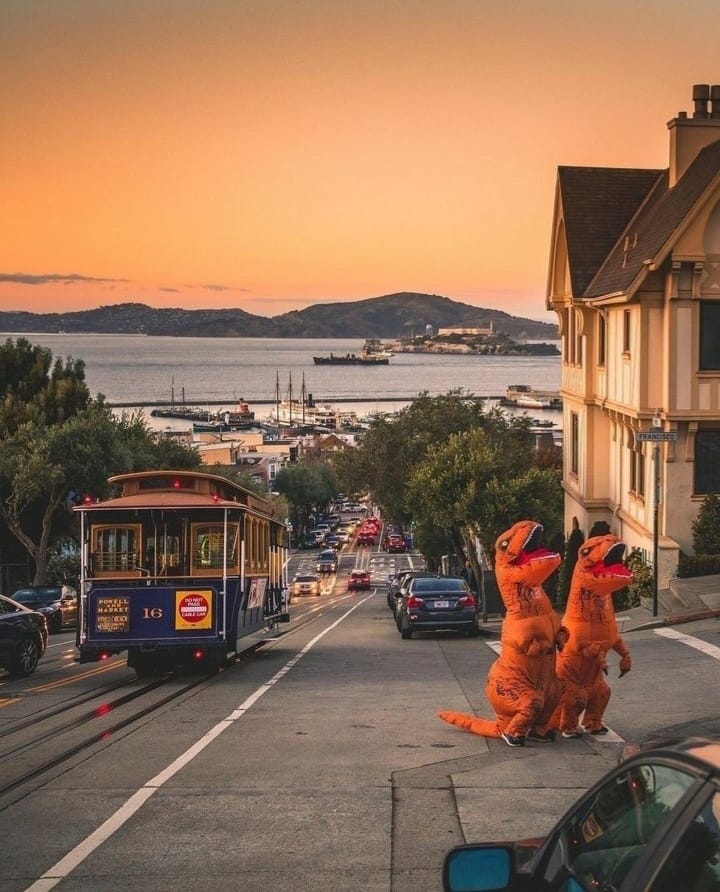
This meme depicts a humorous take on San Francisco's famous Union Square by placing two giant T-Rex costumes on the sidewalk, mimicking the city's iconic skyline. On the back of the blue cable car to the left, the text reads "FORSELLER PARK & MARKET" and the number "16," while a street sign in the background clearly identifies the location as "FRANCISCO." The image cleverly connects the specific San Francisco geography with the "T-Rexes" internet phenomenon.
simple-description (llama3.2-vision_11b)
This meme features two people dressed in full-body "Dinosaur" costumes, commonly referred to as "Dinos" or "T-Rex" suits, standing in the middle of a San Francisco street, likely in the Fisherman's Wharf area, with the iconic cable car tracks and a beautiful view of the Bay Bridge in the background. The meme is likely a humorous take on the city's popular tourist attractions and the absurdity of seeing people in these costumes in a normally mundane setting.
detailed-analysis (gemma3-27b-vision)
Okay, here’s an analysis of the image, broken down into the requested sections. I’ll include a section header only if the image lends itself to that particular lens. Be aware that applying these theories is interpretive, and there can be multiple valid readings.
Visual Description
The image depicts a steeply inclined street in San Francisco, most likely Lombard Street (known for its curves) or a similar hillside street. A historic San Francisco cable car is moving downhill, prominently positioned on the left side. The background features a wide view of the bay, complete with boats and distant hills. The sky is saturated with warm orange and golden tones, suggesting either sunrise or sunset. On the right side of the street, two individuals are dressed in bright orange dinosaur costumes, standing near the curb. Cars are driving along the road, and the architecture on the right suggests Victorian or early 20th-century building styles. The foreground includes the corner of a modern car, providing a sense of the photographer's perspective. The overall impression is vibrant, slightly surreal, and captures a quintessential San Francisco scene.
Foucauldian Genealogical Discourse Analysis
The image can be analyzed through a Foucauldian lens by examining the discourses embedded within it.
- The Cable Car Discourse: The cable car isn't just transportation; it's a symbol of San Francisco's history, a constructed "heritage" discourse. It signifies a romanticized past, a deliberate attempt to preserve and present a specific narrative of the city. Its existence is framed by tourist-oriented discourses of "authenticity" and "experience."
- The Tourism Discourse: The presence of the dinosaur costumes is strongly linked to tourism. It represents a form of performative street culture designed to attract attention and, potentially, money (through tips or photos). This aligns with the rise of "experiential tourism" where spectacle and novelty are key. The costumes, while seemingly frivolous, are part of the practices that constitute this tourism discourse.
- The Urban Landscape as Discourse: The steep street and Victorian architecture are not neutral elements. They are historical products of urban planning, economic forces, and aesthetic preferences. They speak to a specific history of development and the construction of an urban identity. The arrangement of the landscape itself creates a discourse of spatial control and representation.
A genealogical approach would investigate how these discourses emerged historically—the power relations that shaped the preservation of the cable car, the development of street performance culture, and the aesthetic choices that define the city’s look.
Critical Theory
The image can be approached through the lens of Critical Theory, focusing on the power dynamics and ideological undercurrents.
- Commodification of Culture: The dinosaur costumes are a clear example of the commodification of culture. What began as playful expression has been potentially transformed into a means of economic gain. This fits the Critical Theory emphasis on how capitalism transforms authentic experiences into marketable commodities.
- Spectacle and Alienation: The scene arguably participates in a "society of the spectacle" (Debord). The focus on visually striking elements (cable car, costumes, sunset) risks overshadowing the real-life experiences of the city’s inhabitants. This spectacle contributes to a sense of alienation, where people are more concerned with consuming images than engaging in meaningful social interaction.
- The Constructed "Authenticity" of Place: San Francisco's image is heavily curated. The preservation of the cable car and the promotion of iconic landscapes contribute to a carefully constructed "authenticity" that serves both tourist economies and local identity narratives. Critical Theory would question who benefits from this construction and who is potentially marginalized.
Postmodernism
The image possesses several characteristics that resonate with postmodern thought.
- Hyperreality and Simulation: The scene blurs the lines between reality and simulation. The juxtaposition of the historical cable car with the anachronistic dinosaur costumes creates a sense of playfulness and disorientation. It’s a simulation of a San Francisco experience, rather than a straightforward representation.
- Pastiche and Intertextuality: The image combines elements from different historical periods and cultural references (Victorian architecture, prehistoric creatures). This creates a pastiche, a playful blend of styles and meanings. It invites multiple interpretations and rejects a singular, coherent narrative.
- Loss of Grand Narratives: The image doesn't support any single, overarching story. It celebrates diversity, juxtaposition, and the breakdown of traditional structures. This embodies the postmodern rejection of "grand narratives" (Lyotard) in favor of localized, fragmented experiences.
Queer Feminist Intersectional Analysis
While not immediately obvious, a Queer Feminist Intersectional analysis can explore how power, identity, and representation intersect in the image.
- Subversion of Normative Expectations: The dinosaur costumes, while playful, can be read as a subversion of normative expectations. They disrupt the conventional visual landscape of a historic city and challenge expectations of what belongs in that space. This disruption can be linked to queer aesthetics of visibility and disruption.
- Performance of Identity: The act of wearing the costumes itself is a performance of identity. While the intent may be lighthearted, it raises questions about who gets to perform, who gets to be seen, and who is excluded from public space.
- Spatial Politics: The steep street and the architecture reflect a history of urban planning that has historically marginalized certain groups. A queer feminist analysis would consider how access to and use of public space has been unevenly distributed based on gender, sexuality, and class. The image doesn't directly address this, but it provides a context for considering these issues.
It’s worth noting that this analysis relies on a more speculative reading of the image. Without further context, it's difficult to determine the motivations of the people wearing the costumes or the power dynamics at play.
Let me know if you’d like me to elaborate on any of these points or explore other theoretical frameworks!
simple-description (llama3.2-vision)
The meme is an image of two people in full-body T-Rex costumes standing on a San Francisco cable car track, looking out at the city's iconic Golden Gate Bridge. The image is captioned "When you're trying to get to the other side but you're stuck in traffic".
tesseract-ocr
i y WZ. o-- —— ‘Cae er “ ead oa Z a; | i. a i a, <p 5 5 | 38 =: Jalal azz Ne RS se! a a A Ae fe