First Seen
2024-06-13T21:36:38.613851+00:00
simple-description (qwen3.5_2b-q8_0)
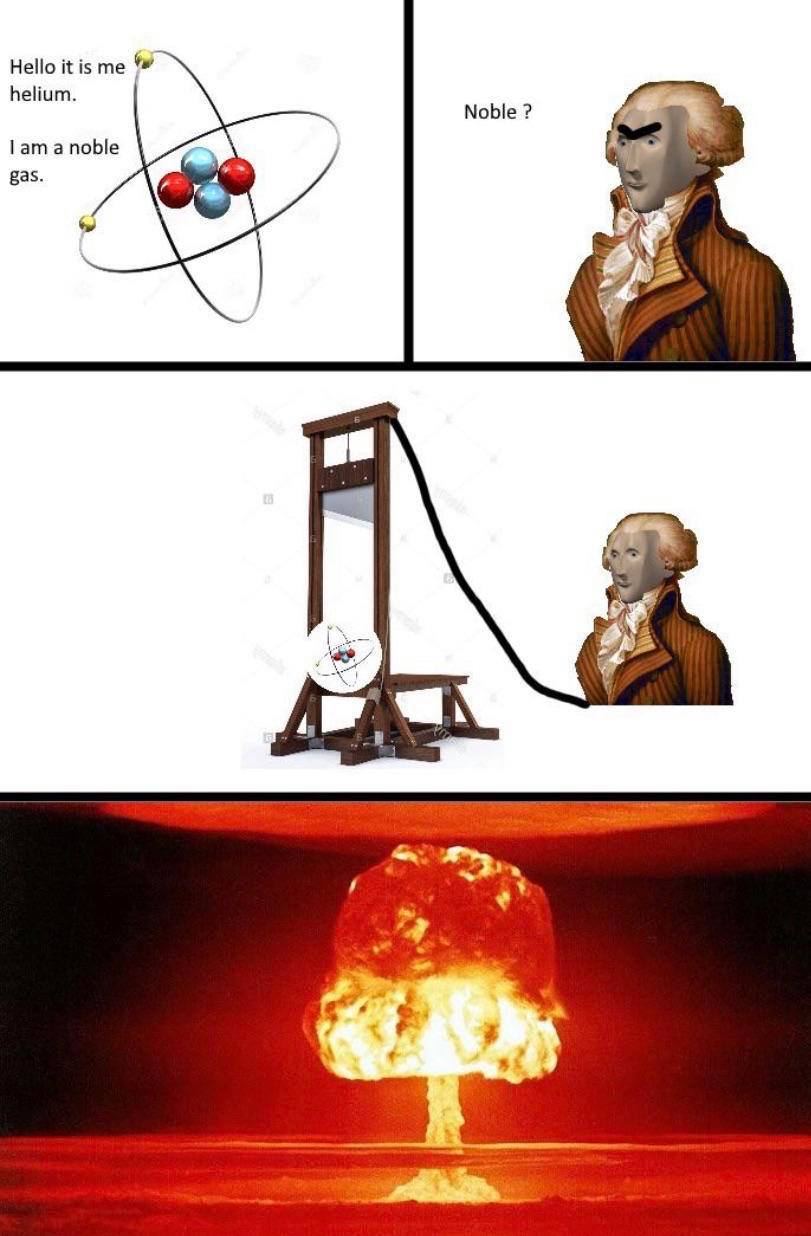
The top panel introduces Helium, a noble gas known for its chemical inertness, as a character who is unreactive and safe. The middle panel depicts the character being executed on a guillotine, with the text "I am a noble gas" visible on the blade, playing on the slang that "I am a noble gas" means "I am dead." The bottom panel shows an explosion, serving as a pun on the word "Helium" sounding like "Hell-ium," suggesting that the concept of "noble gas" eventually leads to an explosive end.
simple-description (llama3.2-vision_11b)
The meme is a humorous comparison between the scientific concept of helium, a noble gas, and the historical figure of Maximilien Robespierre, who was known as "The Incorruptible" and was executed by guillotine. The meme uses a playful juxtaposition of these two concepts to poke fun at the idea of a "noble" gas being associated with a brutal and violent historical figure. The image likely features a picture of Robespierre with a caption that reads "I am a noble gas" in a humorous and ironic tone.
detailed-analysis (gemma3-27b-vision)
Okay, let's break down this image with the requested theoretical lenses. It’s a complex and somewhat absurdist image, so the interpretations will be layered.
Visual Description
The image is a four-panel comic/meme.
- Panel 1: Depicts a simplified diagram of a helium atom, with electrons orbiting the nucleus. Text reads: "Hello it is me helium. I am a noble gas."
- Panel 2: Shows a portrait of a man in 18th-century aristocratic clothing (likely intended to be a representation of nobility). A question mark hovers above his head next to the word “Noble?”
- Panel 3: Features a guillotine, a significant symbol of the French Revolution, with the helium atom diagram positioned where the blade would fall. The man from Panel 2 stands nearby, seemingly connected to the guillotine by a black line.
- Panel 4: Shows a large, bright nuclear explosion. The background is red and the mushroom cloud dominates the frame.
The imagery shifts dramatically, moving from scientific representation to historical symbol to a catastrophic event. This abruptness is key to understanding the meme's potential meanings.
Foucauldian Genealogical Discourse Analysis
This image lends itself well to a Foucaultian reading. Foucault focused on how knowledge and power are intertwined, creating "discourses" that shape our understanding of the world.
- Discourse of Nobility: The image initially draws a parallel between the ‘nobility’ of a noble gas (chemically inert, stable) and the social nobility of the aristocracy. This connection is immediately disrupted. Foucault would be interested in how the concept of nobility has been historically constructed and used to justify power structures.
- Discourse of Science/Atomism: The image introduces the scientific concept of helium, seemingly innocuous, and links it to the historical discourse of revolution. This could be interpreted as the destabilization of a previously stable system through a scientific “force.”
- Genealogy of Power: The guillotine is a central figure. Foucault explored how punishment evolved, becoming less about physical torture and more about normalizing and controlling populations. The guillotine, while brutal, represented a "rational" form of state-sanctioned violence. The connection of the noble man to the guillotine (the line) suggests the inevitable end of aristocratic power, not as a spontaneous event, but as the result of historical forces. The progression through the panels can be seen as tracing the genealogy of a shift in power.
- Disruption of Discourse: The final panel, with the nuclear explosion, violently disrupts all previous discourses. It suggests an ultimate instability, a radical and total destruction that transcends the historical context of the French Revolution. It represents an escalation of violence that breaks down traditional categories of power.
Critical Theory
A critical theory lens, particularly drawing from the Frankfurt School, can interpret this image as a commentary on the modern condition.
- Enlightenment and its Discontents: The image suggests that the Enlightenment project, with its emphasis on reason and progress, has culminated in a terrifying outcome – nuclear devastation. The initial reference to science (helium) and the historical association of the French Revolution with Enlightenment ideals sets this up.
- Instrumental Reason: The image can be seen as a critique of “instrumental reason,” where reason is used as a tool for domination and control, rather than as a means of achieving human emancipation. The progression from noble gas, to revolution, to nuclear explosion, suggests the unintended consequences of applying reason without ethical considerations.
- Domination of Nature: The image hints at the domination of nature. Helium, as an element, exists outside of human social structures. The image suggests that by manipulating nature (represented by science and technological advancement), we have created a force that could destroy us.
- Alienation: The absurdity of the meme and its visual juxtapositions contribute to a sense of alienation. The image leaves the viewer unsettled, reflecting the anxieties of modern life and the feeling of powerlessness in the face of overwhelming forces.
Marxist Conflict Theory
A Marxist reading would focus on the underlying class conflict and power dynamics represented in the image.
- Revolution and Class Struggle: The guillotine is, of course, a key symbol of the French Revolution, which was a struggle between the aristocracy and the rising bourgeoisie. The image positions the “noble” figure as the target of revolutionary violence.
- Historical Materialism: A Marxist would see the progression from noble gas to nuclear explosion as a manifestation of the contradictions inherent in the development of capitalism. The pursuit of technological advancement, driven by the need for profit and accumulation, ultimately leads to destructive forces.
- Ideology: The image can be interpreted as a critique of the ideology of nobility and class privilege. The "noble" figure is shown as ultimately vulnerable and powerless in the face of historical forces.
- The State: The guillotine represents the power of the state to enforce class rule. The nuclear explosion suggests a level of state power that is potentially catastrophic.
Postmodernism
This image fits nicely within a postmodern framework, highlighting themes of fragmentation, irony, and the breakdown of grand narratives.
- Simulacra and Simulation: The image is a simulation of historical events and scientific concepts. It doesn’t necessarily represent anything real, but rather creates a series of signs that refer to other signs.
- Irony and Parody: The juxtaposition of the helium atom, the aristocratic figure, the guillotine, and the nuclear explosion is intentionally absurd and ironic. It undermines any straightforward interpretation.
- Deconstruction of Meaning: The image challenges the idea that there is a single, fixed meaning. It opens up multiple interpretations, depending on the viewer’s perspective.
- Meta-Narrative Breakdown: The image suggests that the grand narratives of progress, reason, and revolution have failed. It emphasizes the fragmentation and instability of the modern world.
Queer Feminist Intersectional Analysis
While not immediately obvious, a queer feminist intersectional analysis can reveal layers within the image.
- Challenging “Noble” Ideals: The term "noble" itself is loaded with patriarchal and class-based connotations. The image can be seen as a deconstruction of these ideals, challenging the traditional notions of masculinity and privilege associated with nobility.
- Violence and Power: The guillotine and the nuclear explosion represent extreme forms of violence. A feminist analysis would highlight how violence is often used to maintain patriarchal power structures.
- Disrupting Linear Time/History: The image doesn't follow a straightforward historical narrative. It collapses different time periods and concepts, disrupting the traditional, linear view of history. This disruption can be seen as a way of challenging dominant historical narratives that marginalize the experiences of women and other marginalized groups.
- Deconstruction of Binary Oppositions: The image disrupts the binary opposition between "noble" and "revolutionary." It suggests that both concepts are complex and fraught with contradictions.
Important Note: This is a complex image, and these interpretations are not mutually exclusive. The meaning of the image is open to debate and will depend on the viewer’s own perspective and theoretical framework. The layers of meaning are the strength of the meme!
simple-description (llama3.2-vision)
This meme is a play on the classic "Hello, I am a [insert noun] from [insert planet/origin]" joke. The meme starts with a typical "Hello, I am a" introduction, but instead of a typical noun, it says "I am a gas, specifically helium". The punchline is a humorous and unexpected twist on the classic joke.
tesseract-ocr
Hello itis me helium. ‘ Noble ? ; lama noble " wy gas. ‘an Ms o Le / = \\ i ; A Hy a 4 Lp’ tH Y S 4 5 BS a eras a f i LF a . a j 2 eis 2 sibs a —