First Seen
2023-05-10T21:03:40+00:00
simple-description (llama3.2-vision_11b)
The meme is an image of a person with a blank expression, but with a thought bubble that contains the text "I can explain it better than a TV book". This meme is related to the topic of science because it is a humorous take on the idea that a person can explain a complex scientific concept in a simple way, even if it's not actually possible.
detailed-analysis (gemma3-27b-vision)
Okay, let's break down this image using the requested theoretical lenses.
Visual Description
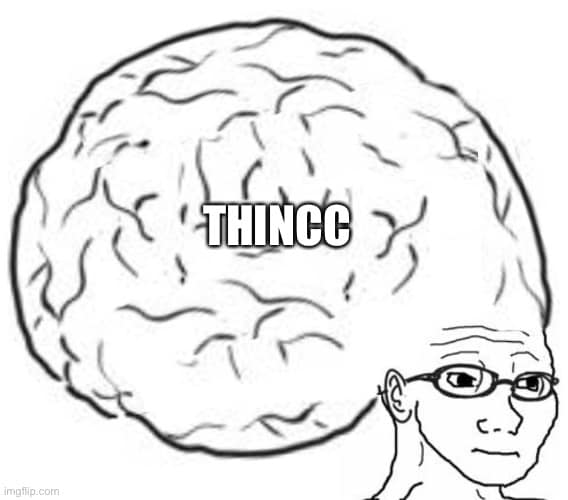
The image is a stark black-and-white line drawing, a meme format known as the "NPC" or "Brah" meme. It depicts a side profile of a head with exceptionally large, highly convoluted brain, occupying most of the frame. The brain is rendered with a network of deep folds, exaggerated to the point of comical absurdity. Superimposed on the brain is the word "THINCC" in bold capital letters. The face associated with this massive brain appears to be a cartoonish, vaguely male rendering of a face with glasses and a slight smirk. The overall aesthetic is deliberately crude and minimalist, resembling internet meme culture. It's a visual representation of overthinking, or a claimed intellectual superiority, often used ironically.
Foucauldian Genealogical Discourse Analysis
This meme's significance can be traced through Foucault's lens. The very notion of a "large brain" as a symbol of intelligence is a discourse – a system of thought, language, and practice – that shapes how we understand knowledge and authority. Tracing its genealogy would reveal how the association of brain size with intellectual capacity has developed over time, influenced by scientific racism in the 19th and early 20th centuries (craniometry) and later absorbed into popular conceptions of genius.
The meme parodies this discourse. The exaggerated brain size, combined with the deliberately simplistic and ironic word "THINCC," destabilizes the traditional connection between physical attributes and intellect. It suggests that intellectual posturing (claiming to be “thinking”) can be divorced from genuine understanding. The meme actively participates in a counter-discourse, highlighting the performance of intelligence, rather than its actual attainment. The "THINCC" inscription is a performative utterance, a claim to intellectual prowess that is undercut by the meme’s intentionally absurd aesthetic.
Critical Theory
From a critical theory perspective, particularly informed by the Frankfurt School, this meme can be viewed as a symptom of a broader societal alienation. The exaggerated brain symbolizes the hyper-rationalization and instrumental reason that critical theorists like Adorno and Horkheimer critiqued. The "THINCC" inscription suggests an obsessive need for cognitive control and a reduction of all things to intellectualization.
The meme's ironic tone suggests a critique of a culture that fetishizes intellect while simultaneously diminishing genuine connection and lived experience. The large brain, divorced from any relatable human features, can be seen as an allegory for the alienation of the modern individual – obsessed with abstract thought at the expense of emotional and social intelligence. It echoes the critical theory idea that the “Enlightenment” project of reason, when taken to an extreme, can become a form of domination.
Marxist Conflict Theory
From a Marxist perspective, this meme can be analyzed in terms of ideology and class. The meme, circulating primarily within online spaces, often utilized by digitally native generations, could be interpreted as a commentary on intellectual elitism. The exaggerated brain, as a symbol of intellect, represents a form of cultural capital.
The "THINCC" inscription can be viewed as a subtle display of this capital, a way of signaling intellectual superiority to others within the online community. This, in turn, reinforces social hierarchies and power dynamics. The ironic tone of the meme could be read as a subversive critique of this system, or alternatively, as a way to reaffirm one’s own position within it. The meme’s circulation within the sphere of internet culture, itself a space often marked by competition for attention and status, reinforces this dynamic.
Postmodernism
This meme is deeply embedded in postmodern sensibilities. Its ironic tone, self-referentiality, and deliberate undermining of grand narratives are all hallmarks of postmodern thought. The exaggeration of the brain, coupled with the simplistic text, creates a pastiche – a playful imitation that deconstructs the conventional association between brain size and intelligence.
The meme challenges the very notion of objective truth. It suggests that "thinking" is not a straightforward process but rather a performance, a social construct. The "THINCC" inscription is a signifier with no fixed meaning, its interpretation dependent on the context and the individual viewer. It exemplifies the postmodern concept of simulacra and simulation – the idea that representations of reality have become more real than reality itself. The meme doesn't claim to be intelligence, it is a representation of intelligence that is divorced from its substance.
Queer Feminist Intersectional Analysis
Analyzing this meme through a queer feminist intersectional lens presents some challenges, as its explicit content doesn't directly address issues of gender, sexuality, or race. However, we can explore its implicit implications.
The emphasis on intellect, framed ironically, could be seen as reinforcing the historical privileging of rationality as a masculine trait. Historically, patriarchal systems have often associated intelligence with masculinity, while devaluing emotional intelligence and intuition, traits often associated with femininity.
The meme’s circulation within online spaces, often dominated by white men, could contribute to the erasure of other voices and perspectives. The ironic tone, while potentially subversive, could also be used to dismiss or invalidate the experiences of marginalized groups. The meme's lack of explicitly addressing intersectional themes subtly reinforces the dominance of certain intellectual traditions and perspectives.
It’s important to note that this analysis requires careful consideration of the context in which the meme is shared and received. It’s crucial to avoid essentializing interpretations and to recognize the complexity of social dynamics.
I hope this detailed breakdown is helpful! Let me know if you'd like me to explore any of these lenses further.
simple-description (llama3.2-vision)
This meme is a picture of a man with a thought bubble above his head. The thought bubble contains the text "THINCC" (which is a typo of "THINC"), implying that the man is thinking about something, but his brain is too lazy to come up with a coherent thought. The image is a humorous commentary on the idea that sometimes, even when we're trying to think, our brains can be a bit... fuzzy.
tesseract-ocr
(on YD (.) Ss ' «eft 9, A) 3 ot /\ QC US Se ¢ NS?