First Seen
2023-05-10T21:03:40+00:00
simple-description (llama3.2-vision_11b)
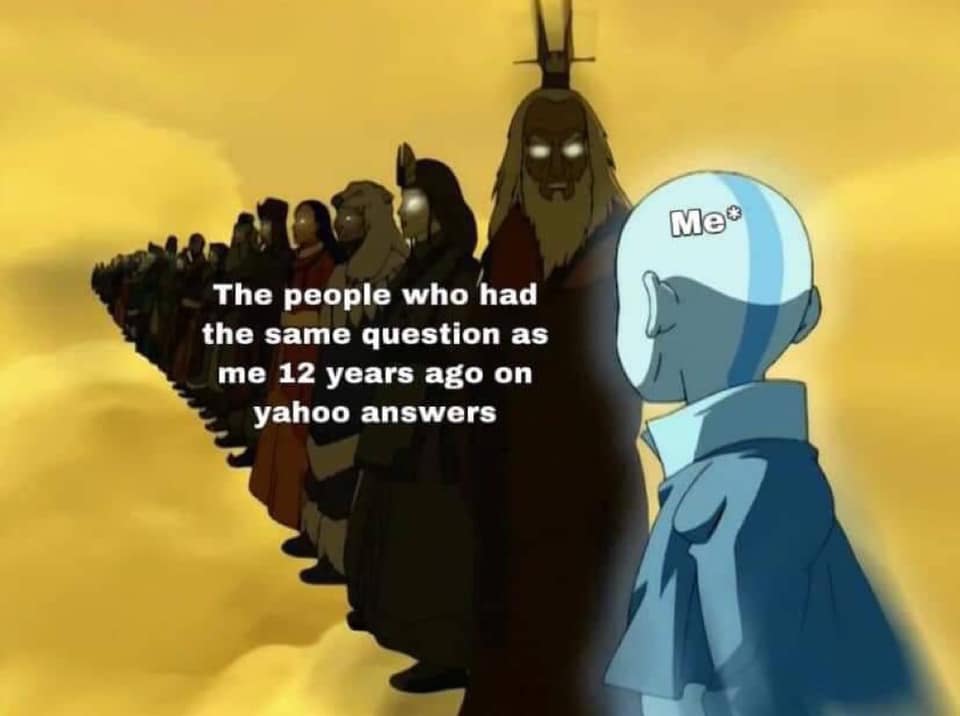
The meme is a humorous take on the idea that some scientific concepts have been around for so long that they seem to have been explained before, even if that's not actually the case. The image is likely a cartoon or illustration of a person looking at a long line of people, with the text "The people who have been saying this for decades" appearing above them. The meme is poking fun at the idea that some scientific concepts have been around for so long that they seem to have been explained before, even if that's not actually the case.
detailed-analysis (gemma3-27b-vision)
Okay, here's an analysis of the image, broken down into relevant sections as you requested. Given the nature of the meme, some sections will be more applicable than others.
Visual Description
The image is a digital manipulation (a meme) based on scenes from Avatar: The Last Airbender. On the left, a large mass of firebenders from the Fire Nation are depicted. They are dressed in their traditional red and gold uniforms, and seem to be in a formation, possibly a marching or advancing line. They all appear to be looking forward.
On the right, a single figure stands, clearly digitally inserted. This figure is Katara, a waterbender from the show, wearing an oversized, blue-hooded cloak and a cap with the word "Me" written on it. She appears isolated and standing apart from the mass of firebenders. The background is a yellow-orange hue, possibly indicative of a landscape within the show's setting. The image is text-based with a caption that reads “The people who had the same question as me 12 years ago on yahoo answers”.
Foucauldian Genealogical Discourse Analysis
This image lends itself well to a Foucauldian analysis, focusing on the formation of knowledge and the power dynamics within discourse.
- Discourse and Power: The central theme of the meme is a shared question. This can be seen as a point of discourse – a system of thought, ideas, and practices. The large group of firebenders represents the “accepted” or “dominant” discourse – the collective of individuals who once engaged with this same question. The “Me” figure, standing apart, represents a potentially altered or updated perspective on that same question. The figure’s very separation suggests a disjunction in discourse.
- Genealogy: The reference to "12 years ago on Yahoo Answers" establishes a genealogy of this question. It traces the question's emergence within a specific historical context – the early internet, a platform for anonymous queries. This genealogy reveals the question wasn’t born in a vacuum, but evolved within a specific technological and social landscape.
- Knowledge/Power: The fact that so many people shared the same question speaks to a gap in knowledge or a common confusion. The image subtly suggests that the individual's present-day understanding of the question is "superior" because they've moved beyond it. This demonstrates how knowledge is intertwined with power – those who possess understanding (however slight) gain a degree of control over the discourse.
Postmodernism
The image exhibits several characteristics associated with postmodern thought:
- Fragmentation and Isolation: The stark contrast between the unified mass of firebenders and the solitary “Me” figure is a representation of postmodern fragmentation and the loss of collective identity. The “Me” is positioned as an isolated subject, no longer part of a shared narrative.
- Self-Referentiality: The meme format itself is self-referential. It’s a commentary on the act of asking questions online and the experience of searching for information. It’s not a direct answer to the question, but a meta-commentary on the process.
- Irony and Parody: The meme likely relies on a degree of irony. The person acknowledging the shared question isn’t necessarily claiming to have solved it, but rather highlighting the shared experience of being confused. The meme format itself is often used for humorous or self-deprecating commentary.
Critical Theory
While not a dominant theme, a critical theory perspective could be applied:
- Ideology and Conformity: The mass of firebenders can be seen as representing the forces of conformity and dominant ideology. The shared question may reflect a common set of assumptions or biases. The “Me” figure, by standing apart, represents a potential challenge to these assumptions.
- Subjectivity and Agency: The image subtly explores the concept of subjectivity. The individual’s recognition of the shared question, and their separation from the mass, suggests a degree of self-awareness and agency. They’ve recognized the shared issue and moved beyond it, asserting their individual perspective.
In summary: The image is a relatively simple meme, but it touches upon complex themes of knowledge, power, identity, and the search for information. The Foucauldian and Postmodern analyses seem to be the most relevant, highlighting the image's focus on discourse, fragmentation, and the self-reflexive nature of online culture.
simple-description (llama3.2-vision)
This meme is a humorous commentary on the fleeting nature of online conversations. The image shows a group of people standing in a line, with a figure in the back labeled "Me" and a figure in the front labeled "The people who had the same question as me 12 years ago on Yahoo Answers." The text "I still remember that one time I asked..." is implied, but not shown. The meme is poking fun at the idea that people can recall specific conversations from years ago, even if they seem insignificant or trivial.
tesseract-ocr
gaan | pie?) \ ae ty) Cm tM Et| s\ ) 4 ATT Teta del ty we / “Le years ago on a SF : yahoo answers \ 4 [