First Seen
2023-05-10T21:03:40+00:00
simple-description (llama3.2-vision_11b)
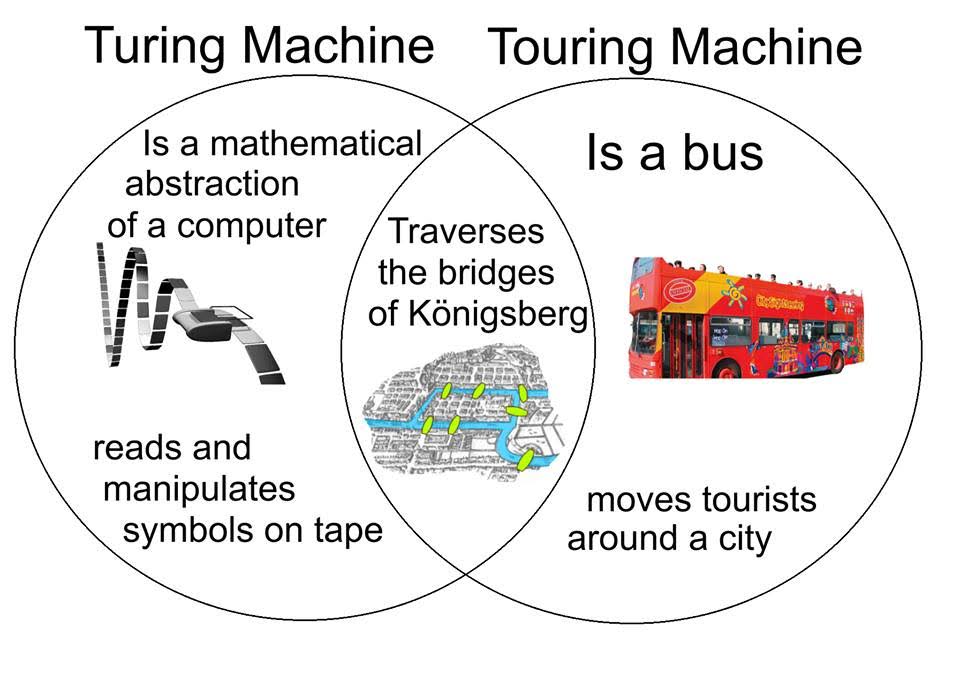
The meme is a comparison between a Turing machine and a tourist information machine (a.k.a. a tourist information board) in a city. The text in the image reads "Turing Machine: reads and writes symbols on an infinite tape; Tourist Machine: reads and writes symbols on an infinite map".
detailed-analysis (gemma3-27b-vision)
Okay, here's an analysis of the image, broken down into relevant theoretical frameworks, based on the provided prompt.
Visual Description
The image is a Venn diagram attempting to connect the concepts of a Turing Machine and a Tour Bus. The diagram’s overlapping sections indicate shared qualities. The left side depicts a stylized image of a Turing Machine, a theoretical device central to the foundations of computer science. It features a tape, a read/write head, and a state transition diagram. The right side shows a double-decker tour bus. At the center of the overlapping sections is an image of a graph representing the bridges of Königsberg, a classic problem in graph theory, solved by Euler. The labels around each element further clarify their functions: the Turing Machine “reads and manipulates symbols on tape”, the tour bus “moves tourists around a city”, and the shared center “traverses the bridges of Königsberg” and “is a mathematical abstraction of a computer”. The overall aesthetic is conceptual and aims to establish metaphorical links between seemingly disparate things.
Foucauldian Genealogical Discourse Analysis
This image can be read through a Foucauldian lens as a visual articulation of discourse and how knowledge is constructed. The act of equating a Turing Machine with a tour bus isn't a statement of fact, but rather a deliberate framing. It's a move to construct meaning, to position these concepts within a certain field of understanding.
- Power/Knowledge: The diagram suggests a particular way of knowing about computation. It implies that the essence of computation – the manipulation of symbols, the following of rules – can be found in the everyday act of moving people around a city. This framing potentially marginalizes other ways of understanding computation (e.g., focusing on its social impact, its hardware components). The diagram’s author exercises power through the construction of this specific knowledge regime.
- Genealogy: Tracing the history of both the Turing Machine and the tour bus reveals distinct lineages. The Turing Machine originates in a specific moment of mathematical and logical inquiry, aimed at formalizing the concept of computation. The tour bus, on the other hand, is a product of urban development, tourism, and transportation technology. The diagram dislocates these histories, bringing them together to suggest a hidden or obscured connection. It's a deliberate move to reshape our understanding of both concepts.
- Discursive Formation: The Königsberg bridges image acts as a mediating term. It provides a shared element – the idea of traversing a network according to specific rules. By situating both the Turing Machine and tour bus within this network, the diagram establishes a "discursive formation"—a grouping of statements and practices that define a particular way of talking about and understanding these concepts.
Critical Theory
The diagram can be interpreted through a Critical Theory lens focusing on the social implications of technology and the construction of rationality.
- Instrumental Rationality: The Turing Machine, as a symbol of abstract computation, represents a form of instrumental rationality—the pursuit of efficiency and control through logical, rule-based systems. The tour bus, in its function of efficiently transporting tourists, embodies a similar logic. The diagram suggests that this form of rationality pervades both the realm of abstract thought and everyday life.
- Reification: The diagram risks reifying (treating as a thing) abstract concepts like computation and transportation. It presents them as self-contained entities, potentially obscuring their social, political, and economic contexts. The diagram does not address, for example, who benefits from efficient computation or transportation, or who is excluded.
- Domination: The image implicitly suggests a logic of control. The Turing Machine "reads" and "manipulates" symbols; the tour bus "moves" tourists. This language evokes a sense of power and domination—of something imposing its will on something else. The diagram doesn't explore the potential for these systems to be used for oppressive purposes.
Marxist Conflict Theory
From a Marxist perspective, the image can be read as an example of how abstract concepts are used to justify and perpetuate existing power structures.
- Ideology: The diagram presents a seemingly neutral connection between the Turing Machine and the tour bus. However, this connection can be seen as an ideological move—a way of obscuring the inherent contradictions and inequalities of capitalist society. Both the Turing Machine (as a symbol of technological progress) and the tour bus (as a tool of consumerism) are products of a capitalist system.
- Alienation: The abstraction of the Turing Machine, while powerful, also distances us from the concrete realities of computation. It hides the labor, resources, and power dynamics that are involved in creating and maintaining digital infrastructure. The tour bus, by commodifying experiences and moving tourists through pre-defined routes, contributes to a form of alienation—a separation from authentic engagement with a place.
- Surplus Value: The efficient movement of tourists (the tour bus) and the efficient manipulation of information (the Turing Machine) both contribute to the creation of surplus value within a capitalist economy. This surplus value is extracted from labor and natural resources, and it reinforces existing class hierarchies.
Postmodernism
The image resonates with several key themes in Postmodern thought.
- Simulacra and Simulation: The connection between the Turing Machine and the tour bus is not based on any inherent similarity, but rather on a constructed simulacrum—a copy without an original. The image suggests that we live in a world where signs and symbols have become detached from their referents.
- Deconstruction: The diagram can be seen as an attempt to deconstruct the seemingly fixed meanings of these concepts. By juxtaposing them in an unexpected way, it challenges our assumptions about what computation and transportation are.
- Fragmentation and Hybridity: The diagram represents a form of hybridity—a mixing of different concepts and discourses. It reflects the fragmented, chaotic nature of contemporary culture. The diagram’s playful juxtaposition highlights the arbitrary nature of categorization and the impossibility of achieving a singular, unified understanding of the world.
Queer Feminist Intersectional Analysis
While this framework isn’t immediately obvious, it can still be applied to the image with some stretching, focusing on the systems of control and navigation embodied in the diagram.
- Mapping and Control: Both the Turing Machine and the tour bus involve systems of mapping and control. The Turing Machine maps out states and transitions; the tour bus maps out a pre-defined route. This can be linked to the ways in which dominant social norms and power structures attempt to map and control bodies and identities.
- Navigation and Resistance: The ability to navigate these systems is not equally distributed. Marginalized groups often face barriers to accessing and utilizing transportation, education, or technology. The diagram could be seen as a metaphor for the challenges faced by those who attempt to navigate oppressive systems.
- Intersectional Perspectives: Considering the diagram through an intersectional lens requires acknowledging how the experience of traveling on a tour bus, or utilizing computation, is shaped by multiple forms of oppression—based on race, gender, class, sexuality, and other factors. For example, a tour bus route may exclude certain neighborhoods or fail to cater to the needs of people with disabilities. Computation can be used to reinforce bias or to exclude certain groups from access to information.
I have attempted to analyze the image based on the provided theoretical frameworks. Some frameworks are more directly applicable than others, and the interpretations are necessarily somewhat speculative. Let me know if you'd like me to expand on any of these points or explore other theoretical lenses.
simple-description (llama3.2-vision)
This meme is a Venn diagram-style illustration comparing the characteristics of a Turing Machine (a theoretical model of a computer) and a Touring Machine (a fictional, humorous concept). The text in the image reads "Turing Machine: Is a mathematical abstraction of a computer. Reads and manipulates symbols on tape. Tours: Is a bus. Moves tourists around a city."
tesseract-ocr
Turing Machine Touring Machine Is a mathematical Is a bus abstraction of acomputer /Traverses ip a: the bridges ul Ss of Kénigsberg ' 4 Sem gaa. reads and BS ali manipulates ~_/ moves tourists symbols on tape around a city