First Seen
2023-05-10T21:03:40+00:00
simple-description (llama3.2-vision_11b)
The meme is a screenshot of a Reddit post titled "I'm a 30-year-old man, but I still love playing with Legos". The text explains that the author's friends and family are concerned about his "childlike" behavior, but he doesn't care and enjoys the freedom to play with toys as an adult. The meme is a humorous take on the idea that it's okay to be a kid at heart, and that adults can still have fun and be playful.
detailed-analysis (gemma3-27b-vision)
Okay, here's an analysis of the provided text snippet, broken down into sections based on the theoretical lenses you requested, with the caveat that some lenses don't readily apply given the limited text. I'll explain why some sections are missing or minimal.
Important Note: This is a preliminary analysis based on a very short text. A full, robust application of these theories would require the full source material and further context.
1. Visual Description
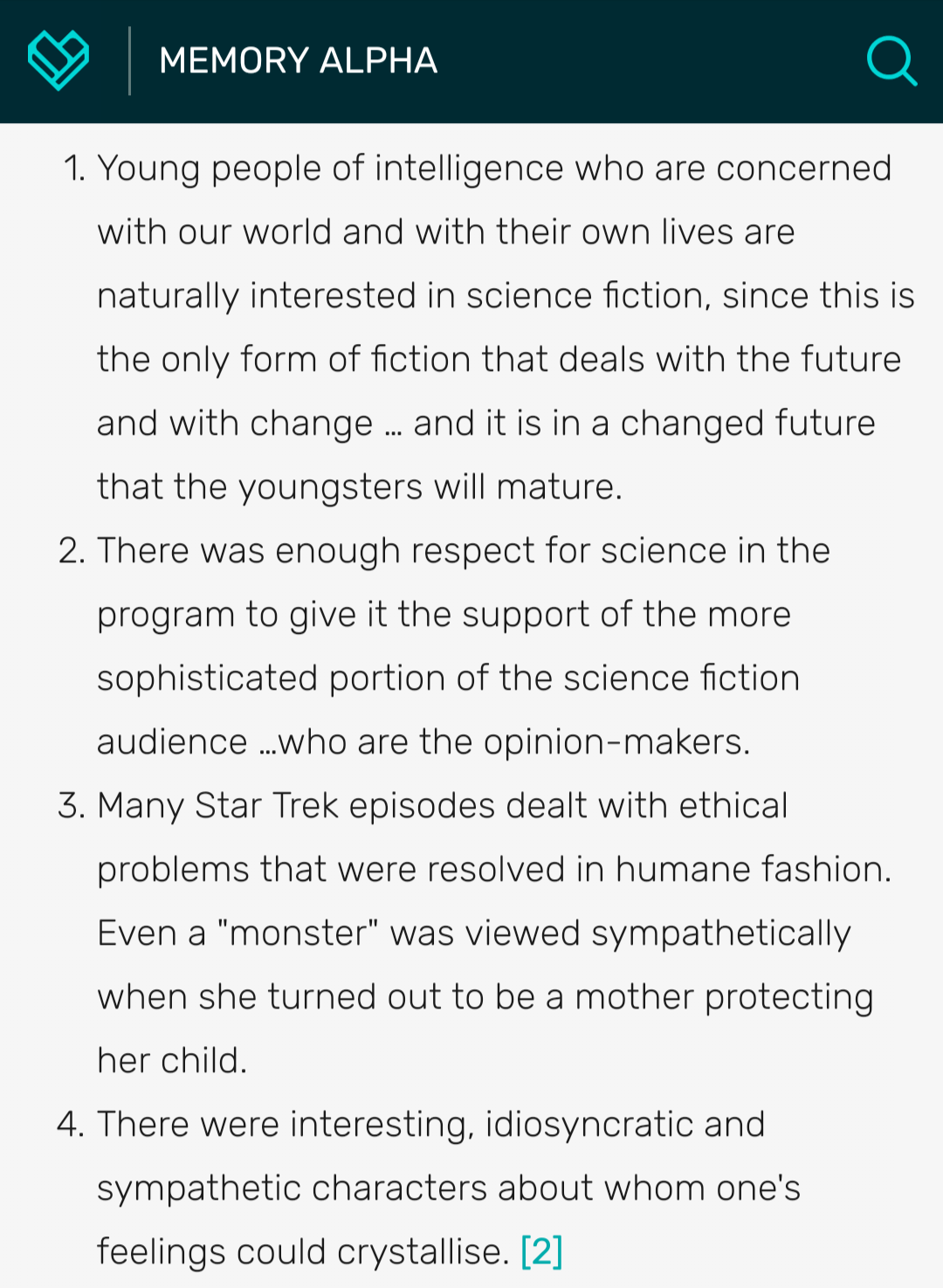
The image is a screenshot of a webpage, likely a wiki or database site called "Memory Alpha" (suggesting a Star Trek focus). The page is primarily text-based with a light background. The heading is in a darker shade, and there’s a small graphic element – a heart-like shape with a symbol. The overall design appears simple and functional, prioritizing information display over visual appeal.
2. Foucauldian Genealogical Discourse Analysis
This is probably the most fruitful lens for this limited text.
- Discourse: The text establishes a discourse around "science fiction" and its value, particularly as it relates to younger audiences. It constructs science fiction as the genre uniquely capable of addressing the future and change.
- Power/Knowledge: The text suggests a connection between valuing science fiction and being a "sophisticated" opinion-maker. It implies a hierarchy where appreciating sci-fi is linked to a position of authority and influence. There’s a subtle claim that valuing this genre is part of being "intelligent" and forward-thinking.
- Genealogy (limited): We can begin to trace a genealogy of how science fiction has been positioned as a "serious" form of literature over time. The text hints that recognizing its importance is a relatively recent development (within the context of "opinion-makers"). It's a claim being made within a historical flow of reception.
- Disciplinary Power: Implied is a kind of “training” of young minds through sci-fi, preparing them for a future change. Sci-fi is presented as a necessary element for dealing with a changing world.
3. Critical Theory
- Ideology: The text implicitly presents an ideology that promotes the value of intellectual curiosity, futuristic thinking, and the importance of understanding change. It's subtly encouraging a specific worldview where sci-fi is not just entertainment, but a vital component of intellectual development.
- Culture Industry (limited): The claim that science fiction is "for" the younger generation suggests a construction of culture aimed at specific demographics.
- Dominant Narrative: It positions science fiction as the genre for understanding change, potentially suppressing other modes of exploring the future.
4. Marxist Conflict Theory
This lens is a weak fit, but can be strained:
- Hegemony (very limited): The argument that sci-fi appeals to a "sophisticated" audience and "opinion-makers" suggests a potential attempt to establish the genre as culturally dominant.
- Ideological Apparatus: Sci-fi could be seen as an ideological apparatus, shaping the worldview of the younger generation to align with certain values (intellectualism, futurism).
5. Postmodernism
This is a very weak fit, and mostly based on inference.
- Meta-narrative challenge (minor): The text could be interpreted as a challenge to other "grand narratives" about understanding the future, by positioning science fiction as uniquely suited to this task.
- Simulation/Hyperreality: While not explicit, the emphasis on understanding "the future" could be seen as engaging with themes of simulation and the construction of reality.
6. Queer Feminist Intersectional Analysis
This lens does not apply. The text makes no reference to gender, sexuality, race, or other aspects of social identity relevant to queer feminist intersectional analysis. The focus is on intellectualism, futurism, and audience demographics.
Important Caveats:
- Limited Text: This analysis is highly constrained by the short text snippet. A full analysis would require the complete source material.
- Interpretative Flexibility: Many of these theoretical lenses are open to interpretation, and different scholars might draw different conclusions from the same text.
- Over-Application: Applying these theories when they don't readily fit can feel forced. I've tried to indicate where the application is weaker or more speculative.
Let me know if you'd like me to elaborate on any specific section or to explore different interpretations.
simple-description (llama3.2-vision)
The meme is a picture of a cartoon character from the show "Star Trek: The Next Generation" named Data, who is known for being an android with a human-like personality. The image is captioned with the text "Data's 'I'm not a robot, I'm a human'... said no one ever".
tesseract-ocr
1. Young people of intelligence who are concerned with our world and with their own lives are naturally interested in science fiction, since this is the only form of fiction that deals with the future and with change ... and it is in a changed future that the youngsters will mature. 2. There was enough respect for science in the program to give it the support of the more sophisticated portion of the science fiction audience ...who are the opinion-makers. 3. Many Star Trek episodes dealt with ethical problems that were resolved in humane fashion. Even a "monster" was viewed sympathetically when she turned out to be a mother protecting her child. 4. There were interesting, idiosyncratic and sympathetic characters about whom one's feelings could crystallise. [2]