First Seen
2025-05-12T05:53:09.167637+00:00
simple-description (qwen3.5_2b-q8_0)
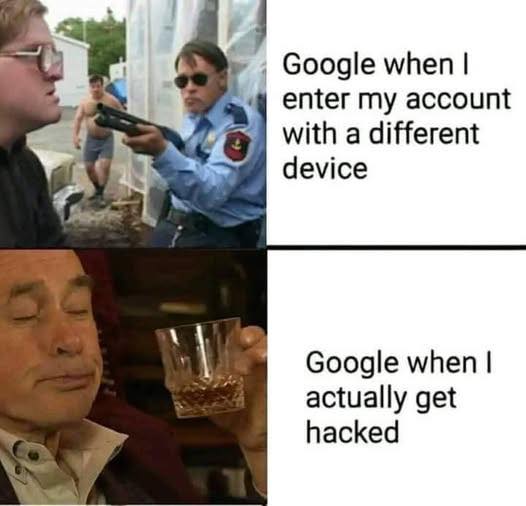
This meme uses security theater to present a fake realistic scenario about account security. In the top panel, a security guard points a gun at a person, which is the classic security theater trope of exaggerating normal security procedures into a scary reality. The text 'Google when I enter my account with a different device' and 'Google when I actually get hacked' appear in the meme, labeling the top and bottom panels respectively.
detailed-analysis (gemma3_27b-it-q8_0)
Okay, let's break down this meme through the lens of "Security Theater," and apply the relevant theoretical frameworks.
Visual Description
The meme employs a "Drake Hotline Bling" format.
- Top Panel: Shows a still from the movie The Terminal. A visibly disturbed man is being interrogated at close range by a security official wielding a shotgun. A bystander casually walks by in the background. The caption reads: “Google when I enter my account with a different device.”
- Bottom Panel: Shows a picture of actor Bryan Cranston with a disgusted and defeated expression, holding a glass of alcohol. The caption reads: “Google when I actually get hacked.”
The contrast is immediately apparent: an over-the-top, disproportionate response (shotgun interrogation) versus a dismissive, almost blasé reaction (a sour expression and a drink).
Foucauldian Genealogical Discourse Analysis
This meme strongly aligns with Foucault's concepts of power, surveillance, and discourse. The core of "security theater" relies on the performance of security, rather than actual security.
- Panopticon: Google's stringent verification processes when logging in from a new device function as a digital Panopticon. You know you're being watched, assessed, and categorized. The system is designed to make you modify your behavior (provide verification codes, answer security questions) even though the actual risk of immediate harm is low. The threat isn’t primarily preventing hacking, but enforcing normalization and conformity to Google’s system.
- Discourse of Security: The meme exposes the discourse around digital security. The shotgun represents the forceful, demanding discourse deployed by Google's security protocols. The disgusted Cranston reflects the reality that despite all this security theater, a real security breach (hacking) receives a much milder response—primarily asking you to change your password, sometimes offering minimal support, and often blaming user error.
- Genealogy of Security: Foucault would trace the historical development of this dynamic. He'd look at how "security" has evolved from physical protection to a complex system of data collection, algorithmic assessment, and behavioral control—a system where the appearance of security has become more important than genuine protection.
- Power/Knowledge: Google exerts power through its knowledge of your login patterns, device information, and potentially, your habits. This knowledge allows them to dictate the terms of access.
Critical Theory
From a Critical Theory perspective, the meme highlights the ways in which power structures reinforce themselves through ostensibly neutral technologies.
- Ideology: The meme exposes the ideology underlying digital security. We're conditioned to accept the constant surveillance and verification as necessary for our safety. The meme challenges this acceptance, pointing out the hypocrisy of a system that’s overly aggressive at perceived low-level risk but relatively passive in the face of actual compromise.
- Commodification of Security: Security is increasingly a commodity. Google's security measures (and those of other tech companies) are often presented as value-added services, justifying data collection and control. The meme implies that this commodification prioritizes profit and control over actual user protection.
- False Consciousness: The user, by dutifully completing the verification steps, participates in their own subjugation. They internalize the idea that these procedures are essential, masking the fact that they largely serve Google's interests.
Marxist Conflict Theory
While less direct, a Marxist reading can be applied.
- Class Conflict: There's a power imbalance between the tech corporations (the "owners" of the data and the security systems) and the users (the "workers" providing the data and subjected to the systems). The meme shows how the security measures primarily benefit the owners, protecting their assets and data, while imposing burdens on the users.
- Alienation: Users become alienated from their own data and control over their digital lives. They are forced to navigate increasingly complex security protocols, feeling powerless against the systems controlling their access.
- Surplus Value: The data collected through these security measures is a form of "surplus value" that Google exploits for profit through targeted advertising, data analysis, and other services.
Postmodernism
A postmodern reading emphasizes the constructed nature of reality and the deconstruction of grand narratives.
- Simulacra and Simulation: The security theater is the reality. The actual threat of hacking becomes less important than the simulation of security provided by the verification process. The shotgun interrogation represents security, even if it doesn’t actually provide it.
- Deconstruction: The meme deconstructs the narrative of digital security. It challenges the idea that more security measures automatically equate to greater safety.
- Irony & Parody: The meme's humor is based on irony and parody. It’s a critique disguised as lighthearted commentary.
In Conclusion:
The meme is a potent critique of "security theater"—the performance of security without meaningful protection. It exposes the power dynamics at play in our digital lives, the ideological structures that reinforce surveillance, and the ways in which technology can be used to control and exploit users. It's a cynical but relatable commentary on a reality where the appearance of security often trumps actual security.
simple-description (llama3.2-vision_11b)
The meme is a humorous commentary on the security of online interactions. It shows a scenario where a person is trying to access their Google account, but the system is asking for a security question to verify their identity. The meme is saying that the security question is so absurdly easy to answer that even Google itself can't get it right.
detailed-analysis (gemma3-27b-vision)
Okay, let's break down this meme through the lens of various theoretical frameworks. Given the content, some sections will be more relevant/substantial than others.
Visual Description
The meme is a "drake posting" format, comparing two panels using reaction images from popular culture.
- Top Panel: Features a scene from the 2008 film "Burn After Reading". Brad Pitt (as Richard) looks disapprovingly at a man (CIA Agent Langley played by John Malkovich) brandishing a firearm.
- Bottom Panel: Shows a distressed, emotional close-up of John Malkovich in the same film, holding a glass of liquid.
- Text: The top panel is labeled "Google when I enter my account with a different device," and the bottom panel is labeled "Google when I actually get hacked."
The meme plays on the juxtaposition of a minor inconvenience (logging in from a new device, triggering security checks) versus a genuine security breach. The exaggerated, comedic images highlight the discrepancy in response.
Foucauldian Genealogical Discourse Analysis
This meme speaks volumes about the power dynamics enacted through digital surveillance and control.
- Discourse of Security: The meme reveals the dominant discourse of digital security. Google's responses (security questions, verification codes) when a new device is used, are presented as overreactions - akin to brandishing a gun. This suggests an anxiety-driven, preemptive control of access. It's not about actual danger, but about establishing control through constant vigilance.
- Genealogy of Surveillance: Tracing the "genealogy" of this behavior, we can see it emerges from a historical context of increasing data collection, risk assessment, and the expansion of power through knowledge. Google’s security protocols are not neutral tools, but historically-situated practices that define and shape our digital experience.
- Panoptic Effect: The system operates like a digital panopticon. The user knows they are being watched (or potentially watched) at all times, even if there's no immediate threat. This induces self-regulation – compliance with Google's demands to avoid being flagged as suspicious.
- Normalization of Control: By presenting the extreme reaction to a new device as “normal,” the meme subtly exposes the normalization of constant surveillance within the digital realm. It’s a discourse that renders excessive control palatable, turning us into willing subjects of constant monitoring.
Critical Theory
The meme reflects Critical Theory’s concern with power structures and social control.
- Instrumental Rationality: Google’s security measures, presented here, can be viewed as an example of "instrumental rationality" – a focus on efficiency and control, even if it comes at the expense of user experience or genuine security. The algorithm doesn't care about convenience; it prioritizes minimizing risk, regardless of the impact on the user.
- Culture Industry: The meme itself can be seen as a product of the "culture industry," commenting on and reinforcing our relationship with tech giants like Google. It’s a form of critique within the very system it questions, highlighting the complex interplay of power and resistance.
- False Consciousness: The disproportionate reaction to logging in from a different device, compared to a real hack, can be seen as a form of “false consciousness”. We’re distracted by the trivial inconveniences, while the more serious threat (actual hacking) remains obscured.
Marxist Conflict Theory
The meme, while not directly addressing class conflict, can be analyzed through a Marxist lens considering the power imbalances between tech corporations and users.
- Means of Production: Google controls the “means of production” in the digital realm – the infrastructure, algorithms, and data that shape our online lives. This control gives them significant power over users.
- Exploitation of Data: Users’ data is a key commodity in the digital economy. Security measures, like the ones highlighted in the meme, can be seen as a way to maintain control over this valuable resource.
- Alienation: The meme suggests a sense of alienation from the systems we rely on. We're subjected to constant monitoring and control, and our agency is diminished.
Postmodernism
The meme aligns with postmodern themes of simulation and the blurring of reality.
- Hyperreality: The meme highlights how our digital experiences are increasingly divorced from “real” life. The exaggerated reaction to logging in from a new device creates a sense of "hyperreality" – a simulated reality that feels more real than the actual threat of hacking.
- Irony and Parody: The meme uses irony and parody to critique Google’s security protocols. It’s a playful, self-aware commentary on the absurdity of our digital lives.
- Deconstruction: The meme "deconstructs" the idea of security by highlighting the discrepancy between perceived threats and actual threats. It questions the underlying assumptions and power structures that shape our digital experiences.
Note: The other theoretical frameworks (Queer Feminist Intersectional Analysis) are less directly applicable to the core themes of the meme, though it's possible to stretch those lenses if one were so inclined. For example, one could argue that digital security practices often reflect and reinforce existing power structures related to gender, race, and sexuality, but that’s a more indirect application.
Let me know if you'd like me to elaborate on any of these points or explore another theoretical framework!
simple-description (llama3.2-vision)
This meme is a play on the idea that Google's search results are often similar to what a user would search for themselves. The image shows a police officer asking a person to hand over their phone, while the person is saying "Google when I enter my password". The second image shows a person looking at a phone with a shocked expression, with the text "Google when I actually get hacked". The meme is poking fun at the idea that Google's search results are often so accurate that it's like they have access to your personal data, even when you're trying to keep it secret.