First Seen
2023-06-30T22:56:00+00:00
simple-description (qwen3.5_2b-q8_0)
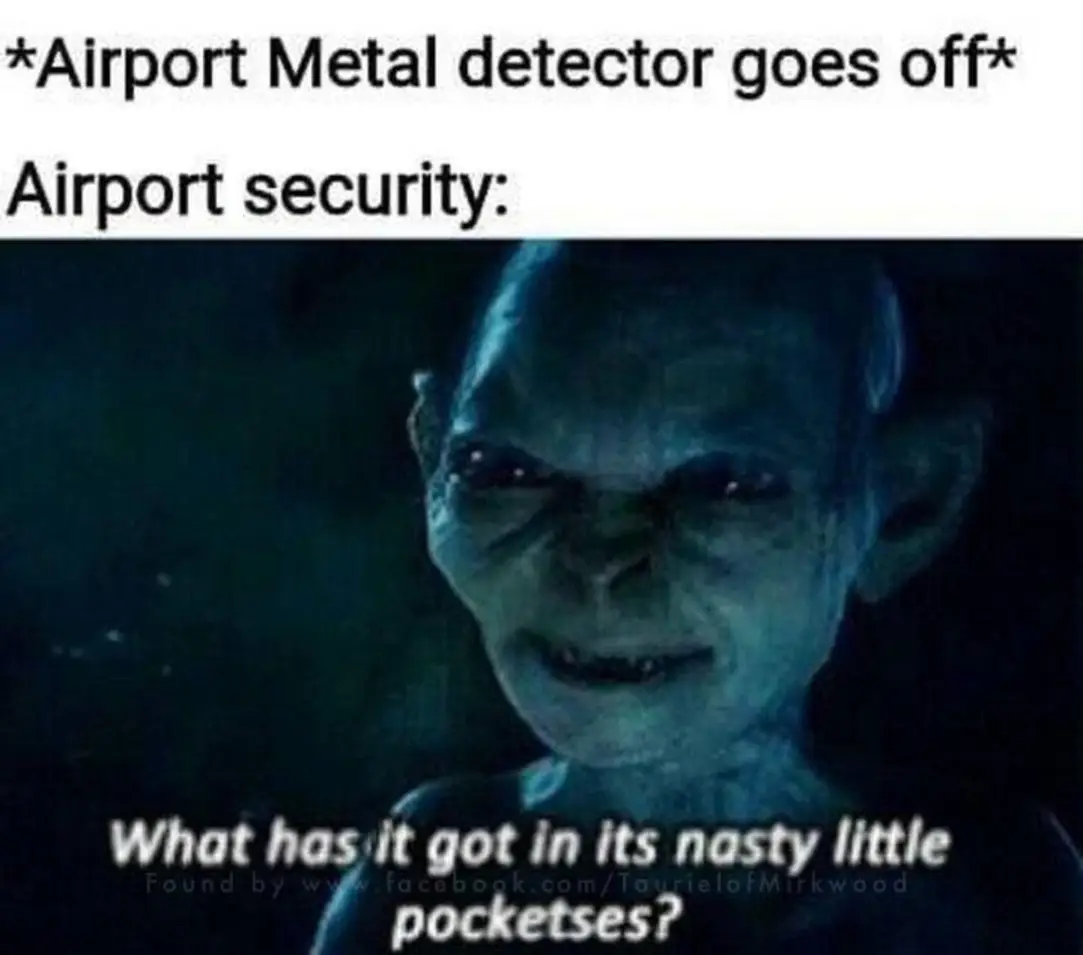
This meme parodies the line from the movie Security, played by Charlie Sheen, where the character asks a mysterious client, "What has it got in its nasty little pocketses?" The image recontextualizes this cryptic line to fit an airport setting, where "Airport metal detector goes off" triggers "Airport security" to ask the question "What has it got in its nasty little pocketses?" about whatever is in the metal detector.
simple-description (llama3.2-vision_11b)
This meme is from the category of Security Theater, which refers to the implementation of security measures that are intended to provide a sense of security, but are not actually effective in preventing security breaches. The meme is a play on the phrase "I can see your security cameras" and features a photo of Gollum from The Lord of the Rings, saying "What has it got in its pocketses?". The text at the top of the image reads "Airport Security: What has it got in its pocketses?". The meme is poking fun at the idea that airport security is often ineffective and that the security cameras are just for show.
detailed-analysis (gemma3-27b-vision)
Okay, let's break down this meme using the frameworks you've requested. It's a rich image for analysis, surprisingly.
Visual Description
The meme consists of an image of Sméagol (from Lord of the Rings), specifically in a close-up showing a distorted, unsettling facial expression. He looks menacing and suspicious. Overlayed text reads “Airport Metal detector goes off” and “Airport security: What has it got in its nasty little pocketsets?”. The color palette is predominantly dark and shadowy, adding to the ominous feel. The composition focuses heavily on Sméagol's face, emphasizing his predatory and questioning gaze.
Foucauldian Genealogical Discourse Analysis
This meme is powerfully resonant within a Foucauldian framework, particularly around themes of surveillance, power, and discourse.
- Discourse and Power: The meme subtly critiques the discourse surrounding airport security. The text attributes a deeply suspicious, almost hostile, internal monologue to airport security personnel. This demonstrates how airport security, as an institution, is constructed through specific ways of speaking, thinking, and acting. The framing of the question (“What has it got…”) assumes guilt before any evidence, aligning with a disciplinary power dynamic.
- Panopticism & Surveillance: The image evokes the idea of the Panopticon – a prison design where inmates are potentially watched at all times. Airport security functions like a modern Panopticon; travelers are subject to constant surveillance, and this creates a self-regulating effect (people often preemptively remove items to avoid scrutiny). The meme hints at the intrusiveness of this surveillance, framing security personnel as predatory, scrutinizing bodies for potential threats.
- Genealogy of "Threat": A genealogical analysis could ask: how did the concept of “security threat” come to be defined as it is today? The meme’s dark tone suggests a descent into paranoia, where everything is potentially dangerous and subject to intense scrutiny. This links to broader historical shifts in how we understand risk and security in the post-9/11 world.
Critical Theory
The meme operates well within the traditions of Critical Theory, specifically regarding the critique of rationalization, the dehumanizing effects of systems, and the creation of "the other."
- Rationalization and Instrumental Reason: The meme critiques the rationalizing forces of modern security systems. The metal detector is presented as a cold, impersonal tool. This system is implemented in the name of “safety” but operates by treating every individual as a potential suspect, reducing them to a set of measurable characteristics that might indicate a threat.
- Dehumanization: The language ("nasty little pocketsets") is deliberately derogatory and infantilizing. This represents the dehumanizing effect of the security process; the traveler is not seen as a person, but as a potential carrier of danger. The use of Sméagol, a creature who is itself already "othered" and diminished, reinforces this idea.
- Creating "The Other": The meme implicitly highlights the creation of “the other”. The traveler, by triggering the metal detector, becomes an object of suspicion, separated from the normalized, "safe" population. The language suggests a degree of animosity and distrust towards this “othered” individual.
Marxist Conflict Theory
While not as overtly Marxist as some examples, the meme hints at power dynamics stemming from class and control.
- Control and Surveillance as Tools of Power: From a Marxist perspective, airport security can be seen as a mechanism by which those in power maintain control over the movement of people (and thus, potentially, their labor and access to resources). The meme, by portraying security personnel as aggressive and distrustful, highlights the inherent power imbalance in this relationship.
- Alienation: The image evokes a sense of alienation. The traveler is treated as a suspect, stripped of their agency, and subjected to scrutiny. This reflects a broader Marxist theme of alienation in modern capitalist society, where individuals are reduced to cogs in a machine.
- Ideology and Justification: The meme subtly questions the ideology that justifies this level of security. The assumption of guilt before evidence is presented suggests a system built on fear and mistrust, perpetuated by those who benefit from maintaining control.
Postmodernism
The meme resonates with postmodern themes of distrust of grand narratives, questioning authority, and the instability of meaning.
- Parody and Irony: The meme utilizes parody. It juxtaposes the image of Sméagol, a fictional character, with a very real-world scenario. This creates a layer of irony and suggests that the security process is often absurd and irrational.
- Deconstruction of "Security": The meme implicitly deconstructs the concept of "security." It suggests that security is not a neutral or objective concept, but rather a constructed ideology that serves specific power interests. The exaggerated suspicion in the text suggests that the quest for absolute security is ultimately unattainable and potentially oppressive.
- Instability of Meaning: The image and text together create an ambiguous meaning. It’s not clear whether the meme is genuinely critical of security or simply a playful observation. This ambiguity reflects a postmodern distrust of fixed meanings and the importance of interpretation.
Queer Feminist Intersectional Analysis
This framework is a bit of a stretch, but certain interpretations are possible.
- Differential Treatment & Surveillance: Airport security, like many systems of control, can disproportionately target and subject marginalized groups (people of color, trans/gender non-conforming individuals, Muslims, etc.) to increased scrutiny and surveillance. The meme’s portrayal of suspicion can be seen as a microcosm of these broader patterns of discrimination.
- Body Policing & Control: The security process is inherently about policing bodies and controlling movement. This can be particularly invasive and harmful for individuals whose bodies are already subject to societal regulation and scrutiny.
- Power Dynamics & Vulnerability: The meme highlights the power dynamic between security personnel and the traveler, creating a situation of vulnerability. This vulnerability can be exacerbated for individuals who are already marginalized and subject to systemic oppression.
Important Note: This is an interpretive exercise. The meaning of the meme is open to debate, and different individuals will likely interpret it in different ways. The above analysis provides a framework for understanding the meme through various critical lenses.
simple-description (llama3.2-vision)
This meme is a play on the classic "I see dead people" line from The Sixth Sense, but with a twist. The image depicts a security camera with a dead body in the background, but instead of a body, it's a security guard who's been dead for 20 minutes. The text reads "I see dead people... but they're not always people".
tesseract-ocr
*xAirport Metal detector goes off* Airport security: , _ What has. it got in its nasty little f pocketses?