First Seen
2023-05-10T21:03:40+00:00
simple-description (llama3.2-vision_11b)
The meme is a screenshot of a conversation between two individuals. One person asks "What's intersectionality?" and the other responds with "It's when you're black, but not black enough to be black". This response is a commentary on the complexities of identity and the nuances of intersectionality, highlighting the ways in which individuals can be marginalized or excluded from certain groups.
detailed-analysis (gemma3-27b-vision)
Okay, here's an analysis of the text message exchange, broken down into sections relevant to the theoretical frameworks you've requested. I'll indicate when a section is not applicable.
Visual Description
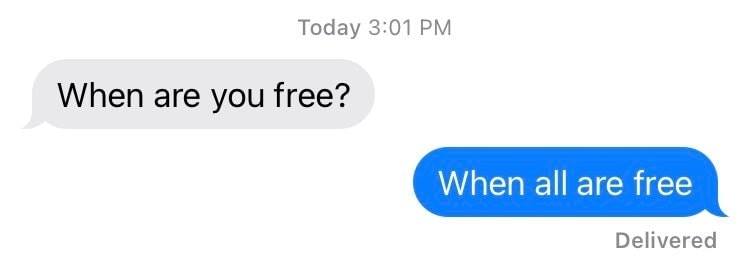
The image shows a screenshot of a text message exchange. The first message, in a light gray bubble, asks “When are you free?”. The second message, in a blue bubble, replies “When all are free.” Below the messages are timestamps ("Today 3:01 PM" and "Delivered"). The aesthetic is minimalistic, reflecting the simplicity of a contemporary digital communication interface. The colors (gray and blue) and the bubble format are standard for this particular messaging platform.
Foucauldian Genealogical Discourse Analysis
This exchange is a rich site for a Foucauldian analysis. The question "When are you free?" seems straightforward, but carries within it power dynamics and the logic of biopower. Historically, questioning someone’s “free” time is a manifestation of the need to schedule, organize, and ultimately, discipline their time. This connects to broader discourses around productivity, labor, and the normalization of being constantly available or occupied.
The response, "When all are free," disrupts this assumed power dynamic. It’s a move against the normalizing force of scheduling and control. It posits a vision of freedom not as an individual capacity, but as a collective condition.
The genealogy would explore how the idea of “free time” evolved—from perhaps periods of respite in pre-industrial life to a commodity within a capitalist system (leisure time, vacation days). The response challenges the very notion of individual, isolatable free time, suggesting it is inherently tied to the liberation of others. It’s a refusal to participate in the logic of managing time for the purposes of production.
Critical Theory
From a Critical Theory perspective, the exchange highlights the illusory nature of individual autonomy within systems of power. The initial question, ostensibly about coordinating schedules, implicitly reinforces the structure of a rationalized, capitalist society where time is a resource to be managed and maximized for efficiency.
The response is a subtle resistance. It challenges the underlying assumption that "free" time is something one possesses individually. Instead, it frames freedom as contingent on the liberation of all. It hints at a broader critique of social inequality, suggesting that true freedom is impossible when some are oppressed or constrained. The response suggests freedom isn’t merely about having availability, but about dismantling structures of domination.
Marxist Conflict Theory
This exchange can be understood through the lens of class struggle and the alienation of labor. The question "When are you free?" subtly reinforces the demands of a system that requires labor to be available on command. It’s a reminder that individuals are often defined by their productive capacity, rather than their inherent worth.
The response, "When all are free," resonates with Marxist ideals of collective liberation. It moves beyond individual scheduling to a broader vision of a society where resources are shared, and all individuals are freed from exploitation and oppression. It’s a rejection of the capitalist prioritization of individual gain and a call for a more egalitarian distribution of time, resources, and power.
Postmodernism
The exchange demonstrates a deconstruction of the assumed meaning of "free." The initial question expects a response outlining specific moments of unoccupied time, but the reply disrupts this expectation. It challenges the idea that “free” has a fixed, universal meaning.
The response operates as a kind of language game, re-contextualizing "free" to refer to a collective socio-political condition. It plays with the ambiguity of the term, creating a multiplicity of interpretations. It exemplifies a postmodern rejection of grand narratives and a focus on the relativity of meaning. The exchange highlights the instability of language and the power of discourse to shape our understanding of concepts like "freedom."
Queer Feminist Intersectional Analysis
This exchange can be interpreted through an intersectional lens. The question “When are you free?” inherently assumes a degree of agency and control over one’s time, privileges often denied to marginalized groups. For individuals facing systemic oppression (based on gender, race, class, ability, etc.), true “free time” is often scarce or non-existent due to the constant demands of survival, care work, and navigating discriminatory systems.
The response “When all are free” can be read as a specifically feminist and queer political statement. It suggests that individual liberation is inextricably linked to the liberation of all marginalized groups. It challenges the notion that anyone can be truly free while others remain oppressed. It acknowledges the interconnectedness of various forms of social injustice and the need for a collective struggle for liberation. The response also implicitly challenges normative notions of time and productivity, which often disproportionately burden marginalized communities.
I hope this comprehensive analysis is helpful. Let me know if you’d like me to elaborate on any particular aspect or apply additional theoretical frameworks.
simple-description (llama3.2-vision)
The meme is a screenshot of a conversation between two people, where one person asks "When are you free?" and the other responds with a simple "I am free" - but with a twist, the second person's response is actually "I am free" ... to leave. The joke is that the second person is implying they are free to leave the conversation, not that they are available to hang out at a certain time.
tesseract-ocr
Today 3:01 PM When are you free? When all are free Delivered