First Seen
2024-04-02T21:42:43.445945+00:00
simple-description (qwen3.5_2b-q8_0)
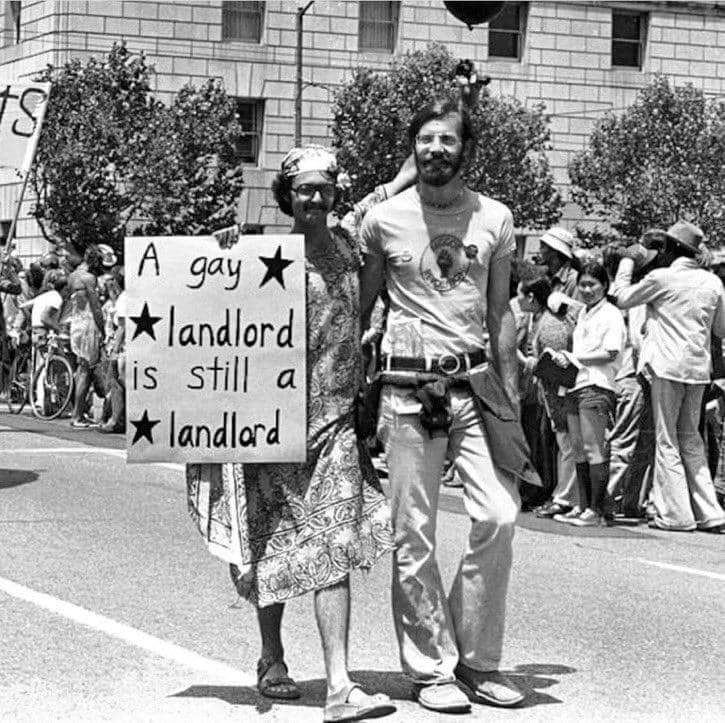
Hello! I see the meme in the image, which reads: "A gay landlord is still a landlord."
This joke plays on a double meaning of the word "gay" (archaic term for 'male opposite' or 'property owner') and "landlord" (archaic term for 'property owner'). It suggests a "gay" person is still a "landlord" person.
This meme is an example of intersectionality (Crenshaw), which is the theory that social identities intersect to create unique experiences. In this case, the intersection of sexual orientation and economic status is played on to create a humorous tautology. It highlights how two different social labels can overlap and create a confusing or humorous identity, which is a common theme in analyzing how race, gender, and sexuality intersect to shape personal experiences.
simple-description (llama3.2-vision_11b)
The meme is a photo of a 1970s gay rights protest, with a sign that reads "A gay person is a person, a gay person is a person, a gay person is a person...". The sign is being held by a woman, and she is standing next to a man who is also holding a sign that says "A gay person is a person, a gay person is a person, a gay person is a person...". The text is a play on the classic children's song "If You're Happy and You Know It", but with a twist to highlight the importance of recognizing and accepting gay people as individuals.
In the context of intersectionality, this meme highlights the struggle for gay rights and the need for acceptance and recognition of gay people as individuals. The sign's repetition of "a gay person is a person" emphasizes the importance of treating gay people with dignity and respect, and the need for society to recognize and accept them as individuals rather than as a group.
detailed-analysis (gemma3-27b-vision)
Okay, here's an analysis of the photograph broken down into sections based on the requested theoretical frameworks, only including those that apply meaningfully. I'll prioritize depth over simply listing each category.
Visual Description
The black and white photograph depicts a street scene, likely a protest or demonstration. A woman and a man are the central figures, walking towards the viewer, carrying a banner. The banner reads "A gay ★ landlord is still a landlord," with star icons punctuating the phrase. The woman is wearing a long, patterned dress, a headscarf and appears to be holding a corner of the sign. The man wears a t-shirt and bell-bottom pants. There are many other people in the background, suggesting a larger event. The setting appears to be urban, with buildings and trees visible. The photograph has a grainy quality consistent with older film photography. The lighting suggests a bright, sunny day. There's a general sense of active public engagement and dissent.
Foucauldian Genealogical Discourse Analysis
This image is rich for Foucauldian analysis. The protest sign isn’t simply making a statement; it’s constructing a discourse. The genealogy would trace how the categories of "gay," "landlord," and even the very idea of property ownership have been historically produced through power relations.
- Discursive Formation: The sign actively disrupts the neat categorization that power (in this case, capitalist and heteronormative structures) seeks to impose. It questions the assumed "neutrality" of property ownership by highlighting how it can be implicated in systems of oppression even when exercised by someone who is themselves marginalized (being gay). The star icons also add an emphasis to each word in the statement.
- Power/Knowledge: The sign demonstrates how knowledge about sexuality and economic structures are interwoven with power. The protesters are acknowledging that while a person may identify as gay, they are still subject to, and can wield, the power inherent in the role of a landlord. The act of naming this contradiction is a form of resistance.
- Archaeology & Genealogy: A genealogical investigation would explore how the categories of "gay" and "landlord" have developed through historical shifts in legal, social, and economic practices. The sign is a historical moment within these shifting discourse.
In essence, the sign is a challenge to the "naturalized" ways of thinking about both sexual identity and economic roles.
Marxist Conflict Theory
The image is directly relevant to Marxist conflict theory. The core of the message – “A gay ★ landlord is still a landlord” – points to the irreducibility of class struggle even within identity politics.
- Class Consciousness: The protesters are demonstrating a level of class consciousness, acknowledging that the economic position of the landlord supersedes any shared identity with the LGBTQ+ community. They are refusing to allow the complexities of identity to obscure the fundamental power dynamics inherent in the landlord-tenant relationship.
- Means of Production: The core of the conflict is rooted in the ownership of the means of production (housing). The landlord, regardless of sexual orientation, is positioned as the owning class, and tenants as the working class. The sign underscores that social liberation won’t be achieved solely through addressing issues of sexuality; it requires dismantling the exploitative economic system.
- False Consciousness: The image implicitly critiques any notion that solidarity with a landlord, even a gay one, is progressive. The sign suggests that focusing solely on shared identity without addressing economic exploitation would reinforce a false consciousness.
The protest sign challenges simplistic notions of solidarity and reminds viewers that class conflict transcends identity-based affiliations.
Queer Feminist Intersectional Analysis
This image is powerfully resonant with queer feminist intersectional thinking.
- Intersectionality: The sign explicitly acknowledges the intersection of multiple forms of oppression. It demonstrates that a person can simultaneously experience marginalization based on their sexual orientation and wield power through their economic position. It's a clear rejection of single-axis frameworks of analysis.
- Challenging Norms: The image disrupts the assumed alliance between the LGBTQ+ community and progressive social movements. By questioning the position of a gay landlord, it challenges the idea that shared identity automatically equates to shared political goals or solidarity.
- Power Dynamics: The sign exposes the complex power dynamics within both LGBTQ+ spaces and broader social structures. It suggests that systems of oppression are not monolithic; they operate in intersecting and often contradictory ways.
- Critique of Inclusion: It implicitly critiques the idea that simply including LGBTQ+ individuals within existing power structures (like property ownership) is inherently progressive. True liberation requires challenging those structures themselves.
The sign is a powerful statement about the need for a nuanced understanding of oppression and the importance of building solidarity across difference without glossing over fundamental power imbalances.
Postmodernism (less applicable, but present)
While not a dominant framework for interpreting the image, elements of postmodernism can be identified.
- Deconstruction of Categories: The sign challenges the stability and fixedness of categories like "gay" and "landlord." It suggests that these categories are not natural or essential, but socially constructed and fluid. It implies the meaning of these categories are not fixed, but are constantly being negotiated and contested.
- Rejection of Grand Narratives: The sign implicitly rejects the idea that there is a single, universal path to liberation. It suggests that progress requires a more complex and nuanced understanding of power dynamics.
However, it's important to note that the image is more directly engaged with material and political issues than with the more abstract concerns of postmodernism.
I hope this detailed analysis is helpful! Let me know if you’d like any of these sections expanded upon.
simple-description (llama3.2-vision)
The meme features a photograph of a 1970s gay rights protest, with a sign being held by a protester that reads "A gay is a boy or girl who doesn't like boys or girls" in response to a sign that reads "A gay is a boy or girl who likes boys or girls."
tesseract-ocr
a | pela a Rape an ce es ss fee) ler es : ss" x keep 8S landlord aa as DR: > «(alee wa.) @ | ye a 8 A ie = \ 4 A landlord VAN Yj (& - ee ae faim a rs Pree —— 4