First Seen
2024-02-02T21:58:37.793402+00:00
simple-description (qwen3.5_2b-q8_0)
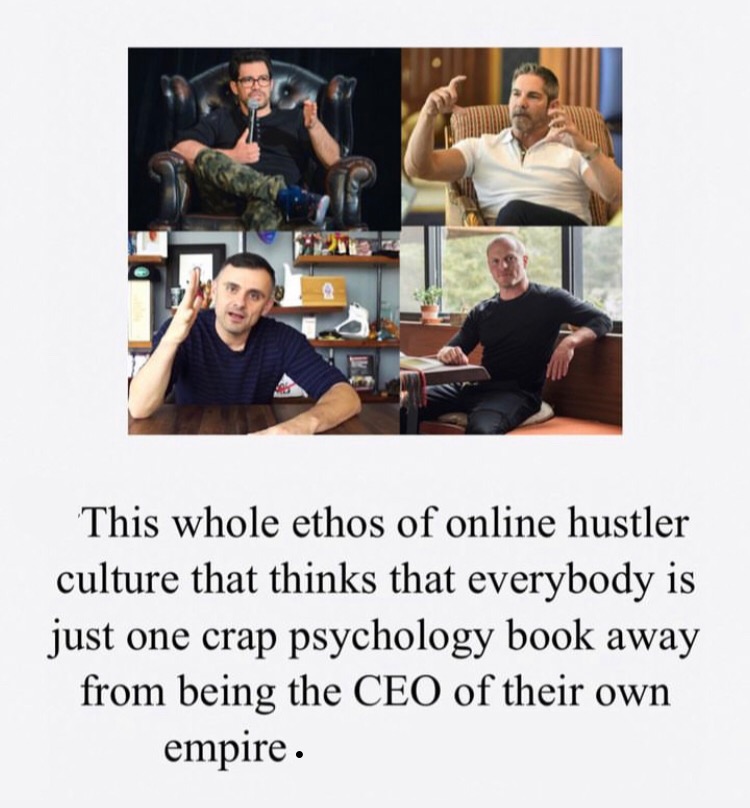
This meme uses the sociology of Simulacra to satirize how the internet generates a "false reality" of self-made success. The four individuals likely represent the "performative" simulacra of entrepreneurship—visual images designed to suggest a self-made path without necessarily reflecting a true reality. The text at the bottom confirms this fabrication by mocking the idea that average people are merely one "crap psychology book" away from achieving such status.
simple-description (llama3.2-vision_11b)
The meme is a humorous commentary on the concept of "influencers" and the idea that they are creating a false narrative about their lives. The image is likely a screenshot of a popular social media influencer's Instagram post, but with a sarcastic caption overlayed on top. The caption reads: "This is my real life, not a 'brand' or a 'business' or a 'career'... just a bunch of dudes in a basement talking about their feelings"
detailed-analysis (gemma3-27b-vision)
Okay, let's break down this image and the accompanying text through the requested theoretical lenses.
Image Description
The image is a collage of four photographs featuring the same man in seemingly domestic or curated "office" settings. He is white and appears to be in his early-to-mid 30s, dressed in either casual button-down shirts and slacks or a t-shirt. The settings are staged to appear affluent, including leather furniture, bookshelves, and a generally "successful" aesthetic. In each picture, he is either gesturing assertively or in a thoughtful pose, as if engaged in a motivational speech or podcast. The overall impression is a carefully constructed image of personal branding and aspiration.
Foucauldian Genealogical Discourse Analysis
The statement "This whole ethos of online hustler culture that thinks everybody is just one crap psychology book away from being the CEO of their own empire" is ripe for a Foucauldian analysis.
- Discourse & Power/Knowledge: This ethos is a discourse – a system of thought, language, and practice – that defines "success" and "self-improvement" within a very specific framework. It proposes that self-improvement isn't about genuine growth or well-being, but about attaining a position of power ("CEO of your empire"). This discourse operates through power/knowledge: it creates what is considered "true" about success and reinforces that truth through consistent repetition.
- Genealogy: We can trace the genealogy of this "hustler culture" to earlier self-help movements (like Carnegie’s "How to Win Friends and Influence People"), and arguably to the American Dream narrative of individual achievement. It's also been heavily shaped by the rise of neoliberalism and the individualization of responsibility. The belief that anyone can succeed if they just apply the right techniques shifts blame for structural inequalities onto the individual, positioning failure as a personal deficiency.
- Subject Formation: This discourse actively creates subjects – individuals who internalize these values and actively strive to become "CEOs of their own empire." The constant consumption of self-help material and branding advice is a form of self-discipline that aligns the individual with this power structure.
Critical Theory
The text and image can be critiqued through the lens of Critical Theory (especially the Frankfurt School) due to its focus on ideology and mass culture.
- Commodification of the Self: The "hustler ethos" promotes the commodification of the self. Individuals are encouraged to become a brand, to package and sell themselves as a product. This reduces personal identity to a set of marketable traits, contributing to a culture of superficiality and alienation.
- False Consciousness: The idea that "one crap psychology book" can turn anyone into a CEO operates as a form of false consciousness. It obscures the systemic barriers to success (class, race, gender, lack of access to resources) and creates the illusion that success is solely a matter of individual effort.
- Culture Industry: This culture is driven by the "culture industry" – a system that mass-produces and disseminates standardized forms of cultural content. This content is designed to reinforce dominant ideologies and keep consumers docile.
Marxist Conflict Theory
From a Marxist perspective, this "hustler ethos" can be understood as a tool used to maintain capitalist dominance.
- Ideology & Class Struggle: The promotion of individual responsibility and self-improvement serves to mask the inherent inequalities of the capitalist system. It shifts the focus away from structural problems (wage stagnation, lack of social safety nets) and onto individual "failures."
- Exploitation & Surplus Value: The "hustler" is essentially encouraged to maximize their own "human capital" to generate more value for the capitalist system. This increased value (surplus value) is then appropriated by those who own the means of production.
- Individualization & Weakening of Collective Action: By emphasizing individual success, the ethos discourages collective action and solidarity. It creates a competitive environment where individuals are pitted against each other, rather than working together to challenge the status quo.
Postmodernism
A postmodern interpretation would focus on the constructed nature of "success" and "selfhood."
- Hyperreality & Simulation: The carefully curated images and narratives of "hustler culture" contribute to a state of hyperreality, where the distinction between reality and simulation becomes blurred. Success is no longer about achieving tangible goals, but about appearing successful.
- Deconstruction of Grand Narratives: The "American Dream" narrative is deconstructed by highlighting its inherent contradictions and its failure to deliver on its promises.
- Subjectivity & Fluidity: While seeming to present a clear path to success, the ethos ironically relies on the fluidity of identity. "Hustlers" are expected to constantly adapt and reinvent themselves to stay ahead of the curve.
Note: A Queer Feminist Intersectional Analysis isn't as immediately apparent from the image and text. However, it would be relevant to consider how this ethos particularly impacts marginalized groups. The pressure to “optimize” oneself can be even more intense for those who already face systemic discrimination. The idealized image of the “successful CEO” is often implicitly coded as white, male, and heterosexual, reinforcing existing power imbalances.
simple-description (llama3.2-vision)
The meme is a screenshot of a news article with a quote from Elon Musk. The quote reads: "This whole thing is a bit of a mess, to be honest. I think it's because I'm a bit of a mess. I'm a bit of a mess, I'm a bit of a mess, I'm a bit of a mess. I'm a bit of a mess, I'm a bit of a mess, I'm a bit of a mess."
tesseract-ocr
“ear ele A Dag’ ee ia 2 I=¢@ , fe Dobie AS wT Fo f I> 55a PS This whole ethos of online hustler culture that thinks that everybody is just one crap psychology book away from being the CEO of their own empire.