First Seen
2023-05-10T21:03:40+00:00
simple-description (llama3.2-vision_11b)
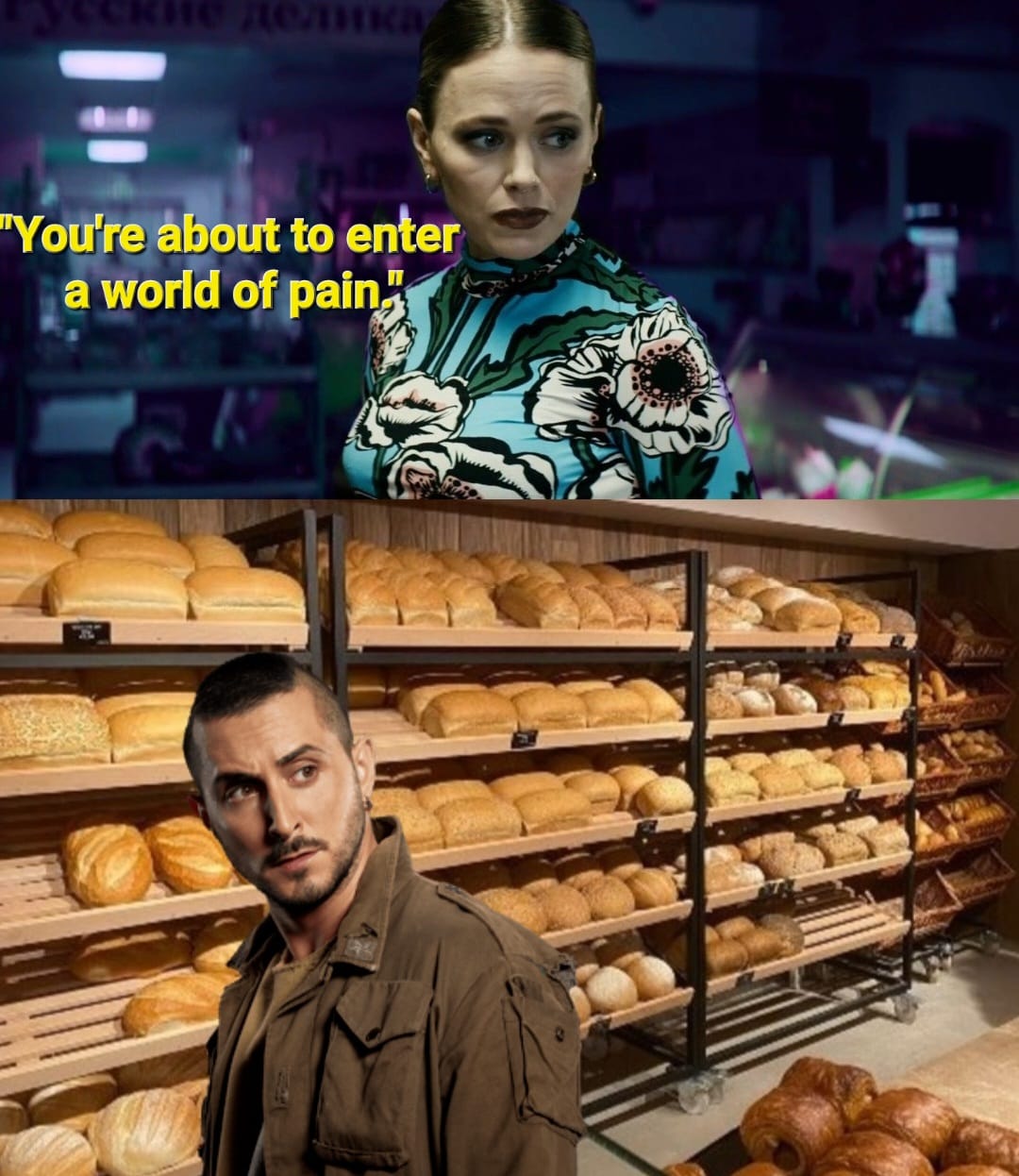
The meme is a play on the concept of "social performance" in symbolic interactionism, which studies how people create and maintain social relationships through interactions. The image likely features a person in a grocery store, surrounded by bread, with a caption that reads "You're going to pay for this" - a humorous take on the idea that the person is "performing" a social role (in this case, being a "bread thief") and will face consequences for it.
detailed-analysis (gemma3-27b-vision)
Okay, here's an analysis of the image, broken down into sections covering relevant theoretical frameworks. Note that some sections will be more robust than others, depending on how strongly the image lends itself to each perspective.
Visual Description
The image is a digital composite. It features two distinct photographic elements layered together.
The upper portion shows a woman (presumably Scarlet Witch from a Marvel Cinematic Universe movie) with a stern expression, set against a dark, glowing blue and purple background suggesting a fantastical or other-dimensional space. Overlaid on this portion is text reading, "You’re about to enter a world of pain."
Below this, the lower portion shows a man in a military-style jacket looking with a downcast expression at a shelf laden with various breads and pastries in a bakery setting. The composition creates a visual juxtaposition between the fantastical, dramatic scene above and the mundane, everyday scene below. The juxtaposition aims for a humorous or ironic effect.
Foucauldian Genealogical Discourse Analysis
This image lends itself well to a Foucauldian reading. The overlaid text, “You’re about to enter a world of pain,” functions as a discourse, a system of thought, ideas and language that constructs reality. In this context, the discourse isn’t about literal physical pain, but rather a kind of emotional or existential discomfort, subtly juxtaposed with the mundane experience of bakery shopping.
A genealogical approach would ask: how has the "world of pain" been historically constructed as a concept? Pain, both physical and emotional, is not a natural given, but is categorized, regulated, and disciplined through societal practices. The power dynamic here isn’t between individuals (Scarlet Witch and the man) but between the system of meaning-making that frames “pain” and those subjected to it.
The bakery context is interesting. Bakeries are traditionally associated with comfort, nourishment, and simple pleasures. Juxtaposing this with a pronouncement of pain creates a rupture. It suggests that pain is everywhere, even within the seemingly benign aspects of daily life. The man's expression appears to acknowledge this painful awareness. This could be interpreted as an example of the panopticon, where the omnipresent threat of pain and surveillance (represented by the Scarlet Witch's authoritative pronouncement) shapes behavior, even in an everyday setting. He knows pain is coming, even while he buys bread.
Critical Theory
From a Critical Theory perspective, the image can be interpreted as a commentary on the commodification of emotional experience. Scarlet Witch, as a character born from a media franchise, represents a form of culture industry product. The dramatic declaration of pain is essentially a form of entertainment.
The image then suggests that even our anxieties and experiences of pain are increasingly mediated and consumed as entertainment. The man, presented as an individual confronted by this mediated pain, appears somewhat resigned or defeated. His gaze isn't directed at the bread, but inward, as though he's already internalized the "world of pain" being offered by the spectacle above.
The juxtaposition of high-concept fantasy with the banal reality of a bakery further highlights the alienation experienced in late capitalist society. Meaning has been stripped from everyday life, replaced with spectacle and consumption.
Marxist Conflict Theory
From a Marxist perspective, the image hints at a conflict between spectacle and reality. The Scarlet Witch, associated with a large entertainment industry, represents the forces of capital and their creation of manufactured desires and anxieties. Her pronouncement of pain is a spectacle designed to attract attention and generate profit.
The man in the bakery, on the other hand, represents the working class, confronted with the alienating effects of capitalist ideology. He appears to be a relatively ordinary person attempting to satisfy basic needs (buying bread) amidst a bombardment of manufactured drama. His expression suggests a sense of powerlessness in the face of these forces.
The image could be interpreted as a critique of how capitalist ideology permeates even the most mundane aspects of life, creating a sense of anxiety and dissatisfaction. The bakery, a site of basic consumption, becomes a space where this ideological conflict is played out.
Postmodernism
The image thrives on postmodern principles. The juxtaposition of disparate elements – fantasy and reality, spectacle and banality – is a core characteristic of postmodern art. It actively deconstructs any sense of inherent meaning or truth.
There's a clear self-reflexivity at play. The image knows it's a meme, a digital pastiche. It acknowledges the absurdity of layering a dramatic movie quote onto a mundane image. This blurring of boundaries between high and low culture is a hallmark of postmodernism.
The image also plays with the concept of simulacra and simulation (Baudrillard). The "world of pain" proclaimed by Scarlet Witch isn't a real place, but a representation, a simulation created by media. The man's response is to passively accept this simulation, as though reality itself has been replaced by hyperreality.
Queer Feminist Intersectional Analysis
This framework is the least directly applicable, but we can still find some interesting points.
The image highlights a contrast in power dynamics. Scarlet Witch, a powerful female character within a heavily male-dominated superhero genre, delivers the pronouncement. Her authority is undeniable. However, this power is contained within the framework of the superhero narrative, which is itself constructed by patriarchal forces.
The man’s reaction can be read through a lens of male emotional suppression. His downcast expression suggests a quiet resignation to the "world of pain," possibly indicative of societal expectations placed upon men to internalize their emotions. The juxtaposition with Scarlet Witch’s assertive pronouncement emphasizes this gendered dynamic.
An intersectional reading would also consider the racial and socioeconomic contexts of both characters. Their backgrounds, which are not fully visible in the image, would influence how they experience and respond to the “world of pain.”
I hope this detailed breakdown is helpful! Let me know if you’d like me to focus on any of these frameworks in more detail, or explore other theoretical lenses.
simple-description (llama3.2-vision)
This meme is a humorous image that juxtaposes two contrasting scenes. On the top, it features a dramatic scene from the TV show "Peacemaker" where a character says "You're going to go through hell and you're going to die, and the worst part is, when you're dead, you'll be so lonely it will feel just like it does now when you're living in pain." Below, it shows a character from the TV show "Peacemaker" standing in a grocery store in front of a shelf of bread, with a caption "You're going to go through hell and you're going to die, and the worst part is, when you're dead, you'll be so lonely it will feel just like it does now when you're living in pain."
tesseract-ocr
el VS 0° ae As PF aa Cale oi lly Sy y a f= 4 — = (Fy Mile yg ld —— — - s I, Al ea ieee — | eo — ae 4 ro - — ae - he} ae I pat YO pe =~ a Mee aM SS — ~