First Seen
2023-05-10T21:03:40+00:00
simple-description (llama3.2-vision_11b)
The meme is a humorous take on the concept of symbolic interactionism, a sociological theory that examines how people interact with symbols and meanings to create shared understanding. The meme pokes fun at the idea of a "strange" or "unusual" request, implying that even the most mundane or ordinary requests can be perceived as unusual or "strange" by others. The text "I asked to read the book aloud because the words were on the wall" is a clever play on the idea that even the most ordinary requests can be perceived as "strange" by others.
detailed-analysis (gemma3-27b-vision)
Here’s an analysis of the image, broken down into relevant sections as requested. It's important to acknowledge that this is a deliberately absurd meme, so applying dense theory is, itself, part of the irony.
Visual Description
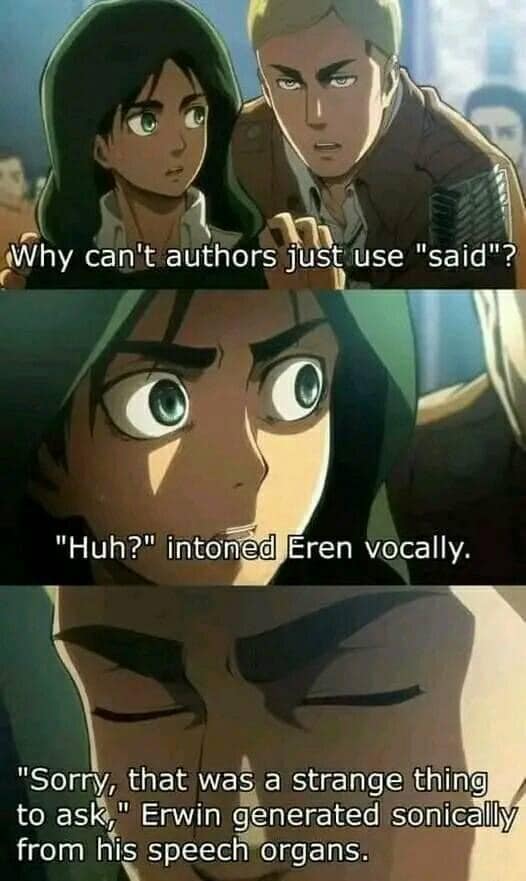
The image is a screen capture from the anime Attack on Titan. It features three characters: Mikasa Ackerman, Erwin Smith, and Eren Yeager.
- Mikasa is positioned to the left, looking concerned/curious.
- Erwin is standing behind Mikasa, looking forward with a serious expression.
- Eren is in the foreground, looking upward with a confused expression. He has prominent sweat droplets on his face.
Overlaid on the image are text captions mimicking dialogue tags, but using overly complex and scientific-sounding language instead of simple "said."
Foucauldian Genealogical Discourse Analysis
This meme provides a compelling example for Foucauldian analysis, as it directly mocks the way language constructs and controls knowledge, specifically within the framework of narrative.
- Discourse & Power: The conventional "said" is the established discourse for reporting speech. This meme deconstructs that discourse by replacing it with unnecessarily technical phrasing. This isn’t about finding the true way to describe speech, but demonstrating how even something as seemingly simple as dialogue tags are governed by a set of rules that dictate how stories are told.
- Genealogy of ‘Said’: We can imagine a "genealogy" of the dialogue tag. At some point, it became normalized, a convention of writing. The meme highlights the arbitrary nature of this normalization. Why this way of reporting speech and not another?
- Surveillance and Control: The over-scientific language isn’t about accuracy; it’s about distancing and control. It makes the act of communication seem cold, clinical, and subject to observation/analysis. It shifts the focus from what is being said to how it is being reported.
Critical Theory
From a Critical Theory perspective, the meme can be seen as a critique of authorial power and the imposition of stylistic choices onto the reader.
- Alienation: The complex language alienates the reader from the simple act of reading dialogue. This mirrors broader themes of alienation in modern society, where language can be used to obscure meaning and control access to information.
- Domination of Form: The meme mocks the tendency of some authors (and, more broadly, institutions) to prioritize stylistic affectation over clarity and accessibility. The overly technical language isn’t serving a purpose, it's being used to demonstrate the author's supposed skill, at the expense of reader comprehension.
- Unmasking the Arbitrary: Critical Theory aims to unmask the underlying power structures that shape our understanding of the world. The meme does this by exposing the arbitrariness of dialogue tags, revealing them as a stylistic choice rather than a necessity.
Postmodernism
The meme is deeply embedded in postmodern sensibilities.
- Meta-Commentary: The meme is self-referential and meta-commentary on the act of writing and storytelling. It’s not just telling a story, it’s commenting on how stories are told.
- Deconstruction of Convention: It actively deconstructs a standard writing convention (dialogue tags) to expose its artificiality.
- Irony & Parody: The humor is derived from the juxtaposition of the mundane (reporting speech) with the absurdly technical language. This irony is a hallmark of postmodernism.
- Rejection of Grand Narratives: Postmodernism rejects grand, overarching explanations. The meme, in its own small way, challenges the notion that there is a single “correct” way to write dialogue.
In summary: The meme is a surprisingly rich example of several theoretical lenses. Its strength lies in its ironic simplicity – it’s funny because it takes complex ideas and applies them to something utterly trivial. It subtly critiques how language functions as a tool of power, style, and control, all while being a humorous observation about writing habits.
simple-description (llama3.2-vision)
The meme is a humorous image featuring a scene from the anime "Attack on Titan" where a character is trying to read out a book to a group of students. The character is struggling to read out a line from the book, which is "In the depths of my heart, there is a boy I want to protect." The character then says "In the depths of my heart..." and is interrupted by another character, who says "In the depths of my heart, there is a boy I want to protect." The second character then says "In the depths of my heart..." and is interrupted by the first character, who says "In the depths of my heart, there is a boy I want to protect." The second character then says "In the depths of my heart..." and is interrupted by the first character, who says "In the depths of my heart, there is a boy I want to protect."
tesseract-ocr
TY can't Liars (UIt<vaa-y- |e bare ale) acon - J vocally. 4 that ee strange thing to ER Erwin eels sonicall from NS speech organs.