First Seen
2023-05-10T21:03:40+00:00
simple-description (llama3.2-vision_11b)
The meme is a humorous representation of the complexities of trauma and its impact on mental health. It depicts a person having a "traumatic experience" (reading a Wikipedia article about trauma) and then having a "mental breakdown" (getting lost in a Wikipedia article about trauma). The text "I had a traumatic experience" is written in a bold, playful font, while the text "I had a Wikipedia article about trauma" is written in a smaller, more subtle font.
detailed-analysis (gemma3-27b-vision)
Okay, let's break down this meme using the requested analytical lenses.
Visual Description
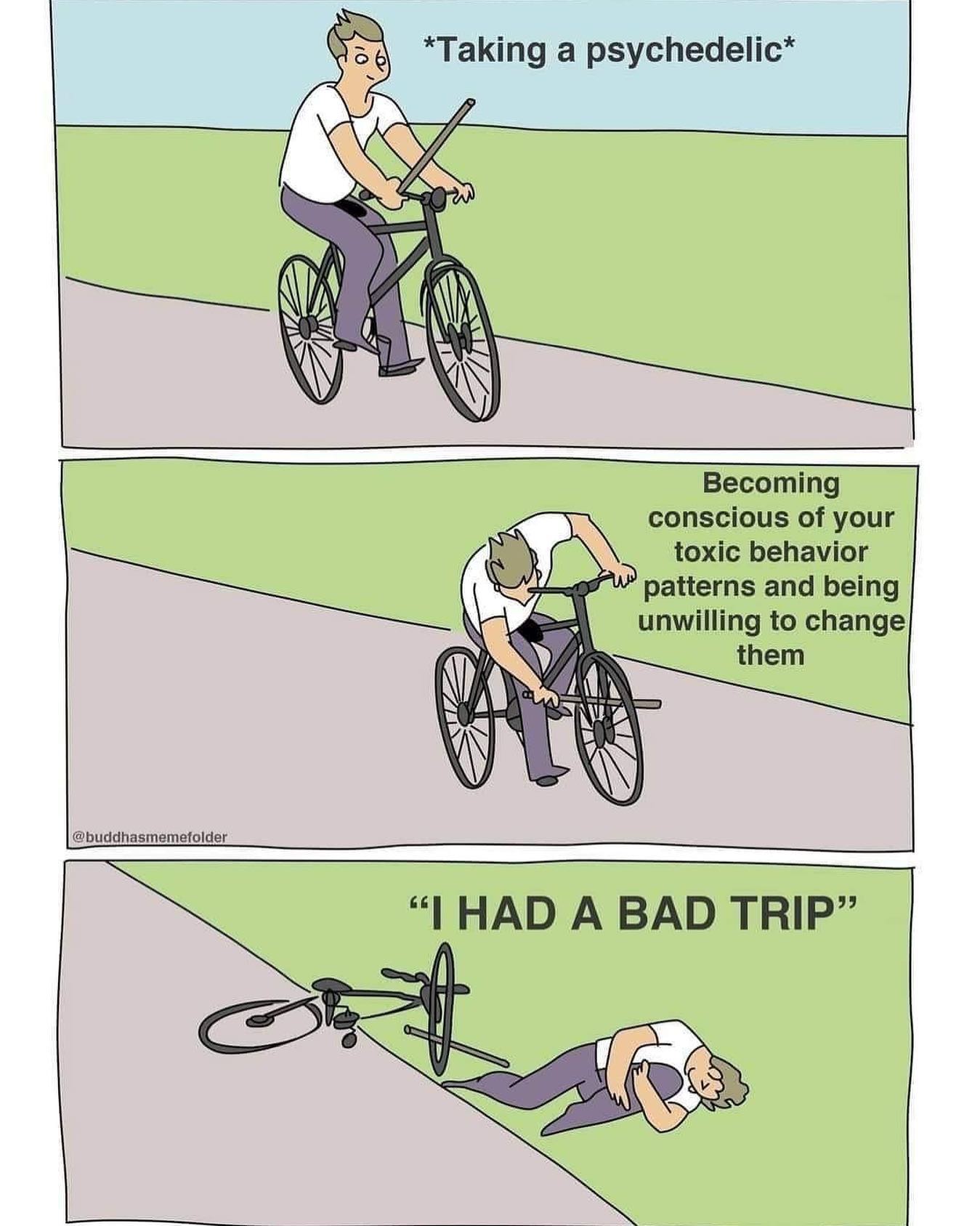
The meme is a three-panel cartoon with a minimalist style. Each panel depicts a man riding a bicycle, with increasingly chaotic and destabilizing results.
- Panel 1: The man is upright and confidently riding a bicycle on a green grassy path. The caption reads, "Taking a psychedelic."
- Panel 2: The man is now struggling to maintain control on the bicycle, the wheel is wobbling. The background still shows grass, but the man has a thought bubble stating "Becoming conscious of your toxic behavior patterns and unwilling to change them."
- Panel 3: The man and bicycle are completely crashed in a pile on the ground. The caption reads, “I HAD A BAD TRIP.” The background also appears more chaotic here.
The color palette is primarily green and shades of brown and peach for the figure. The style is simple and emphasizes the progression of a situation.
Critical Theory
This meme effectively satirizes the often-painful process of self-reflection and the resistance to personal growth, a key theme in Critical Theory. Critical Theory, originating with the Frankfurt School, often focuses on how systems of power and domination are internalized by individuals, leading to self-destructive behaviors.
- Internalized Oppression/Power Dynamics: The meme suggests that the "toxic behavior patterns" are a manifestation of internalised societal norms and oppressive structures. The initial act of "taking a psychedelic" can be seen as a metaphorical attempt to dismantle these structures within oneself, creating disruption and unease.
- Discomfort & Resistance: The resistance to change, specifically indicated in panel 2, is central to the meme's message. Critical Theory examines why individuals often cling to harmful behaviors or ideologies, even when confronted with their negative consequences. Here, the individual is aware of their negative patterns but unwilling to address them, leading to the "crash".
- The Illusion of Control: The initial panel depicts the illusion of control—a sense of smoothly navigating life. But once inner processes begin, this control is lost. This relates to Critical Theory's deconstruction of power structures and the belief that humans have control.
Postmodernism
The meme employs elements of Postmodernism, specifically its deconstruction of narratives and its embrace of fragmentation.
- Deconstruction of Self-Improvement Narrative: The meme subverts the typical narrative of self-improvement. It suggests that simply becoming aware of one’s flaws doesn't automatically lead to positive change. Instead, it can lead to a chaotic and unpleasant experience.
- Subjectivity & Fragmentation: The "bad trip" can be interpreted as a rejection of grand narratives and a recognition of the subjective, fragmented nature of experience. The crash represents a loss of coherence.
- Irony & Satire: The meme employs irony and satire to critique the performative aspects of personal growth. It hints that self-awareness, if not accompanied by genuine action, can be a form of self-deception.
Foucauldian Genealogical Discourse Analysis
Michel Foucault's theories of discourse, power, and genealogy provide a strong lens for understanding the meme.
- Discursive Formation of "Toxic Behavior": The meme implies that the very idea of "toxic behavior" is a product of discourse—of how we define and categorize certain behaviors as harmful. It suggests that these categorizations are not natural or objective, but rather constructed through social and historical processes.
- Power/Knowledge: The meme connects awareness (knowledge) with a struggle for control (power). The man is aware of his toxic patterns, but this knowledge doesn't automatically translate into changed behavior. It highlights how power operates through the regulation of knowledge and self-knowledge.
- Genealogy of the Self: Foucault's concept of genealogy involves tracing the historical origins of ideas and practices. Here, the “bad trip” can be viewed as a genealogical exploration of the self—a painful uncovering of the roots of harmful behaviors.
Important Notes
- This analysis is interpretive. Memes are open to multiple readings.
- The analytical frameworks are interconnected. For instance, Postmodernism and Critical Theory often overlap.
- The meme relies on a shared cultural understanding of psychedelics as catalysts for self-reflection, but it ultimately uses this as a metaphor for any deep introspection.
Let me know if you'd like me to elaborate on any of these points or explore a different analytical angle!
simple-description (llama3.2-vision)
The meme is a humorous illustration of someone's experience with psychedelics. The image shows a person on a bicycle, with the caption "Taking a psychedelic" above them, and then a second panel with the caption "Becoming conscious of your toxic behavior patterns and being unwilling to change them" below them, with the person now lying on the ground, injured. The final panel says "I had a bad trip."
tesseract-ocr
*Taking a psychedelic* ) )\ Ar WA Becoming conscious of your . a toxic behavior a 4 patterns and being iY unwilling to change ) SW, " them \ | Ky “| HAD A BAD TRIP” c= We Lie