First Seen
2023-05-10T21:03:40+00:00
simple-description (llama3.2-vision_11b)
The meme is a quote from Martin Luther King Jr. that reads: "The ultimate measure of a man is not where he stands in moments of comfort and convenience, but where he stands at times of challenge and controversy." This quote is often used to highlight the importance of standing up for what is right, even in the face of adversity.
detailed-analysis (gemma3-27b-vision)
Okay, here's an analysis of the image and quote through the lenses you requested, sectioned as outlined. I'll only include sections where the frameworks are applicable.
Visual Description
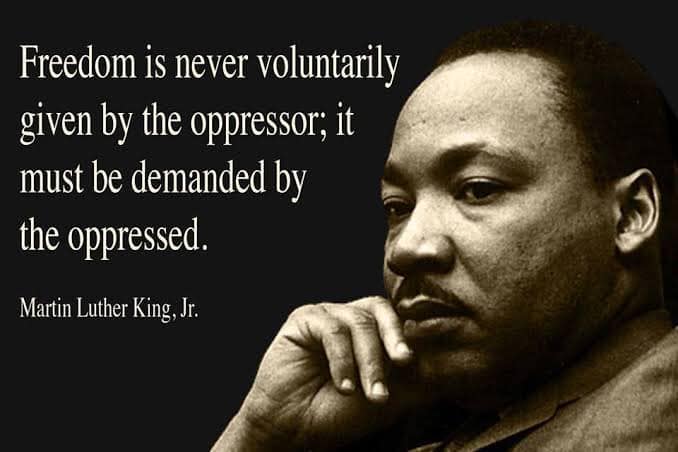
The image is a close-up, monochromatic portrait of Martin Luther King Jr. He appears deep in thought, with his chin resting on a hand, and looking slightly off-camera. The lighting is dramatic, creating strong contrasts and emphasizing the textures of his skin and the lines of his face. The background is black, which further highlights his presence and adds to the serious, contemplative mood. The quote "Freedom is never voluntarily given by the oppressor; it must be demanded by the oppressed" is superimposed over the top left portion of the image, and is attributed to Martin Luther King, Jr.
Critical Theory
This quote and portrait powerfully embody central tenets of Critical Theory. Critical Theory, originating from the Frankfurt School, emphasizes that power structures perpetuate inequality and oppression, and that these structures are not neutral but actively maintained through ideology and cultural narratives.
- Critique of Domination: The quote explicitly rejects the idea that liberation is granted from above. This challenges the narrative that social change is a benevolent act of the powerful. Instead, it frames freedom as something earned through active struggle.
- Power Dynamics: The quote highlights the asymmetrical relationship between the “oppressor” and the “oppressed”. It reveals that those who hold power will not relinquish it willingly, demonstrating the inherent imbalance in hierarchical structures.
- Emancipatory Knowledge: Critical Theory aims at liberating knowledge, and this quote is an example of this goal. It challenges the prevailing ideological assumptions about freedom and encourages a critical awareness of the forces that maintain oppression.
- Portraits and Ideology: The portrait itself, likely widely circulated, contributes to the symbolic representation of King as a figure of resistance. This image, when viewed through a critical lens, reveals how it reinforces certain narratives and expectations about leadership and social change.
Marxist Conflict Theory
This quote aligns strongly with the core tenets of Marxist Conflict Theory.
- Class Struggle: The quote speaks to an inherent conflict between those with power (the “oppressor”) and those without (the “oppressed”). This echoes Marx’s idea that history is driven by class struggle. The quote implies that freedom is not a gift, but a product of conflict and the assertion of agency by the historically marginalized.
- Material Conditions & Ideology: While the quote doesn't explicitly address material conditions, it can be understood as a call to action to challenge the dominant ideology that perpetuates oppression. The oppressor benefits materially from maintaining the status quo, and will therefore not relinquish power without being forced to do so.
- Revolution & Agency: The quote suggests that freedom requires a conscious, deliberate effort by the oppressed. It implies a need for collective action and the rejection of passive acceptance of unjust conditions. The call to demand freedom suggests an active and even revolutionary stance.
Foucauldian Genealogical Discourse Analysis
This quote and its context provide fertile ground for a Foucauldian analysis.
- Power/Knowledge: Foucault argued that power and knowledge are inextricably linked. The “oppressor” doesn’t just hold power; they also define what constitutes freedom, justice, and legitimacy. This definition is part of the power dynamic. The quote challenges this, asserting that the oppressed have their own understanding of freedom, independent of the oppressor’s definition.
- Genealogy of “Freedom”: A genealogical investigation might explore how the concept of “freedom” itself has been historically constructed, and how different groups have been included or excluded from its meaning. The quote implicitly suggests that the dominant definition of freedom historically served the interests of the oppressor.
- Discourse & Discipline: Foucault’s concept of discourse refers to the systems of thought, language, and practice that shape our understanding of the world. The quote challenges the dominant discourse of power, by asserting the agency of the oppressed to define their own liberation.
- Resistance: The “demanding” of freedom, as stated in the quote, can be seen as an act of resistance against the dominant power/knowledge system. It represents a disruption of the established order and an assertion of agency.
Let me know if you'd like me to elaborate on any of these sections or explore additional theoretical frameworks.
simple-description (llama3.2-vision)
This meme features a famous quote from Martin Luther King Jr. in a bold, white font. The image is likely a photograph of Martin Luther King Jr. with a serious expression, and the quote is superimposed over it. The text reads: "Freedom is never voluntarily given by the oppressor; it must be demanded by the oppressed."
tesseract-ocr
teecOBAS ALomTO UNC TNI NY , VOM ACR NDCaSNO EL 3 TITAN CHE) PA IRON NAC a al 'y) Martin Luther King, Jr. Sond |