First Seen
2023-05-10T21:03:40+00:00
simple-description (llama3.2-vision_11b)
The meme is a humorous commentary on the complexities of social justice movements, poking fun at the idea that people are more concerned with individual rights than collective action. The image is likely a screenshot of a Twitter conversation, with the text "They want to talk about police brutality but can't be bothered to talk about gentrification" appearing on screen.
detailed-analysis (gemma3-27b-vision)
Here's an analysis of the provided Twitter exchange, broken down into the requested sections. Note that not every theoretical lens will apply strongly, and I will indicate when that's the case.
Visual Description
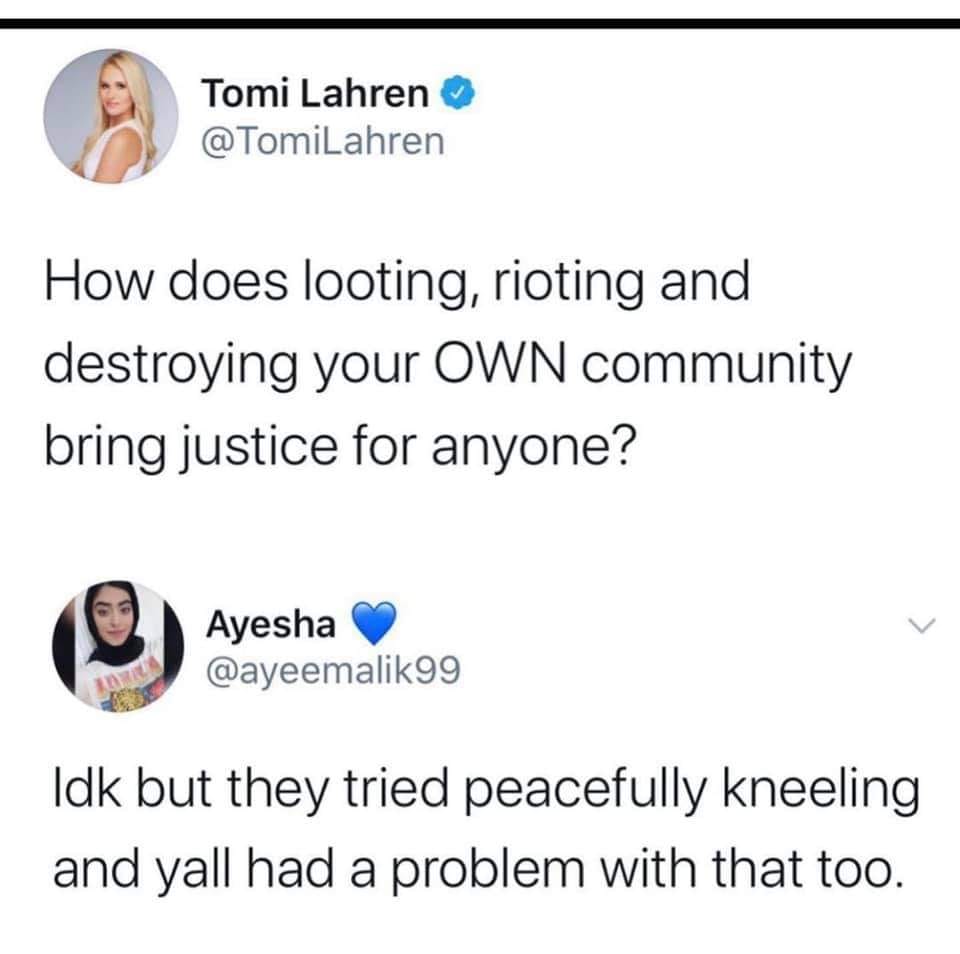
The image displays a screenshot of a Twitter exchange between two users.
- Tomi Lahren: A profile picture of a white woman is shown alongside the username "@TomiLahren." She poses a rhetorical question in her tweet: "How does looting, rioting and destroying your OWN community bring justice for anyone?" The text is clear and directly stated.
- Ayesha: A profile picture of a Black woman is shown alongside the username "@ayeemalik99". Ayesha responds with "Idk but they tried peacefully kneeling and yall had a problem with that too."
Foucauldian Genealogical Discourse Analysis
This exchange is ripe for a Foucauldian analysis. The core of the debate centers on discourse – the ways in which language shapes our understanding of justice, protest, and community.
- Power/Knowledge: Lahren’s question asserts a particular regime of truth – a notion of what constitutes legitimate protest. She frames looting and rioting as inherently destructive and opposed to justice. This is an exercise of power, as it dictates the acceptable boundaries of political action. Ayesha, by referencing peaceful protest (kneeling), challenges this regime. She highlights the hypocrisy of those who condemn violent acts while simultaneously dismissing non-violent resistance.
- Genealogy: A genealogical approach would trace the history of these concepts (justice, protest, community, destruction). What historically constitutes ‘legitimate’ protest? Who gets to define these terms? The question of "your OWN community" is crucial - it implies a possessive relationship to space and a judgment about who is entitled to protect it, and how.
- Disciplinary Power: Lahren's tweet can be seen as subtly enacting disciplinary power by defining the acceptable forms of protest. It polices the boundaries of what is considered ‘responsible’ civic engagement.
Critical Theory
Critical theory, particularly focusing on the Frankfurt School’s interest in ideology and domination, is relevant.
- Ideology: Lahren’s question implicitly relies on the ideology that law and order are paramount and that any deviation from this is inherently destructive. This can mask the underlying systemic issues that might contribute to unrest.
- Domination: The framing of the issue as "destroying your OWN community" subtly places blame on those protesting, rather than focusing on the causes of their grievances. This is a form of subtle domination, shifting the focus away from structures of power and onto individual actions.
- Reason and Enlightenment: The question appears to appeal to reason ("How does…bring justice?") but actually functions ideologically by preemptively dismissing the possibility of justice through disruptive action. It presents a false binary - either peaceful, ‘acceptable’ protest or senseless destruction.
Marxist Conflict Theory
While not directly a class struggle, the exchange reflects the underlying tensions inherent in Marxist conflict theory.
- Social Stratification: The exchange touches on the power dynamics inherent in social stratification. Ayesha's response suggests a frustration with the dismissal of legitimate grievances by those in positions of power (represented by Lahren’s position and audience).
- False Consciousness: Lahren’s question could be seen as contributing to a "false consciousness" by obscuring the underlying economic and social inequalities that drive unrest. It focuses on the symptoms (riots) rather than the root causes.
- Revolution and Resistance: Although not explicitly advocating for revolution, the discussion of "rioting" and "destruction" implicitly raises the question of resistance to oppressive systems.
Postmodernism
The exchange can be analyzed through a postmodern lens, though it's more subtle.
- Deconstruction: Ayesha's response deconstructs Lahren’s question by pointing out the hypocrisy of criticizing both violent and non-violent protest. She exposes the arbitrary nature of the standards being applied.
- Relativism: The exchange highlights the subjective nature of “justice” and “community.” What constitutes justice to one person (or group) may be different for another.
- Metanarratives: The exchange implicitly challenges the “metanarrative” of progress through peaceful means and law and order.
Queer Feminist Intersectional Analysis
This is less directly applicable but still relevant, particularly in understanding the dynamics of power and marginalization.
- Intersectionality: The exchange, though not explicitly about gender or sexuality, is informed by the broader context of racial injustice, which disproportionately impacts Black women and LGBTQ+ individuals.
- Critique of Power: Both feminist and queer theories are concerned with challenging structures of power and oppression. The dynamic between Lahren and Ayesha reflects this, with Ayesha's response challenging the authority of Lahren’s position.
- Marginalized Voices: Ayesha's response can be seen as an attempt to center the voices of those who have been historically marginalized and silenced.
In conclusion, the seemingly simple Twitter exchange encapsulates a range of complex theoretical concepts. It highlights the power of language, the dynamics of social control, and the ongoing struggle for justice and equality.
simple-description (llama3.2-vision)
This meme is a humorous take on the 2020 George Floyd protests and the subsequent looting and rioting that occurred in some cities. The meme pokes fun at the idea that people were protesting for justice, but then went on to destroy their own communities. The text reads: "How does looting, rioting and destroying your own community bring justice for anyone?"
tesseract-ocr
©). Tomi Lahren @ By @TomiLahren How does looting, rioting and destroying your OWN community bring justice for anyone? (2) Ayesha @ way ~@ayeemalik99 Idk but they tried peacefully kneeling and yall had a problem with that too.