First Seen
2023-05-10T21:03:40+00:00
simple-description (llama3.2-vision_11b)
The meme is a screenshot of a Twitter post that reads: "I'm not saying it's the best idea, but it's worth a shot. What if we all just agreed to disagree?" The image is a photo of a person sitting on a beach with a calm expression, and the text is overlaid on top of it.
detailed-analysis (gemma3-27b-vision)
Okay, let's break down this tweet using the requested theoretical frameworks. It's a rather potent statement, lending itself to several interpretations.
Visual Description
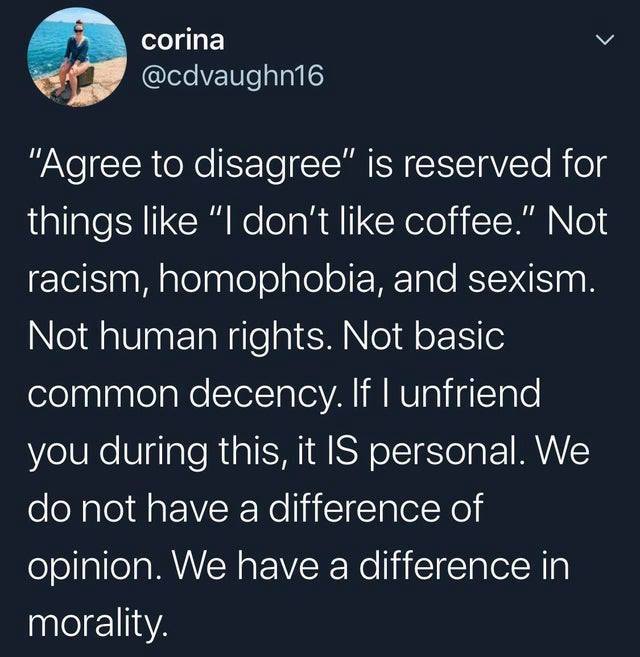
The image is a Twitter post. It features a circular profile picture of a person at a beach or by a body of water. The user’s name is "corina" with the handle "@cdvaughn16." The main component is a text block outlining a strong statement about the boundaries of polite disagreement and the seriousness of certain ethical differences. The background is a standard Twitter interface (dark blue).
Foucauldian Genealogical Discourse Analysis
This tweet can be examined through a Foucauldian lens by looking at the power dynamics it reveals through the discourse surrounding "agreeing to disagree." The author is actively defining what topics are not suitable for "polite disagreement." Traditionally, "agree to disagree" has been a common conversational tactic to sidestep conflict on less important issues. However, corina refutes this, positioning it as only appropriate for trivial matters (like coffee preference).
- Power/Knowledge: The tweet asserts the power to define the boundaries of acceptable discourse. The author positions themselves as someone who understands that certain issues (racism, homophobia, sexism, human rights) are not merely matters of opinion, but are related to fundamental moral principles. This highlights how “opinion” can be a tool to normalize harmful ideologies.
- Genealogy: A genealogical approach would trace the history of the phrase "agree to disagree". How did it originate? What social functions did it serve? And how has it been misused to silence or downplay legitimate concerns? This tweet can be seen as a response to the normalization of accepting harmful views under the guise of “tolerance.”
- Discipline and Normalization: The author is attempting to discipline the discourse by rejecting the idea that all opinions are equal, particularly when they harm marginalized groups. The tweet implicitly challenges the normalization of harmful ideologies by refusing to treat them as merely different viewpoints.
Critical Theory
This tweet aligns very closely with themes within Critical Theory, especially as related to the Frankfurt School.
- Reason & Emancipation: Critical Theory is concerned with how power structures create ideologies that maintain the status quo. The tweet directly challenges the notion that all "opinions" are valid or equal. It's an argument that certain views (racism, etc.) aren’t just different ways of thinking, but actively contribute to oppression and are therefore not worthy of polite debate.
- Ideology Critique: The author is critiquing the ideology that promotes the idea that all opinions deserve equal consideration, even those that are harmful. This “false tolerance” can be seen as a way to silence dissent and perpetuate injustice.
- The Public Sphere: This tweet engages in a small but pointed intervention in the public sphere, attempting to redraw the boundaries of what is considered acceptable discourse.
Marxist Conflict Theory
While not the primary focus, a Marxist reading can be applied. The author is implicitly recognizing the conflict inherent in these issues. Racism, homophobia, and sexism are not simply disagreements; they are manifestations of power imbalances and systemic oppression.
- Power Dynamics: The refusal to "agree to disagree" with these ideologies is a rejection of the idea that the status quo is neutral. It acknowledges that these ideologies serve the interests of dominant groups, and that challenging them is necessary for social change.
- False Consciousness: The idea that someone can hold these harmful beliefs and believe they are simply expressing a different opinion can be seen as a form of "false consciousness" – a lack of awareness of the true nature of social relations and the power structures that maintain them.
Postmodernism
A Postmodern interpretation could focus on the deconstruction of the idea of objective truth and the emphasis on subjectivity. However, the author’s statement challenges postmodern relativism, to a degree.
- Rejection of Grand Narratives: Traditional postmodern thought might deconstruct the idea of universal morality. However, the author is asserting a moral boundary, arguing that certain principles (human rights, decency) are non-negotiable.
- The Social Construction of Reality: The author implicitly recognizes that categories like "racism," "sexism," and "homophobia" are social constructions, but argues that these constructions have real and harmful consequences and are not simply matters of opinion.
Queer Feminist Intersectional Analysis
This is perhaps the most fitting framework for analyzing the tweet.
- Interlocking Systems of Oppression: The author specifically names homophobia alongside racism and sexism. This demonstrates an understanding of intersectionality – the idea that different forms of oppression are interconnected and cannot be understood in isolation.
- Challenging “Civility Politics”: The author rejects the idea that maintaining “civility” is more important than challenging injustice. This aligns with feminist critiques of “civility politics” – the tendency to prioritize politeness over addressing systemic inequalities.
- Centering Marginalized Voices: The author is implicitly prioritizing the experiences of marginalized groups over the comfort of those who hold oppressive beliefs. The tweet is a clear statement that harm is not a matter of opinion.
- Decency as a Political Act: The statement highlights “basic common decency” as a moral imperative. This positions decency not as a neutral concept, but as a political stance against oppression.
In conclusion, this tweet is a complex statement that can be analyzed through multiple theoretical frameworks. It’s a powerful argument against the normalization of harmful ideologies and a call for moral accountability. It emphasizes the importance of recognizing that certain issues are not simply matters of opinion, but are fundamentally about justice and human dignity.
simple-description (llama3.2-vision)
The meme is a screenshot of a tweet from a user named "corin" with the handle "@corin". The tweet reads: "I'm not going to say it, but you know I'm not going to say it. If I said it, I'd have to say it, and then I'd have to say it, and then I'd have to say it, and then...". The tweet is a humorous example of a tongue-in-cheek, self-referential, and absurdly complex statement that is trying to convey a message of "I'm not going to say it, but...".
tesseract-ocr
oh) corina v @cdvaughn16 “Agree to disagree” is reserved for things like “| don't like coffee.” Not racism, homophobia, and sexism. Not human rights. Not basic common decency. If | unfriend you during this, it IS personal. We do not have a difference of opinion. We have a difference in morality.