First Seen
2023-05-10T21:03:40+00:00
simple-description (llama3.2-vision_11b)
The meme is a humorous commentary on the societal norms and expectations of a typical suburban neighborhood. The image shows a seemingly ordinary suburban street, but the caption "This is not a neighborhood, this is a theme park" suggests that the monotony and uniformity of the area is actually a constructed and artificial environment, rather than a natural community.
detailed-analysis (gemma3-27b-vision)
Okay, here's an analysis of the image, broken down into sections based on the theoretical frameworks you've requested. I will note where a section doesn't apply or is less relevant.
Visual Description
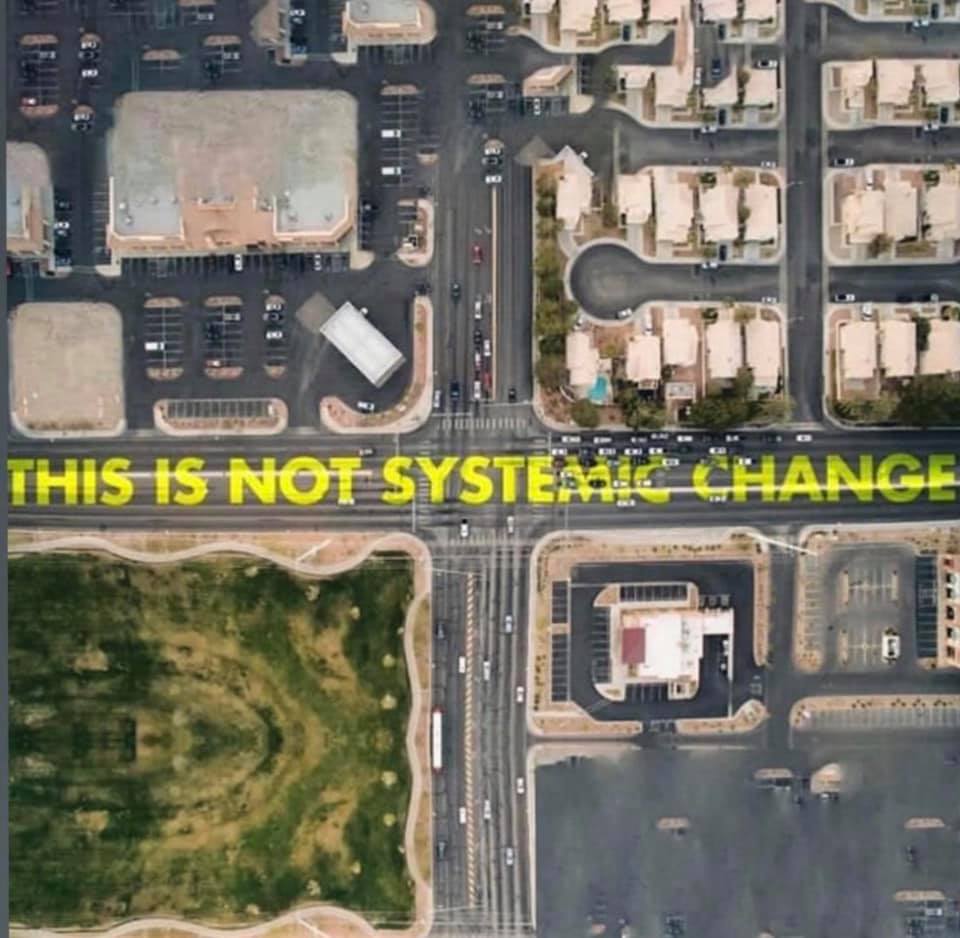
The image is a high-angle, aerial shot of a planned suburban landscape. It is sharply divided horizontally into two distinct sections. The upper portion features a typical North American suburban retail zone: large box stores (likely big-box retailers such as Walmart, Target, or Home Depot), sprawling parking lots filled with cars, and surrounding streets. The lower portion consists of a large, perfectly manicured green space—a park or golf course—also situated within the suburban grid. The contrast is striking—a dense, consumer-oriented zone above and an open, recreational/aesthetic zone below. The image features the text “THIS IS NOT SYSTEMIC CHANGE” superimposed in a bold font across the dividing line. The color palette is muted, primarily consisting of shades of gray, green, and asphalt.
Foucauldian Genealogical Discourse Analysis
This image strongly lends itself to a Foucauldian analysis. The carefully planned layout of the retail space and park represent discursive formations – systems of thought, language, and practice that constitute our understanding of space, leisure, and commerce.
- Power/Knowledge: The division itself reflects a power/knowledge dynamic. The architecture and organization of the retail space are not neutral. They produce certain kinds of subjects (consumers) and regulate their behavior (driving to the store, making purchases). The "perfect" lawn of the green space also enacts a specific notion of "nature" and "beauty" – one that demands constant maintenance, resource expenditure, and control. This is a "bio-political" landscape that shapes the lives and behaviours of those who live in it.
- Genealogy: A genealogical approach would trace the historical development of this spatial arrangement. How did suburban retail spaces and manicured parks come to be considered "normal" or "desirable"? What were the socio-economic and political forces that shaped their emergence? It would expose the contingency of this arrangement—that it wasn't inevitable, but a product of specific historical circumstances.
- Discipline and Panopticism: The parking lots can be seen as a subtle manifestation of panoptic control. The layout encourages surveillance (cameras, security guards, etc.), and the ease of tracking consumer movements. The carefully ordered grid also implies a disciplinary regime—a system of regulation and normalization.
- The Text: The inscription “THIS IS NOT SYSTEMIC CHANGE” is crucial. It suggests that merely changing the surface—re-greening a space or adding a park—without addressing the underlying structures of consumerism, capitalism, and power relations is insufficient.
Critical Theory
From a Critical Theory perspective (drawing on figures like Adorno, Horkheimer, and Marcuse), the image represents the "culture industry" at work.
- Reification: The carefully planned landscape reifies social relations—it presents them as fixed and natural, obscuring the fact that they are socially constructed. The consumerist lifestyle is presented as an inherent part of the landscape, rather than as a result of economic and political forces.
- Commodification: Everything within the landscape is commodified—land, leisure, and even "nature" (the manicured park is a product of market forces, requiring fertilizer, maintenance, and labor).
- False Consciousness: The image can be seen as a critique of "false consciousness"—the idea that dominant ideologies (consumerism, the American Dream) obscure the true nature of social inequalities and exploitation. The park appears to offer an escape, but it is ultimately embedded within the same system of control.
- Textual Critique: The inscription “THIS IS NOT SYSTEMIC CHANGE” is a direct challenge to the notion that superficial changes can address fundamental problems. It is a call for more radical transformation.
Marxist Conflict Theory
From a Marxist perspective, the image is a visual representation of class relations and the contradictions of capitalism.
- Mode of Production: The retail space is a site of production and consumption, driven by the logic of capital accumulation. The park, while appearing non-productive, ultimately serves to reinforce the system by providing a space for workers to recuperate and consume.
- Class Contradictions: The carefully planned landscape masks the underlying class contradictions. The park may be accessible to all, but those who benefit most from the system (capitalists, landowners) ultimately control the means of production and distribution.
- Alienation: The image can be seen as a symbol of alienation—the separation of workers from the products of their labor, from each other, and from themselves. The consumerist lifestyle encourages a focus on material possessions rather than on meaningful social relations.
- Textual Analysis: The inscription “THIS IS NOT SYSTEMIC CHANGE” points to the limitations of reforms that do not address the fundamental power imbalances within the capitalist system.
Postmodernism
From a postmodern perspective, the image deconstructs the idea of a "grand narrative" or a unified vision of progress.
- Simulacra and Simulation: The carefully planned landscape can be seen as a simulacrum—a copy without an original. It creates a hyperreality—a simulated experience that replaces authentic connection to nature or community.
- Fragmentation and Difference: The image emphasizes fragmentation and difference—the juxtaposition of the retail space and the park highlights the contradictions and tensions within contemporary society.
- Deconstruction: The image deconstructs the idea of a "natural" landscape—it reveals the constructedness of our environments and the ways in which they are shaped by power relations.
- Textual Interpretation: The inscription “THIS IS NOT SYSTEMIC CHANGE” is a rejection of metanarratives—it suggests that there is no single path to progress and that change must be localized and contingent.
Queer Feminist Intersectional Analysis
This framework could be applied, though less directly than the others. It focuses on how interlocking systems of power (race, class, gender, sexuality) operate within the landscape.
- Spatial Politics: The image points to how space is gendered and racialized. Who has access to the park? Who works in the retail space? Who benefits from the system?
- Body Politics: The manicured landscape can be seen as a manifestation of patriarchal control—a demand for order and conformity that regulates bodies and desires.
- Intersectionality: A queer feminist analysis would examine how different forms of oppression intersect within the landscape. For example, how does the retail space exploit the labor of women and people of color? How does the park exclude those who do not conform to dominant norms?
- Textual Critique: The inscription “THIS IS NOT SYSTEMIC CHANGE” could be interpreted as a call for intersectional social justice—a demand for radical transformation that addresses all forms of oppression.
I hope this comprehensive analysis provides a thorough understanding of the image through various theoretical lenses. Let me know if you'd like me to elaborate on any specific point or framework.
simple-description (llama3.2-vision)
This meme is a satirical image featuring a typical suburban neighborhood with a bland, cookie-cutter design. The text overlay reads "THIS IS NOT SYSTEMIC CHANGE" in a bold, playful font, implying that the lack of diversity and creativity in the neighborhood's design is not a result of a broader societal problem, but rather a mundane, everyday issue.
tesseract-ocr
aaa SE aoa. fC A lay e— iy ——— a ' me = 2 ae | as 4 1 aie se ae Sey ode hl) eee ere SSS ee ——s a —Z 5 ‘epeaes ts - saa a a: * Le ait : He AG Ebi teiinie 7 ilk Ae 7 “ee aha “| (i - Ae el a a ~ _— A =. 1) rt teger Sas