First Seen
2023-05-10T21:03:40+00:00
simple-description (llama3.2-vision_11b)
This meme is a commentary on the perceived differences in values and attitudes between younger generations (Gen Z) and their parents (Baby Boomers and Millennials). The text "Millennials and Gen Z are just fine with being poor" is a sarcastic remark that pokes fun at the stereotype that younger generations are more accepting of economic inequality.
detailed-analysis (gemma3-27b-vision)
Okay, here's an analysis of the tweet, broken down into the requested theoretical lenses. Note that some sections will be short or non-existent if the tweet doesn't strongly invite that particular analysis.
Visual Description
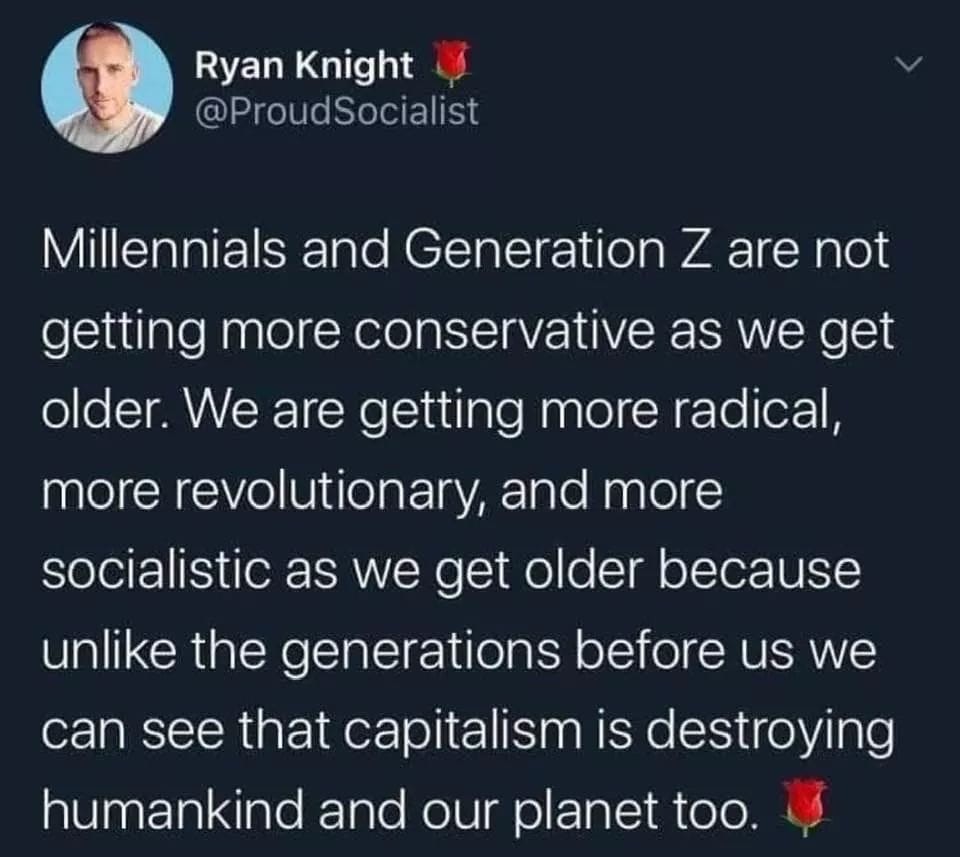
The image is a screenshot of a Twitter post. It features a profile picture of a man (Ryan Knight) on the left. The tweet itself is text-based and states that Millennials and Gen Z are becoming more radical, revolutionary, and socialist as they age, as they witness capitalism's destructive effects on humanity and the planet. There are also rose emojis before and after the text. The color scheme is the default Twitter dark mode: black background with white text. The image is a straightforward communication of a political viewpoint.
Marxist Conflict Theory
This tweet is highly aligned with Marxist Conflict Theory.
- Class Struggle: The core of the message centers on the perceived failure of capitalism, framing it as a destructive force. This immediately positions the tweet within a framework of inherent class conflict – capitalism, by its nature, creates inherent inequality and oppression.
- Historical Materialism: The claim that younger generations “see” capitalism's flaws more clearly implies an evolving understanding of material conditions. The tweet suggests that accumulated experiences of economic hardship, climate change, and social inequality are driving a shift in consciousness.
- Revolutionary Potential: The use of terms like "revolutionary" directly invokes a Marxist goal: the overthrow of the existing capitalist order to establish a more equitable system. The speaker asserts that these generations will not succumb to the ‘false consciousness’ of previous generations, and will instead act to change the structures of power.
- Capitalism as Destructive: The direct accusation that capitalism is "destroying humankind and our planet" is a quintessential Marxist critique – the system's inherent drive for profit leads to exploitation of both people and the environment.
Critical Theory
This tweet fits neatly into the broader project of Critical Theory.
- Critique of Power Structures: The tweet challenges the legitimacy of capitalism as a system, suggesting it’s inherently flawed and destructive. Critical Theory is, at its core, about questioning existing power relations.
- Ideology and Consciousness: The claim that Millennials and Gen Z "can see" the failings of capitalism implies a critique of ideological conditioning. Previous generations are implicitly accused of being blinded by dominant ideologies that legitimize the system.
- Emancipation: The call for radical and revolutionary change is rooted in the Critical Theory goal of emancipation – freeing individuals from oppressive structures and empowering them to live more just and fulfilling lives.
- Social Critique: This is a clear instance of a social critique directed at a particular economic system and its perceived consequences.
Postmodernism
The connection to Postmodernism is somewhat looser, but present.
- Rejection of Grand Narratives: While the tweet does propose a grand narrative (the failure of capitalism), the implicit contrast with previous generations suggests a rejection of their accepted narratives and beliefs.
- Focus on Subjective Experience: The phrase “we can see” emphasizes the subjective experience of Millennials and Gen Z, suggesting that their understanding is based on lived reality, not abstract ideologies.
- Deconstruction of Norms: The call for radical change and revolution can be viewed as an attempt to deconstruct existing norms and power structures.
However, the tweet is relatively straightforward in its assertions, lacking the self-reflexivity and skepticism often associated with more pronounced postmodern thought.
Foucauldian Genealogical Discourse Analysis
This tweet lends itself to a Foucauldian analysis in the following ways:
- Power/Knowledge: The tweet implicitly argues that previous generations held a "knowledge" shaped by the power structures of capitalism. The speaker claims that Millennials and Gen Z have developed a different “knowledge” through their own experiences. This demonstrates the inherent relationship between power and knowledge, as what is considered "true" or "legitimate" knowledge is often shaped by those in power.
- Discursive Shift: The tweet describes a shift in discourse – a change in the way people talk about and understand capitalism. The speaker claims that younger generations are now using a different language (radical, revolutionary, socialist) to describe their relationship to the system.
- Genealogy of the Present: A Foucauldian genealogy would explore the historical conditions that led to this shift in discourse. What specific events, experiences, or social changes have shaped the consciousness of Millennials and Gen Z?
Queer Feminist Intersectional Analysis
While not explicitly stated, an intersectional analysis can be applied to understand the message.
- Interlocking Systems of Oppression: The tweet points towards an understanding that capitalism doesn’t operate in isolation. It’s intertwined with other systems of oppression (patriarchy, racism, colonialism, etc.) that contribute to the destruction of both people and the planet.
- Disproportionate Impact: Intersectional feminism would emphasize that the negative consequences of capitalism are not felt equally by all. Marginalized groups (people of color, LGBTQ+ individuals, women) are often disproportionately affected by economic hardship, environmental degradation, and social injustice. The speaker, though not explicitly making this point, may be hinting at a need to consider the intersectional dimensions of capitalist exploitation.
- Radical Transformation: The call for radical and revolutionary change aligns with the goals of many queer feminist movements, which seek to dismantle oppressive systems and create a more equitable and just world.
In summary: The tweet is most strongly rooted in Marxist Conflict Theory and Critical Theory, but can also be analyzed through the lenses of Postmodernism, Foucauldian Discourse Analysis, and Queer Feminist Intersectional Analysis. It's a statement that highlights the perceived failings of capitalism and calls for radical social change.
simple-description (llama3.2-vision)
This meme is a screenshot of a tweet from a Twitter user named "ProudSocialist" (formerly "ProudLiberal") with the handle @ProudLiberal. The tweet reads: "I'm a millennial and I'm a socialist. I'm a socialist because I'm a millennial. I'm a millennial because I'm a socialist. I'm a socialist because I'm a millennial because I'm a socialist because I'm a millennial because I'm a socialist because I'm a millennial..." The tweet is a humorous example of a self-referential paradox, where the speaker's identity is defined by their own identity, and the identity is defined by the same identity.
tesseract-ocr
a Ryan Knight «/ — @ProudSocialist Millennials and Generation Z are not getting more conservative as we get older. We are getting more radical, more revolutionary, and more socialistic as we get older because unlike the generations before us we can see that capitalism is destroying humankind and our planet too. «J