First Seen
2023-05-10T21:03:40+00:00
simple-description (llama3.2-vision_11b)
The meme is a screenshot of a Twitter conversation between two users, with one user (Nathan Fielder) sharing a quote from a 1776 book, "Common Sense," by Thomas Paine. The quote reads, "These are the times that try men's souls. The last time I read it, I felt like it was written specifically for me." The meme is humorous because it's a sarcastic comment on the idea that the quote is being used in a modern context, implying that the author's words are still relevant today.
detailed-analysis (gemma3-27b-vision)
Okay, here's an analysis of the provided Twitter post, broken down into the requested theoretical frameworks. I'll indicate "Not Applicable" where a framework doesn't clearly lend itself to understanding this content.
Visual Description
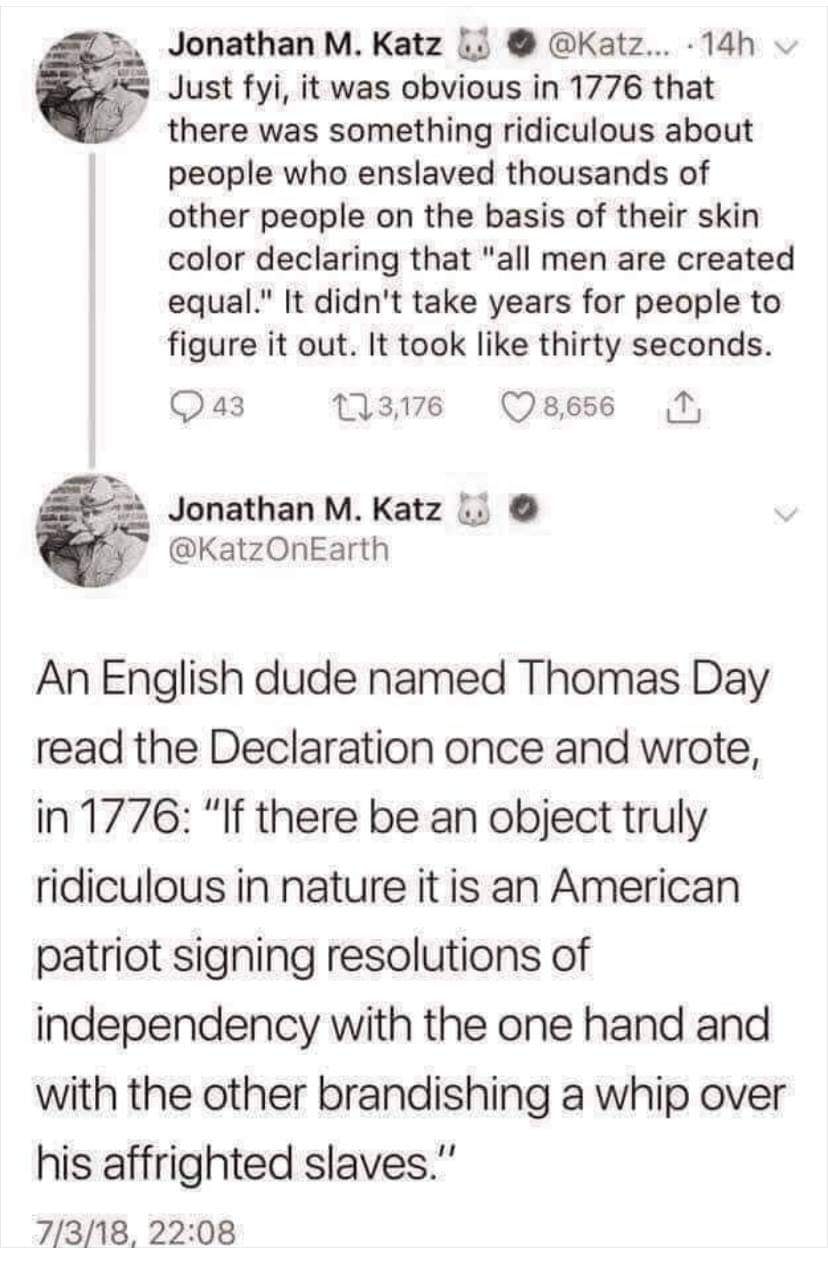
The image is a screenshot of two Twitter posts by Jonathan M. Katz (@KatzOnEarth). The top post features a profile picture (a headshot) of a man and text stating: “Just fyi, it was obvious in 1776 that something ridiculous happened when people who enslaved thousands on the basis of their skin color declaring that 'all men are equal.' It didn’t take years for people to figure it out. It took like thirty seconds.” The post has engagement metrics displayed underneath.
The second post is a continuation of the first, and it quotes Thomas Day, an English writer, from 1776. The quote reads: "If there be an object truly ridiculous in nature it is an American patriot signing resolutions of independence with the one hand and with the other brandishing a whip over his affrighted slaves.” The date of the post is shown at the bottom (7/3/18, 22:08).
Critical Theory
This post is a strong example of Critical Theory in action. Critical Theory, rooted in the Frankfurt School, examines how power structures maintain domination through ideology.
- Ideology & Contradiction: The post directly exposes the contradiction at the heart of the American Declaration of Independence. The assertion of universal equality ("all men are created equal") clashes starkly with the lived reality of enslaved people at the very same time. This reveals that the "equality" proclaimed was not universal, but rather a concept reserved for a specific group (white, property-owning men).
- Unmasking Power: Katz "unmasks" the hypocrisy of the founding fathers. By highlighting the juxtaposition of declaring independence while simultaneously owning slaves, he challenges the traditional, celebratory narrative of American history and reveals the power dynamics that underlay its formation.
- Critique of Enlightenment: The post implicitly critiques the Enlightenment project. While the Declaration of Independence is a product of Enlightenment thought, the continued existence of slavery demonstrates the inherent limitations and contradictions within that project. It shows how Enlightenment ideals could be selectively applied to justify existing power structures.
Marxist Conflict Theory
This post powerfully illustrates key tenets of Marxist Conflict Theory:
- Class Struggle: While the post doesn’t explicitly mention “class,” it underscores a fundamental power imbalance. The enslaved people represent a profoundly exploited group, while the "American patriots" represent the ruling class. The contradiction between the declaration of equality and the continued practice of slavery demonstrates how the ruling class maintains its power through economic exploitation and ideological control.
- Material Conditions: The post implicitly points to the material conditions that sustained slavery. The economic benefits derived from slave labor were central to the American colonies' prosperity and motivated the hypocrisy of the founding fathers.
- Ideology as a Tool of Oppression: The “all men are equal” statement can be seen as a tool of ideological control. It served to legitimize the system by creating a narrative of universal rights while simultaneously denying those rights to a significant portion of the population.
Foucauldian Genealogical Discourse Analysis
This post lends itself well to a Foucauldian analysis. Michel Foucault’s genealogical method focuses on uncovering the historical formation of knowledge, power, and discourse.
- Power/Knowledge: The post exposes how the concept of "equality" was constructed and deployed within a specific power/knowledge regime. The Declaration of Independence isn't simply a statement of truth; it's a discourse that shaped perceptions of freedom and rights, but did so in a way that excluded and marginalized enslaved people.
- Historical Contingency: Foucault argued that concepts and norms are not timeless or universal but are products of specific historical circumstances. This post demonstrates that the meaning of "equality" in 1776 was contingent upon the existence of slavery and the prevailing social order.
- Discursive Practices: The juxtaposition of the declaration and the reality of slavery reveals how language can be used to create and maintain power relations. The discourse of freedom and equality was deployed strategically to legitimize the American Revolution while simultaneously justifying the oppression of enslaved people.
Postmodernism
Postmodernism's contribution to understanding this post comes from its emphasis on deconstruction and questioning grand narratives:
- Deconstruction of the "American Dream": The post deconstructs the traditional "American Dream" narrative by exposing the inherent contradictions and hypocrisy upon which it was built.
- Rejection of Universal Truths: Postmodernism challenges the idea of universal truths or objective reality. This post implicitly supports that challenge by revealing that the "equality" proclaimed in the Declaration of Independence was not universal but rather a socially constructed concept that served specific power interests.
- Focus on Perspective: The post implicitly calls for a consideration of the perspective of enslaved people. The narrative of American independence is traditionally told from the perspective of the founding fathers, but this post suggests that a more complete understanding requires acknowledging the experiences and perspectives of those who were excluded from that narrative.
Queer Feminist Intersectional Analysis
While slavery is not directly related to queer or feminist issues, an intersectional lens can enrich the analysis by highlighting the ways in which multiple forms of oppression intersect:
- Interlocking Systems of Oppression: Enslaved women faced a unique set of challenges, including sexual exploitation and the denial of reproductive rights. The intersection of race, gender, and class created a particularly vulnerable position for them.
- The Construction of Gender Roles: The system of slavery reinforced patriarchal gender roles and expectations. Enslaved men were often subjected to harsh labor, while enslaved women were subjected to both labor and sexual abuse.
- Silencing and Marginalization: The voices and experiences of enslaved people, particularly enslaved women, were systematically silenced and marginalized in the historical narrative. The post implicitly calls for a more inclusive and nuanced understanding of American history that acknowledges the contributions and struggles of all people.
I hope this detailed analysis provides a comprehensive overview of the post through the requested theoretical frameworks! Let me know if you'd like me to elaborate on any of these points.
simple-description (llama3.2-vision)
The meme is a humorous comparison between two historical events. The top text reads: "In 1776, a bunch of dead white guys wrote a document that said 'all men are created equal'". The bottom text responds with: "Then in 1863, Abraham Lincoln said 'all men are created equal' while owning slaves". The meme is poking fun at the hypocrisy of the founding fathers' ideals being in direct conflict with the harsh reality of slavery in the US.
tesseract-ocr
Za, Jonathan M. Katz 5 @ @Katz... -14h » — Just fyi, it was obvious in 1776 that there was something ridiculous about people who enslaved thousands of other people on the basis of their skin color declaring that “all men are created equal." It didn't take years for people to figure it out. It took like thirty seconds. O43 113176 ©se656 ,7, at Jonathan M. Katz &) @ , @KatzOnEarth An English dude named Thomas Day read the Declaration once and wrote, in 1776: “If there be an object truly ridiculous in nature it is an American patriot signing resolutions of independency with the one hand and with the other brandishing a whip over his affrighted slaves.” 7/3/18, 22:08