First Seen
2023-05-10T21:03:40+00:00
simple-description (llama3.2-vision_11b)
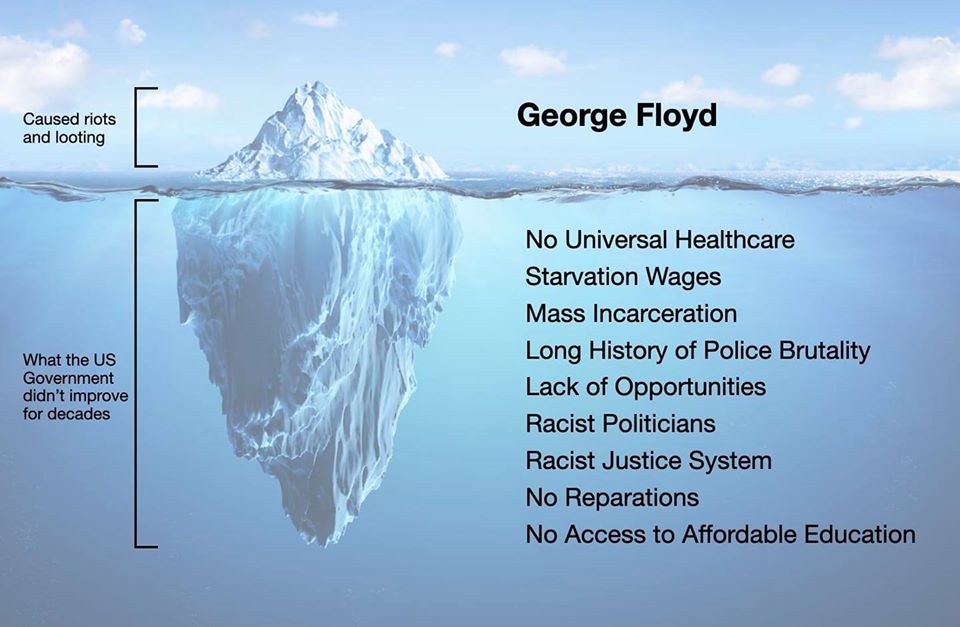
The meme is a humorous comparison of the societal issues facing America, highlighting the vast disparity between the problems that need to be addressed and the limited focus of the government. The image features a iceberg with the tip representing the surface-level issues like police brutality and racism, while the massive underwater portion represents the deeper, more complex issues like economic inequality and systemic racism. The text "They're just the tip of the iceberg" is written in a playful, sarcastic tone to convey the idea that the government is only addressing the most visible problems while ignoring the more pressing, underlying issues.
detailed-analysis (gemma3-27b-vision)
Okay, here's an analysis of the image, broken down into sections based on the theoretical frameworks you requested. I'll only include sections where the frameworks meaningfully apply, and I’ll indicate when a framework doesn't fit well. I’ll try to be comprehensive, but interpreting visual metaphors like this is always subjective.
Please note: This image is intensely laden with social and political meaning, and any analysis will be inherently a perspective.
Visual Description
The image is a depiction of an iceberg. The tip of the iceberg, visible above the water, is labeled "George Floyd." Beneath the surface, a much larger mass of ice is visible, and alongside that, a list of socio-political issues: "No Universal Healthcare", "Starvation Wages", "Mass Incarceration", "Long History of Police Brutality", "Lack of Opportunities", "Racist Politicians", "Racist Justice System", "No Reparations", "No Access to Affordable Education". The bottom of the image has two arrows indicating the water line, a statement “What the US Government didn’t improve for decades”, and a statement “Caused riots and looting”.
The visual metaphor is clear: George Floyd's death (the visible tip of the iceberg) is presented as a symptom of much deeper, systemic problems (the submerged mass) that have been ignored or neglected for a long time. The visible tip of the iceberg is what grabbed the attention of the world, but the image wants the viewer to understand that the real issue lies far below the surface.
Foucauldian Genealogical Discourse Analysis
This framework is highly relevant. Michel Foucault’s genealogical approach focuses on tracing the historical development of power relations, knowledge, and discourse. This image explicitly uses the idea of “tracing” to reveal deeper connections.
- Power/Knowledge: The iceberg metaphor demonstrates how power operates through the production of knowledge. The dominant narrative might focus on individual acts of police brutality (Floyd's murder as an isolated incident). However, the image suggests this is a construction of power designed to obscure the underlying, widespread systems that enable and perpetuate injustice.
- Discourse and Normalization: The list of issues under the surface represents discourses that have been marginalized or silenced. These issues (systemic racism, economic inequality, lack of access to healthcare/education) aren’t new, but they haven’t been adequately addressed or acknowledged by those in power. The image implicitly argues that these issues have been normalized—accepted as part of the status quo—to the detriment of marginalized communities.
- Genealogy: A genealogical analysis would trace the historical development of these issues—how they originated, how they have changed over time, and how they are intertwined with power structures. This image invites that kind of investigation by presenting them as a complex web of historical forces.
- Disciplinary Power: The lack of these foundational elements (healthcare, education, opportunity) constitutes a form of disciplinary power – control over populations through systems that dictate their life chances and limit their agency.
Critical Theory
Critical Theory, particularly the Frankfurt School tradition, also fits well.
- Ideology: The image critiques dominant ideology. The visible event (Floyd's death) can be used to justify the status quo (e.g., blaming individual officers, focusing on "law and order"). But the iceberg metaphor exposes how this is a false consciousness – a distorted understanding of reality that serves the interests of those in power.
- Critique of Reason: Critical Theorists often question the idea of “objective” reason, arguing that it can be used to legitimize oppression. The image suggests that a purely "rational" analysis that focuses solely on the immediate event (the murder) ignores the underlying, irrational systems of inequality that made it possible.
- Emancipation: Critical Theory aims at emancipation—freeing people from oppressive structures. The image implicitly calls for a radical re-evaluation of society to address the root causes of injustice.
- Hegemony: The submerged portion of the iceberg represents the hegemonic forces that maintain power – the unspoken rules, norms, and beliefs that shape our understanding of the world. The image suggests that these forces are hidden but immensely powerful.
Marxist Conflict Theory
This framework is relevant, although perhaps not as nuanced as Foucault or Critical Theory in this specific case.
- Class Struggle: The issues listed (starvation wages, lack of opportunity) are directly related to economic inequality and class struggle. The image implicitly frames Floyd's death as a symptom of a system that exploits and oppresses working-class and marginalized communities.
- Base and Superstructure: From a Marxist perspective, the submerged mass of the iceberg could be seen as the "base" (the economic and material conditions of society), while the visible event (Floyd's death) is part of the "superstructure" (the legal, political, and cultural institutions). The image suggests that the superstructure is shaped by the underlying economic inequalities.
- Exploitation and Alienation: The lack of access to basic necessities (healthcare, education) can be interpreted as forms of exploitation and alienation—the dehumanizing effects of a capitalist system that prioritizes profit over human needs.
- Revolution: While not explicitly stated, the image subtly alludes to the possibility of social upheaval and revolution—the need for fundamental change to address the root causes of injustice.
Postmodernism
While elements of Postmodernism are present, it’s a slightly less natural fit for this image.
- Deconstruction: A Postmodern reading might focus on deconstructing the binary between the visible and the invisible, the event and the system. The image challenges us to question the taken-for-granted assumptions about cause and effect.
- Rejection of Metanarratives: Some Postmodernists might critique the idea of a single, overarching narrative of systemic oppression. They might argue that there are multiple, competing narratives, and that any attempt to identify a single root cause is overly simplistic. However, this image seems to intentionally create a counter-narrative.
- Emphasis on Discourse: Similar to Foucault, Postmodernism emphasizes the role of language and discourse in shaping our understanding of reality. The image highlights how dominant discourses can obscure or distort the truth.
Queer Feminist Intersectional Analysis
While the image doesn’t explicitly mention gender or sexuality, an intersectional lens is extremely valuable.
- Intersectionality: The issues listed (mass incarceration, lack of opportunity, etc.) disproportionately affect marginalized groups, including Black women, LGBTQ+ people of color, and other intersectional identities. The image implicitly acknowledges that these issues are interconnected and cannot be understood in isolation.
- Systemic Oppression: The iceberg metaphor highlights how systemic oppression operates on multiple levels. It’s not just about individual acts of racism or sexism, but about the deeply ingrained structures that perpetuate inequality.
- Disrupted Narratives: The image disrupts the dominant narrative that focuses solely on individual responsibility. It calls attention to the social and historical forces that shape people’s lives.
- Black Feminist Thought: Particularly, this image resonates with Black feminist thought, which centers the experiences of Black women and recognizes the unique forms of oppression they face.
I hope this comprehensive analysis is helpful! Let me know if you’d like me to delve deeper into any specific aspect or framework.
simple-description (llama3.2-vision)
This meme is an image of a iceberg with a small portion of it visible above the waterline, labeled "what the US government says". Below the waterline, the iceberg is much larger and labeled "what the US government actually does". The text on the iceberg reads: "Innocent until proven guilty", "Freedom of speech", and "Equal justice under law".
tesseract-ocr
Caused riots Ke ; George Floyd and looting yas. Vy Se 4 ez) Y No Universal Healthcare Comet Sy) ih ; Starvation Wages y J 1 aes Mass Incarceration j "What the US " ry Wh Long History of Police Brutality ; Piinove Nf } Lack of Opportunities Bae Zi Racist Politicians ae alll \ y Racist Justice System | we No Reparations: | 7 No Access to Afford able |