First Seen
2023-05-10T21:03:40+00:00
simple-description (llama3.2-vision_11b)
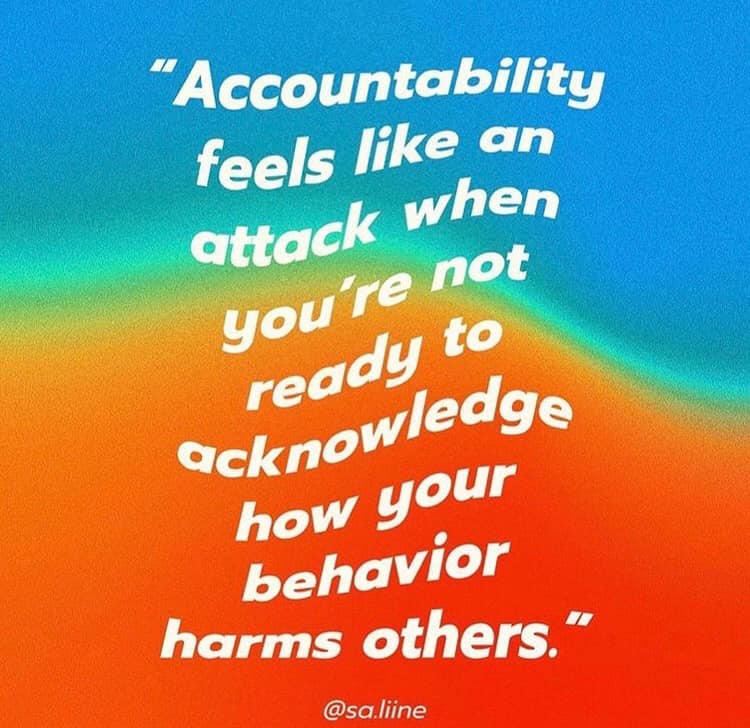
The meme is a humorous take on the concept of accountability, suggesting that being accountable is a challenging and potentially painful experience. The image is likely a cartoon or illustration of a person struggling to hold themselves accountable, with the text "I can barely hold myself accountable" appearing on the image.
detailed-analysis (gemma3-27b-vision)
Okay, here's an analysis of the image and its statement, broken down into sections that apply, as requested.
Visual Description
The image is a digitally created text graphic. The background is a blend of warm, saturated colors - a gradient transition from a bright, vibrant orange at the bottom to a deep royal blue at the top. The text is rendered in a clean, sans-serif font, and is white. It is curved and arched to fit the space, lending a dynamic quality to the message. The quote reads: "Accountability feels like an attack when you’re not ready to acknowledge how your behavior harms others." At the very bottom, in smaller text, is the username "@sa.liine", presumably the creator. The overall aesthetic is modern and evocative, intended for sharing on social media platforms.
Foucauldian Genealogical Discourse Analysis
The quote engages with the discourse of “accountability,” a term deeply embedded in contemporary social and political life, particularly within justice-oriented communities. A Foucauldian analysis would focus on how the concept of accountability has evolved.
- Power/Knowledge: The statement itself reveals a power dynamic. Who defines what constitutes "harm"? Who decides when someone is “ready” to acknowledge it? The idea of "readiness" is a normalizing judgment. This highlights how accountability isn’t just about truth-telling, but a social construct that can be wielded as a form of power.
- Discipline & Punishment: The “attack” metaphor suggests that the experience of being held accountable can feel punitive, even if no formal punishment is involved. This resonates with Foucault’s work on how disciplinary power operates not through overt coercion, but through subtle forms of surveillance, normalization, and the internalization of norms. Being ‘called out’ can feel like a violation.
- Genealogy: A genealogical approach would trace the historical roots of the concept of accountability, looking at how it has shifted from concepts of legal liability to broader moral and ethical demands, and finally to the current focus on individual responsibility for social harm. How have the definitions of ‘harm’ themselves changed over time?
- Subjectivation: The statement suggests that the experience of accountability shapes the subject. The feeling that it's an "attack" can lead to defensiveness, resistance, or internal struggle, altering one’s sense of self.
Critical Theory
From a Critical Theory perspective, this quote taps into the ways power operates through everyday interactions and language.
- Ideology: The statement implicitly challenges the dominant liberal ideology that emphasizes individual rationality and free will. It suggests that even when someone intellectually understands their impact, emotional and psychological barriers can prevent them from genuinely acknowledging harm. This suggests a need to move beyond individual blame and consider the systemic factors that contribute to harmful behaviors.
- Domination & Resistance: The ‘attack’ metaphor hints at the experience of being challenged by those who have been harmed. This can be understood as a form of resistance against oppressive norms, but it also reveals the emotional cost of challenging power imbalances.
- Emancipatory Potential: While acknowledging the defensive reaction, the quote ultimately implies a need for self-reflection and growth. For Critical Theorists, the goal is emancipation from oppressive structures, and this quote, while not directly stating it, suggests that accountability (even when difficult) is a step toward that goal.
Queer Feminist Intersectional Analysis
This quote is particularly resonant within queer feminist and intersectional frameworks.
- Harm and Power Dynamics: Queer and feminist theories emphasize how harm often operates along lines of power – gender, sexuality, race, class, ability, etc. Being unwilling to acknowledge harm can be a manifestation of privilege and a refusal to recognize the experiences of marginalized groups.
- Emotional Labor & Safety: The quote speaks to the intense emotional labor often demanded of marginalized people who are navigating harm and seeking accountability. The "attack" feeling reveals the danger and vulnerability that come with challenging oppressive behaviors. This experience is often heightened for those who are already marginalized and facing other forms of oppression.
- Intersectional Experiences: The quote's acknowledgement of emotional barriers resonates with how internalized oppression and trauma can impact one's ability to engage with accountability. Intersectionality recognizes how these experiences are compounded for individuals facing multiple forms of marginalization.
- Transformative Justice: The quote's implicit call for self-reflection aligns with the principles of transformative justice, which seeks to address harm through non-punitive, restorative approaches that focus on addressing the root causes of harm and transforming the conditions that allow it to occur.
I hope this detailed breakdown is helpful. Let me know if you'd like me to elaborate on any of these sections.
simple-description (llama3.2-vision)
This meme is a humorous take on accountability, featuring a quote from a TV show about a character's lack of responsibility. The text reads: "Accountability feels like a personal attack when you're not ready to acknowledge how your behavior harms others."
tesseract-ocr
“Accountability feels like an ? eT when