First Seen
2023-05-10T21:03:40+00:00
simple-description (llama3.2-vision_11b)
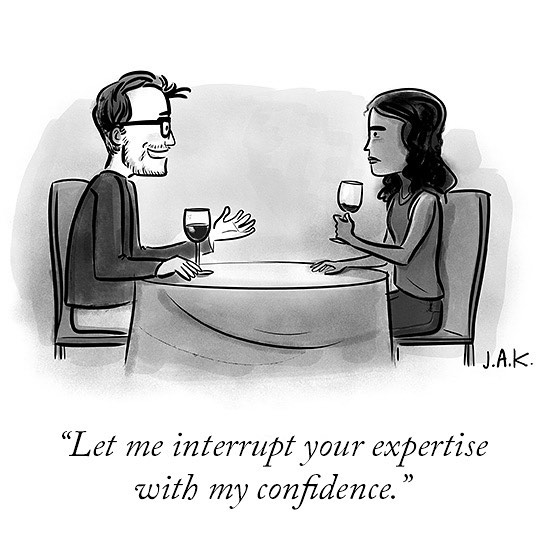
The meme is a humorous illustration of a conversation between a man and a woman in a social setting. The text "I'm not arguing, I'm just explaining why I'm right" appears below the image, implying that the man is being obstinate and refusing to listen to the woman's perspective. From a sociological perspective, this meme highlights the common social phenomenon of men being more likely to engage in argumentative behavior and being less receptive to others' opinions.
detailed-analysis (gemma3-27b-vision)
Okay, here's an analysis of the cartoon, broken down into sections as requested. I'll note if a section isn't applicable based on the image.
Visual Description
The cartoon is a black and white illustration depicting two people seated at a round table, likely in a dining setting. The man is animated and seems to be speaking animatedly, gesturing with his hands. His facial expression is self-assured, maybe even smug. He holds a wine glass. The woman, positioned opposite him, looks unimpressed and is looking away, almost as if dismissing him. She also has a wine glass. The background is plain. A speech bubble above the man contains the caption "Let me interrupt your expertise with my confidence." The artist's initials, “J.A.K.” are in the bottom right corner.
Foucauldian Genealogical Discourse Analysis
This cartoon is deeply relevant to a Foucauldian analysis. The central tension revolves around power dynamics and discourse. Foucault would see the cartoon as illustrating how "knowledge" (the woman’s "expertise") is intertwined with power. The man is attempting to displace this knowledge with a performance of confidence.
- Discursive Formation: The cartoon reveals a “discursive formation” around communication—a set of rules and assumptions about how conversations should happen. Usually, respect for expertise is part of this, but the man’s behavior actively disrupts it.
- Power/Knowledge: The man isn’t appealing to knowledge or insight; he's appealing to confidence. This suggests that, in some contexts, performance and assertiveness can be wielded as forms of power that override actual competence. Foucault would argue this isn’t accidental; it’s a symptom of how power often operates through discourse.
- Genealogy: A genealogical analysis might look at how this “confidence over competence” dynamic has developed historically. One could trace it back to social systems that reward brashness and self-promotion, even in the absence of demonstrated skill (e.g., some corporate cultures, political systems).
Critical Theory
The cartoon is highly relevant to Critical Theory, particularly as it touches on the ways social structures perpetuate inequalities through communication patterns.
- Ideology: The man’s behavior reveals an ideological assumption that assertiveness and self-belief are sufficient for legitimacy, even at the expense of genuine knowledge. This reinforces a societal norm that prioritizes appearing competent over being competent.
- Domination: The man’s attempt to interrupt the woman can be seen as an act of subtle domination – an effort to assert control over the conversation and silence her expertise.
- Habermas & Communicative Rationality: The cartoon contrasts with Habermas’s ideal of “communicative rationality,” where arguments are evaluated based on their validity and truth. Here, the man isn't interested in reasoned exchange; he's interested in imposing his voice.
- Cultural Critique: The cartoon can be read as a critique of contemporary culture, where confidence and self-promotion are often valued more than genuine expertise, particularly in fields like marketing, finance, or even politics.
Marxist Conflict Theory
While the cartoon isn't directly about class struggle, a Marxist lens can still be applied to analyze power dynamics.
- Power Relations: The cartoon illustrates unequal power relations, though not necessarily based on class. The man is attempting to assert dominance in the social exchange, effectively silencing the woman's voice. The man is trying to exert 'cultural capital' through performance, rather than demonstrable skills.
- Symbolic Capital: The man is attempting to create 'symbolic capital' for himself by portraying confidence, regardless of actual knowledge. This aligns with Bourdieu's concepts of how power operates through symbolic forms.
- Ideological Hegemony: The cartoon implies a broader societal issue. If this kind of behaviour is accepted or even encouraged, it reinforces a system where those who appear confident can succeed, regardless of their expertise. This can perpetuate inequalities.
Postmodernism
Postmodernism is highly relevant to this cartoon:
- Deconstruction of Authority: The cartoon deconstructs the traditional notion of authority based on expertise. It suggests that “confidence” can be a performative substitute for actual knowledge, challenging the idea of objective truth.
- Simulacra & Simulation: The man's confidence can be seen as a "simulacrum"—a copy without an original. It's a performance of assurance that doesn't necessarily reflect any underlying competence.
- Subjectivity & Perspective: The cartoon highlights the subjective nature of communication. What constitutes "expertise" and "confidence" are themselves constructed concepts, influenced by social norms and individual perspectives.
Queer Feminist Intersectional Analysis
This is potentially the most compelling lens for understanding the cartoon. The power dynamic is heightened when considering gender.
- Silencing of Women: The cartoon vividly depicts a common scenario where women’s expertise is dismissed or interrupted by men. This is a form of subtle sexism and patriarchal control.
- Performance of Masculinity: The man’s assertive behaviour can be interpreted as a performance of traditional masculinity—an attempt to dominate the conversation and assert his authority.
- Intersectional Perspective: Intersectionality recognizes that power imbalances are complex and layered. The woman’s experience of being interrupted may be further compounded by other factors, such as her race, class, or other marginalized identities.
- Microaggressions: The interruption itself can be seen as a microaggression—a subtle, often unintentional act of discrimination that contributes to a hostile environment.
I hope this detailed analysis is helpful! Let me know if you’d like me to expand on any of these sections.
simple-description (llama3.2-vision)
The meme is a cartoon of a man and a woman sitting at a table with wine glasses in front of them. The man is saying "I'm sorry, I didn't mean to interrupt your expertise, I just wanted to add my two cents." The text at the bottom of the image reads "Let me interrupt your expertise with my confidence."
tesseract-ocr
US oe | fe) bo! TY NT) [/ \ me AY 9 | Sc fo ee ee eee JAK. “Let me interrupt your expertise with my confidence.”