First Seen
2023-05-10T21:03:40+00:00
simple-description (llama3.2-vision_11b)
The meme is a visual representation of the concept of inequality, using a tree to illustrate the idea that everyone starts with the same amount of "apples" (resources, opportunities) but as they grow, some people's trees become more fruitful while others wither. The text "We are equally endowed at birth" is written above the tree, emphasizing the idea that everyone begins with the same potential. The image shows a tree with some apples falling off, representing the unequal distribution of resources and opportunities in society.
detailed-analysis (gemma3-27b-vision)
Okay, let's break down this impactful image through the lenses you've requested. It's a complex visual metaphor, so the analysis will be detailed.
Visual Description
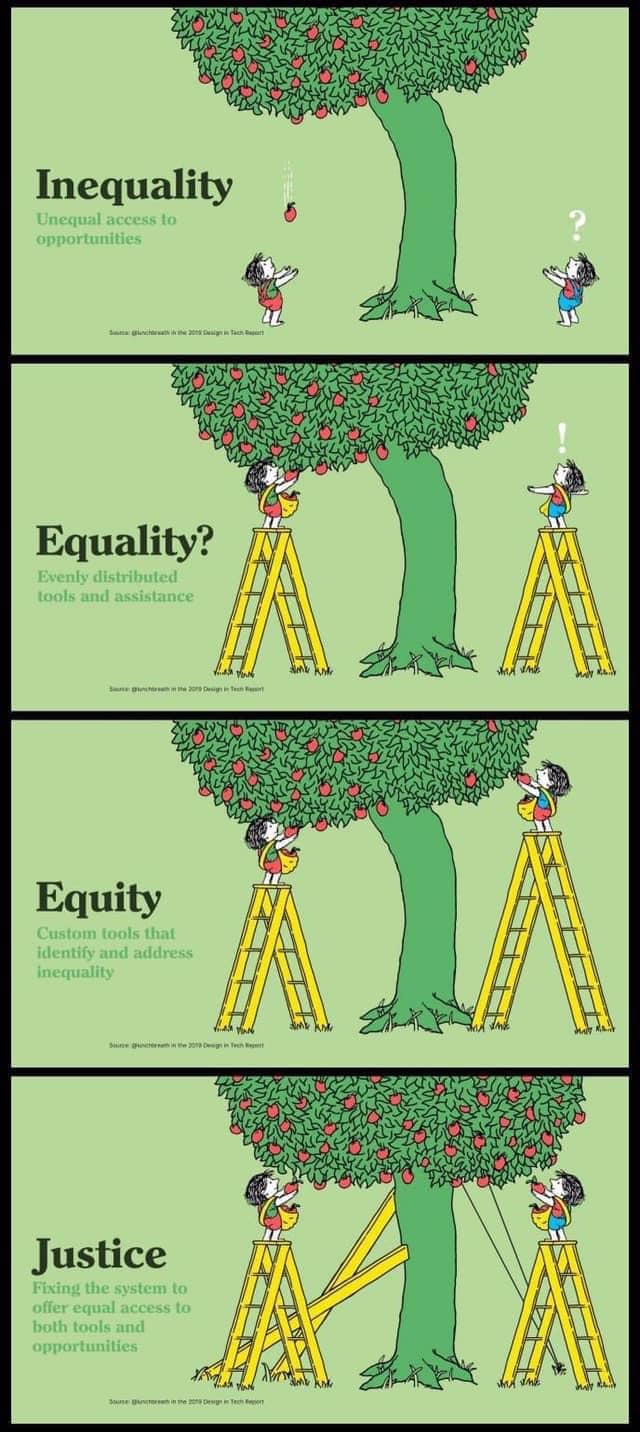
The image is a series of four panels arranged vertically. Each panel depicts a tree laden with red fruit. In each panel, there are figures attempting to reach the fruit, but the means by which they do so changes.
- Inequality: The first panel shows three figures of differing heights. The tallest can reach the fruit easily. The medium figure can reach a few lower branches, while the shortest figure cannot reach any fruit at all.
- Equality?: The second panel shows the same figures, but now each has a box of the same size to stand on. The tallest figure doesn't need it, and now the medium and short figures can reach some of the fruit, but the medium figure still struggles.
- Equity: The third panel shows the same figures but with ladders of varying heights. Each ladder is customized to allow each figure to reach the fruit, demonstrating an individualized approach to access.
- Justice: The fourth panel shows an orchard of trees, meaning a systemic change. There's no need for ladders or boxes; all figures have easy access to the fruit.
The visual metaphor clearly depicts a progression from unequal access to an envisioned state of justice. The color palette is relatively muted, drawing attention to the core message. The figures are somewhat androgynous, avoiding specific gender identification.
Critical Theory
This image functions as a potent illustration of key concepts in Critical Theory, particularly around power and access. It challenges the idea of a "neutral" system.
- The critique of ideology: The first panel highlights how systems appear to be meritocratic (the tallest person 'deserves' the fruit), but the reality is one of inherited or structural advantage. The "Equality?" panel illustrates how simply giving everyone the same thing doesn't address pre-existing disadvantages. It critiques the 'equality of opportunity' as a rhetorical justification for inequality.
- Emancipatory knowledge: The transition to "Equity" and "Justice" represents the goal of Critical Theory – to uncover the systemic forces that perpetuate oppression and to envision (and work towards) a more just society.
- Habermas and Communicative Rationality: The image implicitly suggests that true justice requires a dialogue that acknowledges different needs and vulnerabilities. The "Justice" panel shows a reimagined system built on mutual accessibility and not solely focused on individual ‘success.’
Marxist Conflict Theory
The image strongly resonates with Marxist principles, framing access to the “fruit” as a metaphor for resources and opportunity within a capitalist system.
- Class Struggle: The figures can be interpreted as representing different classes. The taller figure, initially having effortless access, embodies the privileged class, while the shorter figures represent those disadvantaged by the system. The struggle to reach the fruit symbolizes the class struggle.
- Means of Production: The fruit can be seen as the means of production, the resources that create wealth. The initial inequity represents the uneven distribution of these resources.
- Revolution/Systemic Change: The final panel, with the orchard, can be viewed as a metaphor for a revolutionary change in the system—a restructuring that dismantles the unequal distribution of resources and provides access for all. The shift from individual solutions (boxes/ladders) to systemic change is crucial.
- False Consciousness: The ‘Equality?’ panel can be interpreted as illustrating how a superficial solution (giving everyone the same resource) can mask the underlying power dynamics and maintain the status quo.
Foucauldian Genealogical Discourse Analysis
Through a Foucauldian lens, the image illuminates how concepts like “equality” and “justice” are constructed through discourse and power relations.
- Genealogy of "Equality": The image reveals how the term "equality" is often used not to address genuine disparities, but to justify existing power structures. Simply giving everyone the same box doesn't challenge the underlying conditions that put some individuals at a disadvantage. This exposes the historical development of the concept and how it's been used to serve specific interests.
- Power/Knowledge: The image demonstrates how knowledge (about what constitutes “fairness” or “equality”) is intertwined with power. Those in positions of power often define what constitutes “equal” access, shaping the discourse to maintain their privilege.
- Discipline & Normalization: The initial state of "inequality" can be viewed as a form of social discipline – the normalization of unequal access based on inherent (or perceived) differences. "Equity" and "Justice" represent efforts to disrupt these disciplinary mechanisms.
- The shifting discourse: As we move through the panels, the discourse around access shifts. The image encourages us to question what we think we mean when we talk about equality and justice and to consider alternative framings (equity) that acknowledge systemic disparities.
Postmodernism
While not as overtly aligned with Postmodernism as the other analyses, certain elements resonate with the Postmodern critique of grand narratives and universal truths.
- Deconstruction of ‘Equality’: The image deconstructs the traditional notion of “equality” by revealing its limitations and the ways in which it can be used to perpetuate inequality. It challenges the idea of a single, universal definition of fairness.
- Rejection of Metanarratives: The shift from "equality" to "equity" suggests a rejection of the idea that there is one ‘right’ way to achieve social justice. It embraces a more nuanced and context-specific approach.
- Emphasis on Perspective: The image implicitly acknowledges that there are multiple perspectives on what constitutes fairness. The varying heights of the figures represent different lived experiences and needs.
- The instability of meaning: The panels move through different understandings of "fairness," suggesting that meaning is not fixed but constructed and negotiated.
Queer Feminist Intersectional Analysis
This is perhaps the most impactful lens through which to view the image.
- Intersectional Oppression: The figures represent not just different classes, but potentially other marginalized identities (race, gender, sexuality, disability). The varying heights can be seen as metaphors for the multiple layers of oppression that individuals face. The initial inequality isn’t just about height—it’s a stand-in for all forms of systemic disadvantage.
- Challenging Universalism: Traditional feminist and queer theory critiques the idea of a universal experience of oppression. This image embodies that critique. What constitutes “equal” access for one individual may not be sufficient for another.
- Equity as a Queer/Feminist Principle: The concept of "equity" aligns strongly with queer and feminist principles of valuing difference and addressing systemic barriers to inclusion. It moves beyond simply treating everyone the same to providing the support that each individual needs to thrive.
- Centering Marginalized Voices: The shift to "equity" and "justice" can be seen as a call to center the voices and experiences of those who have been historically marginalized. It’s about moving beyond a dominant perspective to create a more inclusive system.
- Challenging Normative Assumptions: The final panel shows a reimagined system, challenging the normative assumptions that perpetuate inequality. It calls for a radical restructuring of society to create a truly just and equitable world.
I hope this comprehensive analysis is helpful. Let me know if you’d like me to elaborate on any specific point!
simple-description (llama3.2-vision)
The meme is a humorous illustration of a person climbing a tree to pick an apple, but instead of finding a juicy apple, they find a tiny, empty bucket labeled "Equality". The text in the image reads: "Inequality: Unequal access to opportunities. Equality: Unequal access to opportunities. Inequality: Unequal access to opportunities. Equality: Unequal access to opportunities." The meme is poking fun at the idea that "equality" is just a fancy word for "inequality" with a few words changed.
tesseract-ocr
SYD ODD ROL AOR ISS TRIN 7s Lee aaa ees RO Inequality [ Aon et On NO eee Le Nee 5 UALR © Eee Ga Rae a % 3 iS S 7 BY eS HHT \\\ cadre. [EL \\\\ __ fate Why Za E hed Und ay Aa! LOD ee wa, ES NN IN H\\\ ff DA\ | [/ \\\ HH\\\ edit! = \\\ bid, why Zall An WOR IAA EA I PLAST NCAA Te Te Ee aire Rene, 6S J /} Pay HME HU AAS pyrene /UN\\\ Mk hd My nk Zi € af dn de