First Seen
2023-05-10T21:03:40+00:00
simple-description (llama3.2-vision_11b)
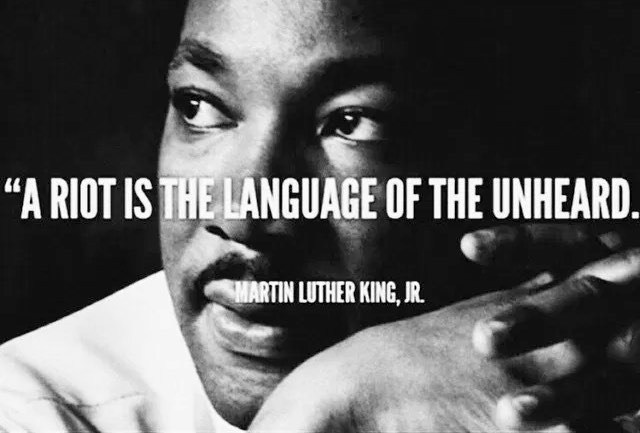
From the perspective of sociology, this meme is a commentary on the relationship between social movements and the media. The image of Martin Luther King Jr. with the quote "A riot is the language of the unheard" highlights the struggle for social justice and the need for marginalized communities to be heard. The meme is using this quote to emphasize the importance of amplifying marginalized voices and the need for social change.
detailed-analysis (gemma3-27b-vision)
Okay, let's break down the image of Martin Luther King Jr. with the quote "A Riot Is The Language of the Unheard," through the lenses of several theoretical frameworks.
1. Visual Description
The image is a stark, black-and-white close-up portrait of Martin Luther King Jr. It focuses on his face, particularly his eyes and mouth. The lighting is dramatic, creating strong shadows that emphasize the contours of his face, adding to the intensity of the image. He appears deep in thought or perhaps in mid-sentence, almost as if he’s speaking directly to the viewer. His expression is complex – it’s a blend of seriousness, pain, and resolve. The image is deliberately stripped of any background distractions, highlighting the power of his gaze and the weight of his words. The quote is prominently displayed in bold white letters across the top half of the picture, and his name is cited below. The monochrome aesthetic lends a historical and gravitas feeling to the portrait.
2. Foucauldian Genealogical Discourse Analysis
Foucault’s genealogical method traces the historical development of ideas and practices to reveal how power relations shape them. Here’s how we can apply it:
- Discourse of Order & Riot: The image juxtaposes the concept of “riot” with the idea of communication ("language"). This challenges the dominant discourse that typically frames riots as chaotic, irrational acts of violence. Foucault would be interested in how this framing serves power. Riots have historically been labelled as breaches of order and therefore justification for state repression. The image, by equating riots with the "language of the unheard," suggests riots are a response to a lack of recognition and a denial of voice.
- Power/Knowledge: The power to name something is a form of power. By labeling something a "riot," authorities can justify force. The image disrupts this by framing the event as a communication. The image suggests the state has deliberately chosen not to hear the cries for change, thus forcing people to communicate through disruption.
- Genealogical Trace: Investigating the historical construction of "riot" as a category would reveal how it’s been used to maintain social hierarchies. Tracing the evolution of legal definitions and media representations of riots would demonstrate how the term has been consistently used to delegitimize protests and suppress dissent.
3. Critical Theory
Critical Theory, originating from the Frankfurt School, examines how social structures create and maintain domination.
- Emancipation and Reason: The image speaks to the failure of reason and progress to deliver justice. The quote suggests that despite the claims of a rational society, many people are excluded from participating in the democratic process. It implies that the only way to be heard is through actions that disrupt the established order.
- Ideology Critique: The dominant ideology often presents social inequalities as natural or inevitable. The image challenges this by highlighting the systemic forces that silence marginalized groups. It implies that the "unheard" are not simply making noise, but responding to a deeply unjust system.
- Alienation: Critical Theorists like Marx and Adorno spoke of alienation within capitalist societies. This image could be seen as showing the ultimate expression of alienation – the point where dialogue breaks down and people resort to actions that are perceived as destructive by the dominant culture.
4. Marxist Conflict Theory
Marxist theory understands society as being in a constant state of conflict between different classes.
- Class Struggle: The quote can be interpreted as reflecting the tensions inherent in a society structured by economic inequality. “The unheard” could represent the working class or marginalized communities who have been systematically excluded from political and economic power.
- Revolutionary Potential: Riots, in this framework, aren't just random acts of violence, but expressions of accumulated grievances that threaten the existing power structure. The quote could be seen as suggesting that when peaceful channels of protest are closed, people will inevitably resort to more forceful means of expressing their demands.
- Base and Superstructure: The image highlights the role of the "superstructure" (ideology, culture, politics) in maintaining the "base" (economic system). The quote suggests that the authorities are actively suppressing dissent in order to protect the interests of the ruling class.
5. Queer Feminist Intersectional Analysis
This lens examines how various forms of oppression (race, gender, sexuality, class, etc.) intersect to create unique experiences of marginalization.
- The Silencing of Multiple Identities: "The Unheard" is not a homogenous group. The quote is applicable to marginalized individuals facing multiple oppressions – for example, Black women, LGBTQ+ people of color, disabled individuals, etc. Their voices are often drowned out by dominant narratives that prioritize the experiences of privileged groups.
- Challenging Normative Narratives: The quote challenges the idea that social order is always beneficial or just. It suggests that sometimes, disruption is necessary to challenge oppressive norms and create a more equitable society. It suggests that the dominant narratives are always biased towards people in power.
- Reclaiming Voice and Agency: By framing riots as a form of communication, the image implicitly affirms the right of marginalized groups to express their anger and frustration, even if it means challenging the status quo.
Let me know if you'd like me to delve deeper into any of these theoretical frameworks or explore other angles!
simple-description (llama3.2-vision)
The meme is a black-and-white image of Martin Luther King Jr. with a quote superimposed over his face. The quote is in a bold, white font and reads: "A riot is the language of the unheard."
tesseract-ocr
ies oe a “ARIOTIS# yan Nour THE UNHEARD. i : € > eu ee a \ : ~ r