First Seen
2023-05-10T21:03:40+00:00
simple-description (llama3.2-vision_11b)
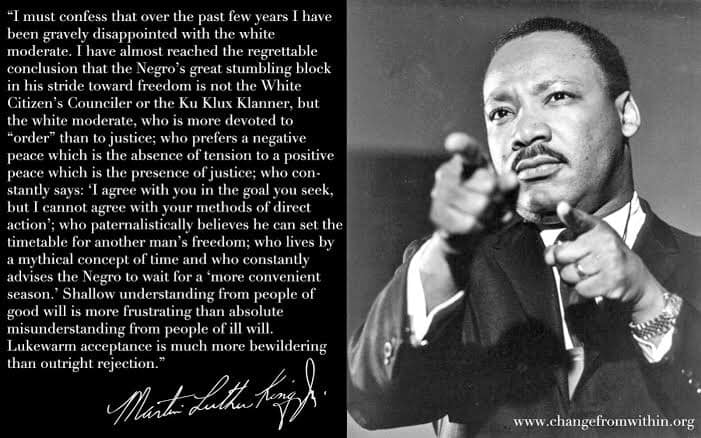
The meme is a quote from Martin Luther King Jr.'s "Where Do We Go From Here?" speech, in which he critiques the American social and economic system, highlighting the disparities between the country's ideals and its reality. The quote emphasizes the need for collective action to address these issues.
detailed-analysis (gemma3-27b-vision)
Okay, here's an analysis of the image and quote, broken down into the sections you requested, only including sections that are demonstrably applicable. I'll be detailed, but will also try to be concise given the scope of possibilities.
Image Description
The image is a black and white portrait of Martin Luther King Jr. He is captured from the chest up, looking directly at the viewer with a serious expression. He is wearing a dark suit and a white shirt with a dark tie. His gaze is intense, and his overall presentation conveys gravitas and moral authority. The background is a neutral, dark tone. Below the portrait, there is his signature. The text accompanying the image is a direct quote from one of his speeches/writings. The bottom right of the image includes a website URL: www.changefromwithin.org. The picture and quote together clearly evoke the themes of the Civil Rights Movement, social justice, and the struggle for equality.
Critical Theory
This image and quote are powerfully aligned with the tenets of Critical Theory. Specifically, it showcases the critique of dominant ideology and power structures. King’s quote directly challenges the myth of neutrality. He argues that the "white moderate" isn't simply someone with different tactics, but a force that actively impedes progress towards racial justice.
This is central to Critical Theory's concern with how seemingly benign or "reasonable" positions can in fact serve to maintain the status quo and oppress marginalized groups. The white moderate's desire for "order" is revealed as a prioritization of comfort over justice, enabling systemic inequality.
The quote exposes the hypocrisy of those who claim to agree with the goal of equality but object to the methods used to achieve it. This is a classic tactic of maintaining power—appearing to be sympathetic while simultaneously undermining real change. King’s critique resonates deeply with critical thinkers who expose the hidden power dynamics within society.
Marxist Conflict Theory
The image and quote have strong ties to Marxist Conflict Theory. King's statement highlights the class conflict interwoven with racial conflict. The 'white moderate' represents a segment of the dominant class (owners of the means of production – both economic and social) who are invested in maintaining their privilege and the existing power structures, even if it means obstructing racial justice.
The conflict isn’t simply about different ideas, but about material interests. The white moderate benefits from the existing system, and genuine equality would threaten their position. King identifies this segment not as overtly hostile like the Ku Klux Klan, but as more insidious, because they present themselves as reasonable and offer excuses for inaction. This is a clever tactic to maintain the status quo without seeming to be malicious, and allows for an easier continuation of oppressive structures.
The quote points to a struggle for control – control over the timetable of change, control over the methods, and ultimately control over the very definition of justice.
Important Considerations:
- Context is crucial: Any analysis like this is strengthened by a full understanding of the historical and social context in which King wrote and spoke.
- Interconnectedness: These theoretical frameworks aren't mutually exclusive. They can be used in combination to provide a richer and more nuanced understanding of the image and its message.
Let me know if you’d like me to expand on any of these points, or to explore other aspects of the image or quote!
simple-description (llama3.2-vision)
This meme is a screenshot of a quote from Martin Luther King Jr.'s "Where Is the Promise of Life?" speech, given on March 25, 1960, in which he discusses the struggle for civil rights and the promise of life in the United States. The quote is often referenced in a humorous or ironic way to highlight the disparity between the promise of life in the United States and the reality of racism and inequality.
tesseract-ocr
Seinen Ce ene eee See et — rocco NMG SO ec Ge cu oe cn eee ee eee ness 5 Core enn ea CA aera ora tices pers in his stride toward freedom is not the White Ses Citizen’s Counciler or the Ku Klux Klanner, but a the white moderate, who is more devoted to eS Sr a eee coat J) peace which is the absence of tension toa positive tan E> i peace which is the presence of justice; who con- gor stantly says: ‘I agree with you in the goal you seek, ‘ arenes ene ree) A ann - : 2 action’; who paternalistically believes he can set the = timetable for another man’s freedom; who lives by | a mythical concept of time and who constantly 7 eee AC ee Rte eee aa i season.’ Shallow understanding from people of ‘ F, Pein entrar teiaa rn eons ‘ misunderstanding from people of ill will. ; Pen contents tee eS eee i d Tren res eee Ta 4 Je iN 7s Sass ene er Te